
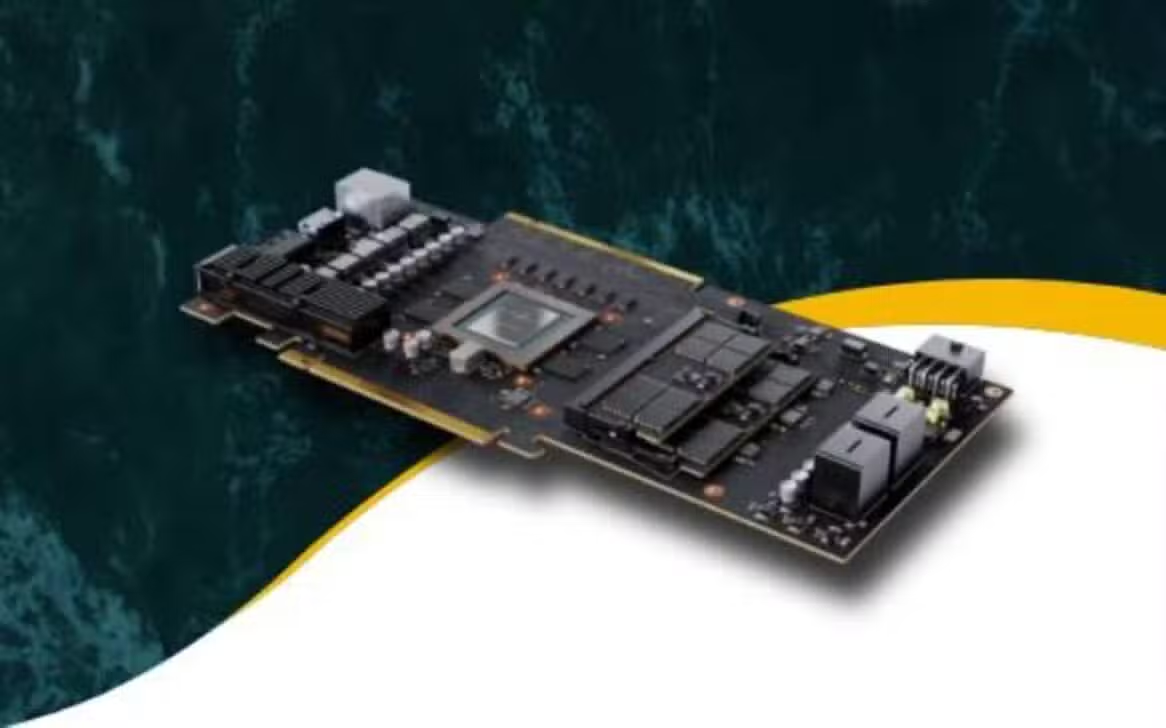
Bolt Graphics has completed the tape-out of the Zeus platform test chip, advancing to the manufacturing phase. The American startup developed a graphics processing unit aimed at high-performance computing, artificial intelligence and advanced rendering applications. This week’s announcement marks a concrete step towards commercialization, reinforcing the promises of energy efficiency and high performance in specific tasks such as path tracing, a technique that simulates the behavior of light in virtual environments.
Custom Arquitetura focused on efficiency
The Zeus adopts an innovative architecture with a RISC-V-based command processor and dedicated accelerators for specialized tasks. The design uses TSMC’s 12-nanometer process in the initial chip, but the platform is already preparing for migration to more advanced technological nodes. The company highlights the use of LPDDR5X and DDR5 memories instead of traditional GDDR, reducing production costs and allowing greater memory capacity compared to competing solutions.
The modular approach with scalable chiplets offers configurations with one, two or four cores, adapted to different corporate use scenarios. Essa flexibility allows customers to choose the most suitable solution for their specific demands, from simpler operations to massive data processing.
Modelos available with varying specifications
- Bolt Zeus 1c26: occupies one PCIe slot, consumes 120 W, offers 32 GB of LPDDR5X and achieves 20 TFLOPs at FP16 precision.
- Bolt Zeus 2c26: uses two slots, consumes 250 W, provides 64 GB or 128 GB of LPDDR5X, up to 256 MB of on-chip cache and reaches 40 TFLOPs in FP16.
- Bolt Zeus 4c26: reaches 500 W consumption, supports 256 GB of LPDDR5X, 512 MB of cache and 80 TFLOPs in FP16.
Versões for servers in 2U format significantly expands the numbers, promising up to 2 GB of cache, 1 TB of LPDDR5X memory and 5.8 TB/s bandwidth. Essas configurations prioritize tasks that require large memory volumes and intensive parallel calculations, common scenarios in data centers and research laboratories.
Performance Comparação with current solutions
Bolt Graphics positioned the 250 W 2c26 configuration against the RTX 5090, which operates at around 575 W. Segundo the company, Zeus delivers up to 5 times more performance in path tracing and up to 6 times in high-performance computing workloads. In the 4c26 version with four chiplets, the gain increases to up to 10 times in path tracing, a significant difference considering the lower energy consumption.
The startup also mentions a reduction of up to 17 times in total cost of ownership in complex operations when compared to NVIDIA rack solutions. The greater memory capacity appears as a decisive factor in this equation. In racks, the Zeus offers up to 19 times more memory than comparable competitive systems, a critical aspect for applications that process massive volumes of data.
Especialistas note that the results presented come from pre-silicon simulations, that is, before the physical manufacture of the chip. Real Testes on physical hardware still need to confirm the manufacturer’s promises. Bolt recognizes that the commercial launch is only expected to occur in late 2027, allowing time for validation and final adjustments.
Estratégia Market and Differentiation
The Bolt Graphics positions the Zeus primarily for enterprise markets where energy efficiency and memory volume outweigh raw performance in traditional applications. High-performance Computação and artificial intelligence appear as priorities, while use in games receives secondary mention in the commercial strategy. The proposal seeks to offer a cheaper and more efficient alternative than current NVIDIA and AMD solutions, exploring specific niches where customized architecture offers real advantages.
The focus on path tracing explores dedicated accelerators that do not follow the traditional shader model of conventional GPUs. Instead, the Zeus combines RISC-V cores with blocks optimized for ray tracing and physics simulations. Essa’s specialized approach explains the projected gains in specific workloads, but may limit performance in traditional games that rely on textures and rasterization, a conscious trade-off from the company.
Próximos industry steps and outlook
The tape-out in TSMC’s 12 nanometer process marks a concrete advance in the startup’s trajectory. The company plans to move to more advanced technology nodes in the future, which can further increase energy efficiency and overall performance. For now, the test chip allows the design to be validated before volume production, reducing the risk of large-scale problems. Clientes has been testing the platform for around four years, according to the manufacturer, providing valuable feedback for final optimizations.
The emergence of a startup with ambitious proposals adds pressure to the NVIDIA-AMD duopoly in the graphics processor market. Zeus focuses on niches where energy efficiency and memory volume are critical, paving the way for more affordable options in professional rendering and scientific computing. If the promises are confirmed in independent tests, the platform could transform the landscape of solutions available to data centers and research laboratories around the world.