

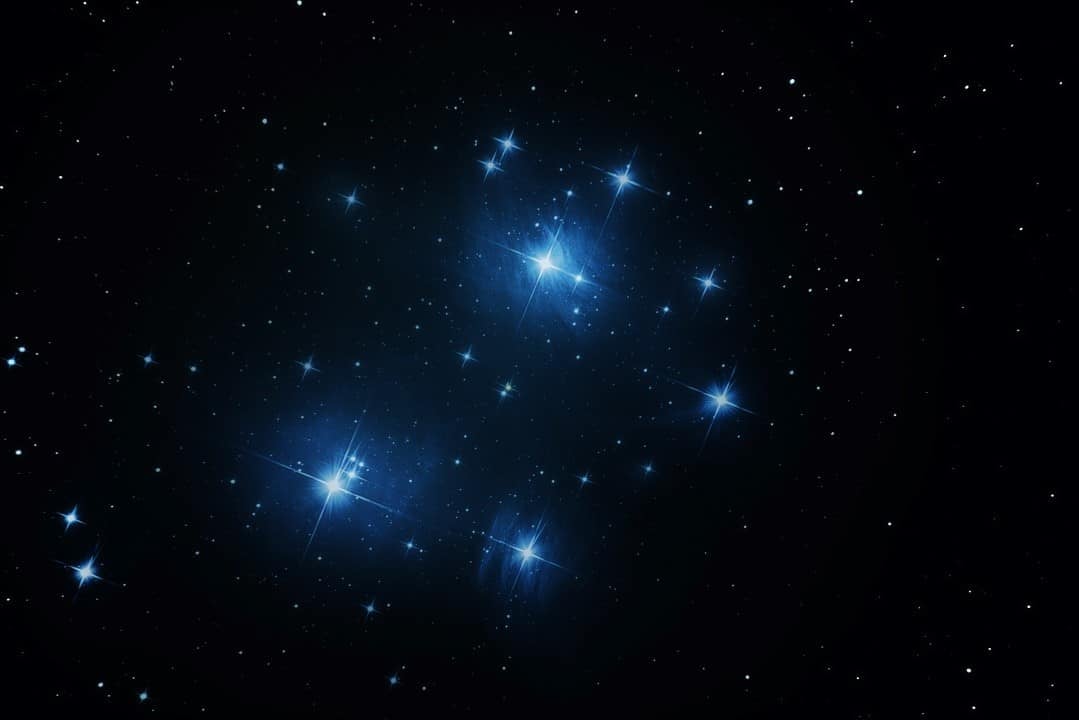
Telescópio Espacial James Webb identified unambiguous signals from Universo’s first stars. The detection occurred near the galaxy GN-z11, just 400 million years after Big Bang. The source, called Hebe, is located about 3 thousand parsecs from the galactic nucleus and does not show any trace of heavy elements. Essa discovery confirms decades-old theoretical predictions about the so-called Population III stars, formed exclusively from primordial hydrogen and helium.
Ionized Hélio reveals total absence of metals
The ionized helium spectral line (He II λ1640) emerged with clear intensity in recent observations of Webb. Essa emission indicates extremely energetic ultraviolet radiation, capable of ionizing helium twice in a row. Nenhuma line of heavy elements appeared in the analyzed spectrum, eliminating the possibility of more recent stellar populations or chemical contamination.

Astrônomos identified distinct components in the detected emission. One of them aligns perfectly with theoretical expectations for a massive cluster of primordial stars. Modelos computational data show that a cluster with a total mass of approximately 100 thousand solar masses naturally explains the observational data. Essa agreement between theory and practice represents an important milestone in observational cosmology.
GN-z11 offers access to early Universo
The galaxy GN-z11 has a cosmological redshift of 10.6, placing it among the most distant objects ever studied in depth. The gas around Hebe has not had enough time to enrich itself with metals ejected by previous stellar generations. Essa chemical purity maintains the conditions expected for Population III, with surface temperatures reaching 100 thousand degrees and massive production of ultraviolet radiation.
- The He II emission appears without heavy metal contamination.
- The estimated cluster has a mass compatible with established theoretical limits.
- The distance to the center of GN-z11 is approximately 3 kiloparsecs.
- Redshift confirms age of 400 million years after Big Bang.
- Modelos from 2001 accurately predicted the spectral line now observed.
Previous Pesquisas already indicated this possibility with remarkable accuracy. A paper published in 2001 predicted exactly this spectral signature emanating from first-generation stars. The current work crosses groundbreaking Webb observations with these theoretical calculations from two decades ago, validating the scientific predictions.
Supermassive Estrelas as black hole seeds
Complementary Pesquisa, led by Devesh Nandal, examines supermassive stars as potential progenitors of black holes. Essas stars could collapse and form seeds of massive black holes through a process involving mass loss in pulsating episodes. The star contracts, burns hydrogen and enters relativistic instability, ejecting layers of material in successive pulsations.
The calculations followed five models with different chemical abundances. In the almost pure hydrogen and helium scenario, four distinct mass ejection episodes occurred. The last episode contributed the largest portion of lost material. The resulting envelope creates the environment observed in the “little red dots” detected by the Webb telescope in distant galaxies.
Dense Casulos explain “small red dots”
Webb observations have revealed an intriguing population of compact, reddish galactic nuclei. Esses objects appeared during the era of quasar formation, exhibiting properties that defied previous explanations. The new model shows that the late mass loss of supermassive stars forms dense cocoons reproducing the observed properties of these “little red dots”.
The ejected material is rich in hydrogen, helium and nitrogen, creating the abundance pattern seen in the analyzed spectra. Astrônomos followed the evolution after the end of gas accretion, using radial pulsation calculations and stability diagnostics. The results indicate that the physical origin of the compact cocoons fits perfectly with the collected spectroscopic data.
Implicações for cosmology and structure formation
The Population III star confirmation helps piece together the puzzle of the initial Universo. Essas stars functioned as intense ultraviolet radiation factories, ionizing the surrounding gas and influencing the formation of larger structures. The path to supermassive black holes gains a more direct and efficient route, instead of relying solely on light seeds that grow slowly over billions of years.
Futuras observations of Webb should look for more similar signatures in different regions of the early Universo. Equipes plan to map environments around other distant galaxies to accurately measure the fraction of Population III stars in varying contexts. Current data already limits alternative scenarios, with sources such as accreting black holes or metal-poor Wolf-Rayet stars explaining only part of the observed properties. The research demonstrates how Telescópio Webb transforms decades-old theoretical predictions into concrete, measurable evidence of the primordial Universo.