Scientists discover giant radio halo in galaxy cluster considered silent
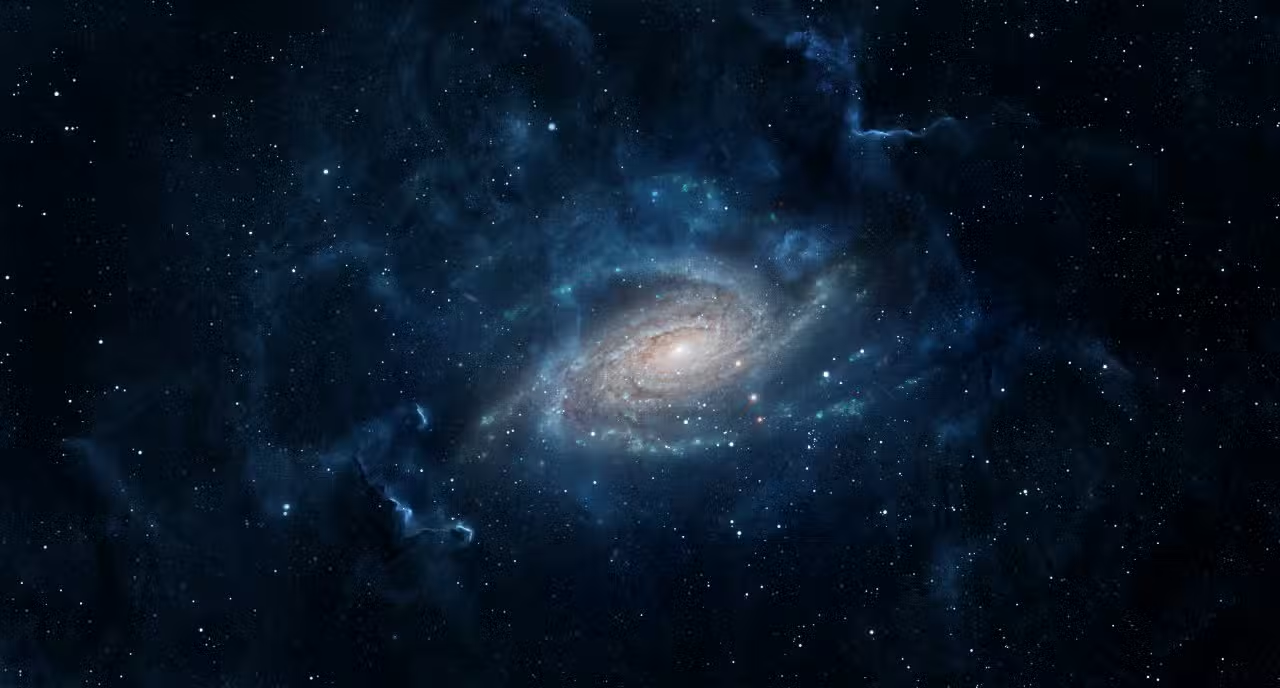
An international team of astronomers has detected a radio halo of gigantic proportions inside the galaxy cluster RXCJ0232-4420. Until then, the space system was classified as a silent environment without major large-scale magnetic activity. The discovery was detailed in a scientific article published in the arXiv repository on April 29. The study was led by researchers from Instituto Nacional of Astrofísica of Itália. The observation changes the current understanding of the dynamics of galaxy clusters considered relaxed.
Scientists used combined data from two of the world’s most powerful radio telescopes to map the region. The uGMRT, located on the Índia, and the MeerKAT, located on the África of the Sul, provided the necessary sensitivity to capture the weak signals. Radio emission spans more than 3.3 million light years. The phenomenon indicates the presence of complex magnetic fields and accelerated particles in an area where theoretical models did not predict such intensity.
Histórico observations and new dimensions of the system
The cluster RXCJ0232-4420 was identified for the first time in 2002. Durante more than two decades, the limitations of astronomical equipment allowed observing only a small radio emission. The signal was restricted to the surroundings of the brightest galaxy in the group, known technically as BCG-A. Astronomers believed it was an isolated and compact phenomenon. The new measurements proved that the structure covers practically the entire volume of the cluster.
The internal structure of RXCJ0232-4420 has two distinct main cores. The BCG-A primary nucleus and the BCG-B secondary nucleus are separated by an approximate physical distance of 330 thousand light years. The gravitational interaction between these two gigantic masses creates an environment conducive to particle acceleration. Recent data show that the radio halo surrounds both nuclei continuously. The mapping revealed precise contours that previously blended into the background noise of deep space.
Além from the central halo, researchers found an additional structure in the eastern region of the cluster. Trata is a radio relic, a type of elongated emission that often forms at the edges of colliding systems. Esta specific formation has an estimated size of 980 thousand light years. The simultaneous presence of the giant halo and the peripheral relic provides a complex picture of the formation history of this group of galaxies.
Análise spectral and particle behavior
The team of astrophysicists carried out a detailed study of the spectral index of the captured emissions. The spectral index measures how the intensity of light varies at different radio frequencies. The analysis indicated a value of -1.17 for the giant halo. The relic located in the eastern portion had an index of -0.85. The numbers help scientists understand the age and energy of the electrons that produce electromagnetic waves.
- Extensão’s total radio halo surpasses the 3.3 million light-year mark.
- Radio Relíquia in the eastern region measures approximately 980 thousand light years.
- Distância physics between the two main cores of the cluster is 330 thousand light years.
- Índice spectral of the central halo maintains uniformity between values of -1.0 and -1.3.
The most surprising aspect of the spectral analysis was the uniformity found across the entire extent of the halo. The index remained stable in the range of -1.0 to -1.3, without sudden variations between the different areas of the cluster. The constancy suggests that electrons are being re-accelerated in a continuous and global manner. The process does not just depend on proximity to active galactic nuclei. The energy is distributed throughout the intergalactic plasma in a homogeneous way.
Revisão of spatial dynamics models
The discovery challenges the standards set by modern astronomy. Traditional models associate giant radio halos exclusively with clusters of galaxies undergoing a violent process of merger. Sistemas classified as relaxed or silent should not have sufficient energy to sustain emissions of this magnitude. RXCJ0232-4420 displays characteristics of a calm system in X-ray observations. The presence of the halo indicates an internal dynamic that is much more agitated than its appearance suggests.


The researchers classify the current state of the cluster as a transient dynamic phase. The system maintains a cool, stable core, typical of ancient, relaxed structures. At the same time, it displays clear signs of a recent or ongoing merger. The collision of galactic masses generates shock waves that travel through the intergalactic gas. The turbulent motion acts like a natural particle accelerator on a cosmic scale.
The coexistence of a relaxed core and a giant halo raises new hypotheses about the durability of these phenomena. Scientists are evaluating the possibility that radio emissions persist for long periods after the most violent phase of a galactic merger. The study of RXCJ0232-4420 serves as a natural laboratory to test these theories. Understanding exactly how magnetic energy dissipates in deep space still requires additional observations.
Technological Avanço and next research steps
The success of the mission directly depended on the evolution of radio telescopes over the last decade. The MeerKAT equipment, operated on the África of the Sul, has dozens of synchronized antennas that function as a single, gigantic eye facing space. The ability to filter terrestrial interference made it possible to isolate the cluster’s weak signal. The Indian uGMRT complemented the research with data at lower frequencies. The union of the two technologies formed an unprecedented database for astrophysics.
The scientific community is already preparing the ground for the next generation of observation instruments. The Square Kilometre Array (SKA) project, currently under construction, promises to multiply the radio wave detection capacity. The international complex will have stations spread across several continents. The new observatory will be able to map magnetic fields in even more distant and ancient galaxies. The technology will allow us to visualize structural details that today escape the most sensitive sensors.
Data collected on RXCJ0232-4420 will continue to undergo processing in the Instituto Nacional, Astrofísica, and Itália laboratories. Astronomers seek to refine the magnetic polarization maps of the eastern region of the cluster. Cataloging systems with similar behavior has become a priority for research teams. Systematic surveying of the sky at low frequencies will provide a complete census of the true number of giant halos in the universe.
Veja Tambem em Latest News (EN)

Park Mi-sun returns to TV after battle with breast cancer

Hiroshima Carp confirm Tokoda against Nippon Ham on the 3rd after game postponed by rain

Older, poorly maintained vehicles face problems when using E10 gasoline

Heavy rain and storms hit 17 Indian states this Tuesday with warning from IMD

Claude down in global outage and Anthropic confirms errors in models

Typhoon No. 6 Chanmi approaches southern Kyushu and advances to eastern Japan

Seibu Lions have game canceled due to typhoon and schedule Kaima Taira for the 4th against Hanshin Tiger

Facebook whistleblower, Sarah Wynn-Williams, complies with Meta’s order and remains silent at event in the United Kingdom

Romantic comedies and mysteries arrive on Netflix in June with Office Passion and Oasis

Uruguay announces squad list for the 2026 World Cup with six Brazilian football players

When does the 2026 World Cup start? Date, time, first game and opening ceremony