

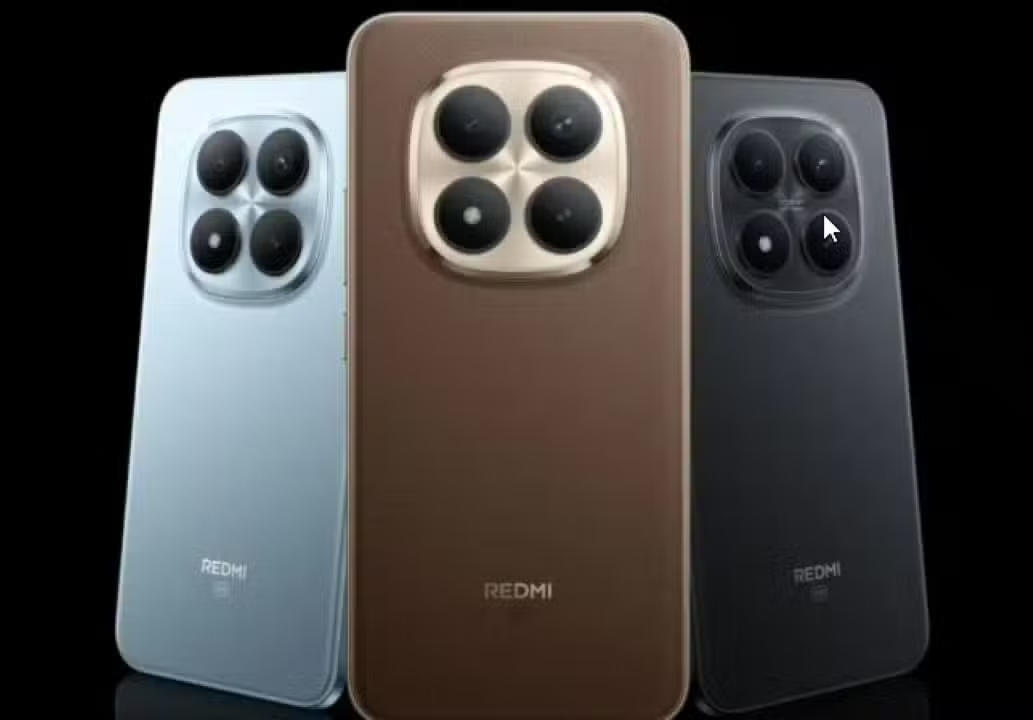
Chinese manufacturer Xiaomi subjected the recently launched Redmi Note 15 Pro+ to a battery of practical evaluations in the Bonito region, in the Mato Grosso state of the Sul. The mobile device faced severe humidity conditions, including prolonged submersion and direct exposure to natural waterfalls, with the aim of proving the durability of the physical components. The model is positioned in the premium intermediary segment and features robust technical specifications to attract demanding consumers.
Durante three days of continuous use in Brazilian ecotourism, the equipment maintained full functioning of all its hardware and software functions. The focus of the demonstration was on the capacity of the high-density battery and the performance of the main photo sensor under environmental stress. The company’s strategy aims to consolidate public trust in devices that offer top-of-the-line features at a more affordable cost.

Reinforced Estrutura and water and dust certifications
The engineering design of the new cell phone incorporates multiple layers of physical protection that go beyond the usual standard found in the mid-cost category. The device boasts IP66, IP68, IP69 and IP69K certifications, guaranteeing complete sealing against solid particles and resistance to high pressure and temperature water jets. An independent audit conducted by the German TÜV SÜD validated the integrity of the equipment after keeping it submerged two meters deep for an uninterrupted period of 24 hours.
The external construction uses materials developed to absorb severe mechanical impacts. The rear lid is made from an ultra-resistant fiberglass alloy, while the main chassis is reinforced with aerospace-grade aluminum. The front screen features Corning Gorilla Glass Victus 2 technology, designed to prevent shattering. The set obtained the SGS seal, attesting to the survival of the hardware after accidental drops from up to 2.5 meters onto hard surfaces.
Nas trails and rivers of Mato Grosso of Sul, direct contact with rain and diving into currents did not cause operational failures. The speakers experienced temporary sound muffling due to the accumulation of liquid in the audio outputs, an expected physical reaction. Após natural evaporation of moisture, sound emission returned to original factory levels without the need for technical intervention.
- Vedação IP66 for blocking directed water jets
- Certificação IP68 and IP69 for full and prolonged submersion
- Proteção IP69K against extreme pressure and high temperatures
- Chassi aluminum drop resistant 2.5 meters
- Vidro front Gorilla Glass Victus 2 against deep scratches
The physical shape of the device does not require curved side edges, a design decision that minimizes points of structural weakness. The global catalog offers the product in light blue, black and brown, with a matte finish to reduce marks from daily use.
Desempenho visual and photographic capabilities of the device
The front panel features a 6.83-inch AMOLED screen with a resolution of 2,772 by 1,280 pixels, delivering an image density equivalent to the 1.5K standard. The brightness of the display reaches peaks of 3,200 nits, an index that ensures comfortable reading of texts and viewing of media even under direct sunlight at midday. The 120 hertz refresh rate provides smooth transitions in system animations and increases the accuracy of touch commands when playing video games.
Support for HDR 10+, Dolby Vision and Vivid HDR formats expands the color range and contrast when playing compatible audiovisual content. Durante evaluations in open environments, the front glass demonstrated efficiency in controlling unwanted reflections. The large size of the display favors productivity in editing applications and improves immersion when consuming video streaming platforms.
The rear camera module is led by a 200-megapixel main sensor, equipped with optical image stabilization and f/1.7 lens aperture to maximize light collection. The secondary set includes an 8-megapixel ultra-wide lens aimed at wide landscapes, as well as a 32-megapixel front camera focused on self-portraits. The processing software prioritizes realistic tones with a slight bias toward cooler color temperatures.
Capturing images in nighttime scenarios or with dense clouds requires greater effort from the internal algorithm to balance areas of shadow and light. The system offers four levels of digital approximation with minimal loss of detail, thanks to direct cropping on the high-resolution sensor. Video recording reaches 4K quality and integrates artificial intelligence-based tools to apply dynamic filters and correct exposure in real time.
Efficient Processamento and updated operating system
The smartphone’s processing core is controlled by the Snapdragon 7s Gen 4 chip from Qualcomm, built using 4-nanometer lithography. The modern architecture ensures strict management of power consumption and reduces heat dissipation. RAM memory options vary between 8 gigabytes and 12 gigabytes, while the non-expandable internal storage offers 256 gigabytes or 512 gigabytes versions for storing files and applications.
The manufacturer installed an enlarged cooling chamber inside the chassis to stabilize the motherboard temperature during demanding tasks. An exclusive component called Xiaomi TS1 Tuner works to optimize wireless connectivity antennas. Essa piece of hardware provides an increase of up to 26% in the stability and range of Wi-Fi network signals and Bluetooth connections compared to the previous generation of the same line.
The device leaves the factory with the HyperOS 2 interface, developed on the basis of Android 15. The virtual environment brings advanced features from the HyperAI package, which performs simultaneous translations, generates suggested responses in messaging applications and transcribes audio to text natively. The operating system also facilitates data synchronization and screen sharing with tablets and computers of the same brand.
Autonomia energy and sales scenario in the national market
The battery module adopts silicon-carbon technology to achieve a full capacity of 6,500 milliampere-hours without increasing the thickness of the phone. Durante practical tests in nature, with constant use of GPS, recording videos in 4K and continuous search for an operator signal, the device ended a 12-hour cycle with 59% of charge remaining. The technical estimate points to up to two days of operation away from the sockets under a moderate usage pattern.
The 100-watt charger included in the box restores power from zero to one hundred percent in approximately 40 minutes of connection. The hardware supports reverse charging function, allowing the phone to act as a 22.5-watt portable power source to power wireless headphones or smart watches. The chemical composition of the battery ensures normal operation of the equipment even in environments with extreme negative temperatures.
The brand’s official representation at Brasil has not yet confirmed the release date or suggested price for this specific version in local stores. Import Plataformas and independent marketplaces already list the model with 12 gigabytes of RAM for values close to R$3,607. On the international market, the starting price is around US$397.50, which is equivalent to just over R$2,100 without the addition of customs taxes.
Acquiring the product through unofficial means excludes the consumer from the authorized technical support network and the legal guarantee offered in the country. Outros members of the device family, such as the standard versions and those with 5G connectivity, are already on Brazilian shelves with prices ranging between R$1,642 and R$1,822. The most advanced model tested in the Brazilian center-west is consolidated as a robust tool for users who require extreme durability and long daily autonomy.