
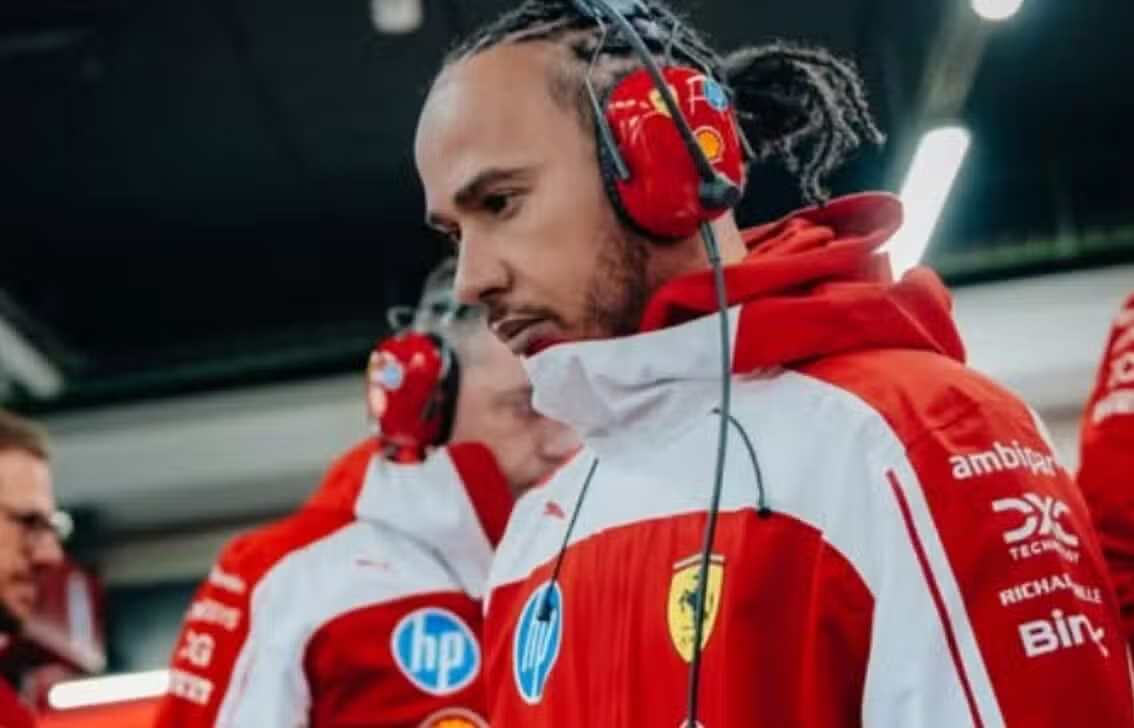
Lewis Hamilton decided to radically change his training routine for the Canadá GP of Fórmula 1. The British driver will stop using the Ferrari simulator in the weeks before the race on the Montreal circuit. The choice takes place after the competitor identifies that the technology was hindering the car’s performance on the track. The seven-time world champion intends to repeat the planning adopted in the China GP, the only stage of the 2026 season where he did not use virtual equipment and obtained his best performance of the year.
Dissatisfaction with the computerized system became evident after Miami’s GP. On the North American track, Lewis Hamilton finished in sixth place, struggling to find the ideal balance of the SF-26 model. Dissatisfaction with the answers given by digital technology motivated the athlete to talk to engineers at the Maranello factory to suspend the virtual sessions. The goal is to focus on real data analysis and in-person tactical meetings.

Desempenho underwhelming compared to Charles Leclerc
The start of the 2026 season has proven challenging for Lewis Hamilton in his new journey with the Italian team. With the exception of the round played in Xangai, the English driver has been consistently outperformed by his Ferrari teammate, Charles Leclerc. The Miami GP highlighted this difference in performance between the two competitors from the Maranello team since the first official activities.
Durante the qualifying sessions in Flórida, Charles Leclerc demonstrated greater speed and adaptation to the urban layout. The official numbers show the size of the advantage established by the Monegasque driver over his garage partner in the last race:
- Diferença in the classification for Corrida Sprint: Charles Leclerc was 0s379 faster than Lewis Hamilton.
- Diferença in the classification for the main GP: Mônaco’s competitor secured an advantage of 0s176.
- Distância in the regulation race: Lewis Hamilton was lapping 24 seconds behind Charles Leclerc before the final lap.
- Incidente final: Charles Leclerc spun, hit the wall and ended up punished for cutting corners, minimizing the Briton’s loss on the table.
Atualmente, the British driver occupies fifth place in the general classification of the Fórmula 1 World Drivers’ Championship. The distance in points to the leaders bothers the driver, who seeks immediate solutions from the organization’s technical staff.
Falha correlation between the virtual environment and the real track
Lewis Hamilton’s main argument for discarding the Ferrari simulator is the lack of harmony between the vehicle’s behavior in the digital environment and the reality faced on the asphalt. According to the driver, the modifications made at the factory do not translate into performance gains when the car hits the track. Esse mismatch generates frustration and causes the team to waste precious time looking for basic adjustments during free practice.
The behavior of the SF-26 model in Miami irritated the British driver in the first laps of free practice one. The competitor explained that the car proved to be heavy when cornering, showing a strong tendency to oversteer in the middle of low and medium speed trajectories. Esse behavior required last-minute profound mechanical changes, compromising the Ferrari testing schedule.
The dynamics of weekends with the Sprint format further worsens the situation described by the Ferrari driver. Nessas stages, the Federação Internacional and Automobilismo regulations establish only one free practice session before the competitive sessions. Mudar heavy elements such as suspension geometry become a high risk, as the athlete has few laps to understand the car’s new reactions before the official times are taken.
Expectativa struggles with engine power on Canadian track
Apesar severely criticized the technological preparation process, Lewis Hamilton praised the general characteristics of the Ferrari car for 2026. The Brit highlighted that the new single-seaters in the category, built with smaller dimensions and greater agility in curves, match perfectly with his aggressive driving style. The central problem, therefore, lies exclusively in the adjustment decisions caused by incorrect data from the virtual tool.
The challenge in Circuito Gilles Villeneuve tends to be complex for reasons that go beyond chassis calibration. The track located on the island of Notre Dame has features that expose the current deficiencies of the Ferrari power unit. The Canadian circuit is marked by a succession of full-throttle sections that require maximum final speed from the machines.
The Canadá GP layout has four major straights that promise to test the mechanical capacity of the red cars:
- Reta starting and pits with a total length of 600 meters.
- Intermediate acceleration Trecho measuring 550 meters between structural curves.
- Reta opposite main with a length of 1.2 kilometers where the moving wing system is crucial.
- Reta final approach to the Muro chicane of Campeões at 650 meters.
The internal diagnosis of the Ferrari indicates that the Italian engine has a slightly lower performance in final speed when compared to the propellants supplied by the Mercedes. Lewis Hamilton knows that the disadvantage on the long straights will require a perfect car when braking and restarting. Therefore, the decision not to use the simulator aims to ensure that the car begins the first training session in Montreal with a solid base of mechanical setup, identical to the one that Charles Leclerc uses successfully.