

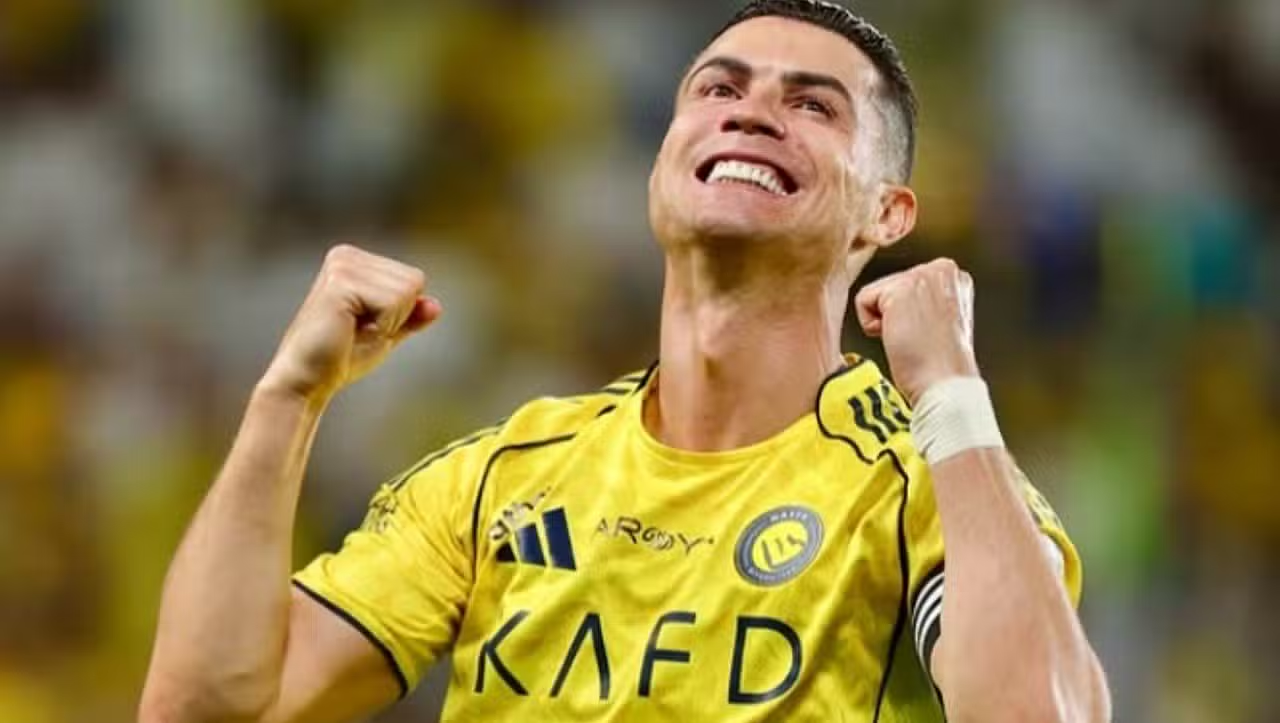
The Copa of the 2026 Mundo in the Estados Unidos, Canadá and México will mark the end of a cycle that has redefined international football over the last two decades. Aos 39 and 41 years old, Lionel Messi and Cristiano Ronaldo arrive at the tournament in a condition that is unlikely to be repeated in future Mundiais. Ambos treat the event as the final moment of a rivalry that spanned almost 20 years and established new standards of longevity and protagonism in the sport.
Cristiano Ronaldo has already communicated his decision about the future. The Portuguese stated in an interview at the end of 2025 that the 2026 Copa will “definitely” be his last participation in Mundiais. Convocado this week for Roberto Martínez, he will compete in his sixth Mundial — an unprecedented mark among outfield players. The striker consolidated this cycle by remaining among the main names of his team even at the age of 41.
Messi heads towards closing cycle after world title
Messi maintains a more cautious stance when discussing international retirement, but signs indicate a similar process. Campeão worldwide in 2022, the Argentine went so far as to state in 2023 that the Catar had been “in principle” his last Copa. Depois relativized the decision and treated 2026 as a possibility conditioned on physical performance. Nos has returned to normal Confederação Argentina’s planning for the tournament in recent months.
The cycle is not limited to the two biggest rivals of the contemporary era. Desde At the end of the 2000s, Messi and Cristiano monopolized individual awards, broke historical records and sustained a rivalry that especially shaped the period in which they defended Barcelona and Real Madrid at Espanha. Essa dynamic marked generations of football fans and professionals.
Brasil also ends generation with Neymar and Casemiro
Brasil will experience its own cycle closure. Neymar, at 34 years old, treats the 2026 Copa as the last opportunity to win the main title of his career. Maior top scorer in the history of the Brazilian team, the striker arrives at the tournament after years marked by injuries and traumatic eliminations in previous Mundiais. Casemiro, another legend of Brazilian football, must also say goodbye to the competition.
Neymar has already shown emotion with the call-up for 2026, recognizing the relevance of the moment for his trajectory. The path to Copa was filled with physical and psychological challenges, including long recovery periods after serious injuries. Sua’s presence in the squad reinforces the confederation’s commitment to leveraging the expertise and leadership of veterans during generational transition.
Historical Europeus also close international cycles
The 2026 Copa should also mark the farewell of other historic names in European football. Na Croácia, Luka Modrić will arrive at the tournament at the age of 40 after leading the best generation in the country’s history. The Croatian team was runner-up in the world champion in 2018 and third in 2022, consolidating Modrić as a symbol of an era that also ends in 2026.
Na Alemanha, Manuel Neuer is on track to end its international career at the age of 40. World Campeão in 2014, the goalkeeper helped transform the position over the last decade due to the innovative way in which he started to act outside the area and actively participate in the teams’ offensive construction. Sua’s technical contribution redefined the role of the goalkeeper in modern football.
European gold Geração says goodbye to Kevin De Bruyne
Kevin De Bruyne represents the last outstanding generation of Bélgica that will reach 2026. The Belgian midfielder must lead for the last time the so-called “golden generation” of his country, which accumulated several continental and South American titles, but never won an Copa from Mundo. De Bruyne’s participation marks the end of a promising period that did not result in the maximum trophy.
Outros veterans still appear as possible relevant farewells during the competition, expanding the reach of this generational transition. The 2026 tournament will act as a turning point where multiple generations find themselves in their last moments of maximum protagonism.
Nova generation will take the lead from 2026
At the same time that veterans say goodbye, the tournament marks the definitive consolidation of the next generation. Kylian Mbappé, Jude Bellingham, Erling Haaland and Lamine Yamal arrive at Mundial as protagonists of a football that is beginning to separate itself from the Messi-Cristiano Ronaldo era. Esses names represent the future of the sport that will be built after the end of this historic era.
Historical Dados marks continuity of Messi and Cristiano Ronaldo
The joint participation of Messi and Cristiano in Mundiais represents a rare phenomenon in modern football. Desde to Copa from 2006, in Alemanha, both were together in all subsequent Mundiais. The 2026 edition will end this 20-year sequence of international meetings between the two greatest protagonists of contemporary football.
Informações relevant to the generational transition:
- Messi and Cristiano Ronaldo have starred in six Mundiais together since 2006
- Cristiano Ronaldo will compete in his sixth Mundial in 2026 — an unprecedented milestone among outfield players
- Neymar is the greatest scorer in the history of the Brazilian team
- Manuel Neuer took Copa from Mundo in 2014 as a German goalkeeper
- Luka Modrić reached the world final in 2018 with Croácia
- Kevin De Bruyne leads the Belgian golden generation that has never beaten an Mundial
- Mbappé, Bellingham, Haaland and Yamal represent the next generation of protagonists
The 2026 Copa will act as a portal between two distinct eras of international football. The tournament will bring together for the last time veterans who dominated the competition for decades while showcasing young talent who will shape the future of the sport for the next 20 years.