
Nereid, Neptune’s moon, may be only intact survivor of ancient collision

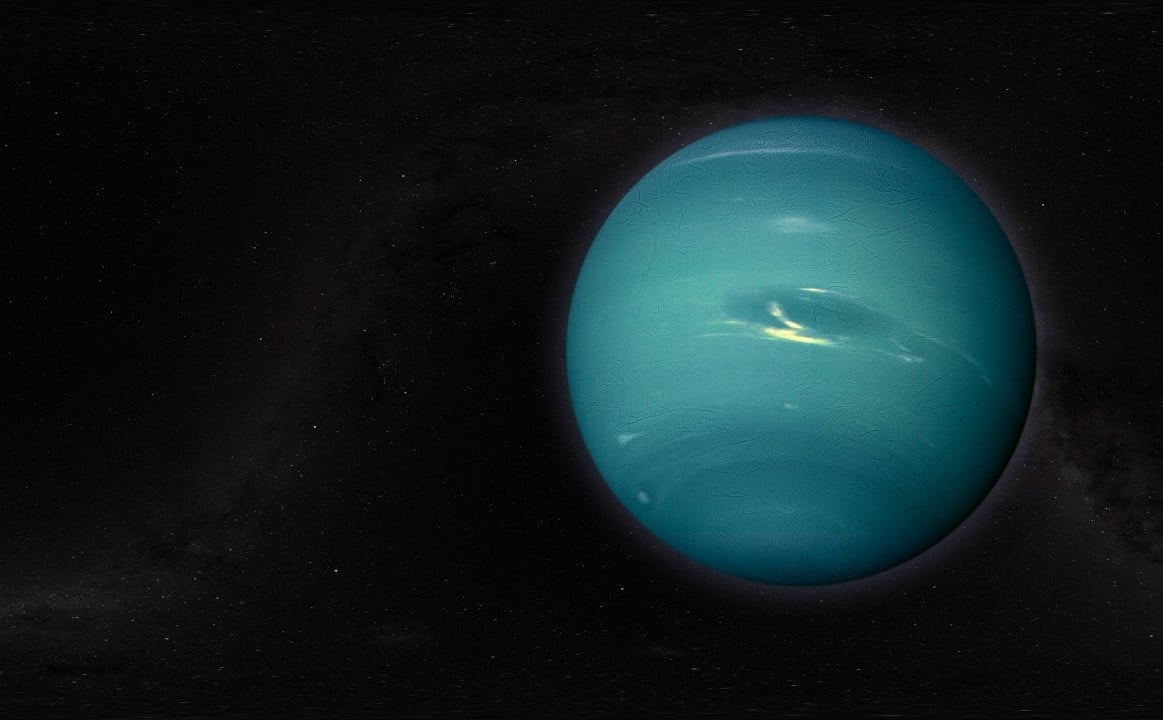
Observações from the James Webb space telescope reveal that Nereid, the third largest moon of Netuno, may be the only intact satellite remaining from an ancient cluster of moons destroyed early in the solar system’s history. The discovery challenges previous hypotheses and offers new insights into how the gas giants’ satellite systems formed and evolved more than 4 billion years ago.
Matthew Belyakov, Instituto of Tecnologia of Califórnia planetary science graduate student, led the study published Wednesday in the journal Science Advances. Segundo research, Nereid would be the only intact survivor of a catastrophic process that involved the capture of Triton, the largest moon of Netuno, coming from a distant region of the solar system. Essa capture would have triggered a chain collision that destroyed virtually all of Netuno’s original lunar system.
The uniqueness of Netuno among gas giants
Netuno stands out among the outer planets of the solar system for having an unusual and chaotic set of satellites. Urano, Saturno, and Júpiter feature ordered systems of moons, with several larger satellites orbiting in the same direction as the host planet’s rotation. Netuno, in contrast, has a considerably smaller and much more disorganized collection.
Triton, the largest moon of Netuno, reigns over this peculiar system. With a size comparable to Earth’s Lua, Triton orbits in the opposite direction to its planet’s rotation, the only large satellite in the solar system to do so. Essa’s anomalous feature has intrigued astronomers for decades and led to the development of a well-established hypothesis: Triton did not originate from the remnants of the formation of Netuno, but was captured from outside.
Cientistas believe that Triton originated from Cintura from Kuiper, an annular region of icy bodies at the edge of the solar system, and entered the Netuniano environment more than 4 billion years ago after a close approach. Netuno’s gravity would have captured the satellite, catapulting it inland and causing devastating impacts against the planet’s primordial satellite system.
Triton’s impact and cosmic chaos
Se Netuno indeed possessed an original set of moons similar to its planetary neighbors, Triton’s arrival would have been cataclysmic. With a diameter just smaller than that of Lua, Triton would collide with the other satellites, destroying many of them in the process. The current characteristics of the Netuniano system corroborate this scenario, with the seven inner moons appearing to be residues of this ancient collision.
Belyakov explained: “Nereid is the only intact survivor of this process. The other survivors are the innermost moons of Netuno, but they are not intact because we have images of them from Voyager 2, and they appear to be disturbed rubble piles. São is surviving material from the early system, but they are not fully intact moons.”
Essa’s conclusion contrasts with previous research that assumed Nereid was an object captured from Cintura of Kuiper, as well as Triton and some other moons Netunianas. The new James Webb data revealed that the composition of Nereid does not match what scientists know about Cintura objects from Kuiper, invalidating this previous hypothesis.
Nereid: the elusive moon that defies explanation
Astrônomos knows little about Nereid because it is weak and distant from Terra and Sol. The only image scientists have comes from a blurry photo captured in 1989 by NASA’s Voyager 2 probe during its brief flyby of Netuno. Nereid is the outermost known moon of Netuno and has one of the most eccentric (non-circular) orbits in the entire solar system, taking 360 Earth days to complete one revolution around the planet.
Nomeada Named after the Nereids of Greek mythology, Nereid is believed to be approximately 210 miles (338 kilometers) in diameter. Essa’s dimension makes it twice as large as Febe, the next largest irregular moon, situated around Saturno. Dentre the irregular satellites objects whose orbits are tilted, retrograde or distant from their host planets, suggesting external capture, Nereid is a notable outlier.
Belyakov pointed out: “It’s not that far from its host planet compared to many of the other irregular satellites.” Algumas’s characteristics of Nereid have long made astronomers doubt its origin in Cintura from Kuiper, but concrete data was lacking until the intervention of James Webb.
The reveal of James Webb
A ten minute and forty second observation carried out specifically for the study, utilizing James Webb’s infrared capabilities, revealed the surface composition of Nereid and provided compelling evidence. The researchers discovered a highly water-rich object on the surface, brighter than many objects in Cintura and Kuiper, with a detectable presence of carbon dioxide.
“The overall signature was more similar to regular satellites around Urano than objects from Cintura to Kuiper,” said Belyakov. The results were compared with data from James Webb involving 54 bodies from Cintura and Kuiper, reinforcing the conclusion.
Simulações computational support the hypothesis
Belyakov and his colleagues ran computer simulations to test whether the hypothesis of Nereid as part of an original lunar system would withstand scientific scrutiny. The results were encouraging: in cases where Triton survives rather than being destroyed or ejected into Netuno, approximately 25% of the time one or more satellites can survive the encounter with Triton in distant orbits.
Essa probability compares favorably to the chances of Nereid being a captured object. In the proposed scenario, during the first 100 to 200 million years of the solar system’s history, Triton would have collided with the Netuniano system, destroying several original moons. Nereid, however, would have been spared and sent to an eccentric orbit. The event would also have slowed down the eccentric orbit of Triton itself, placing it on its current trajectory, closer to Netuno.
Perspectivas Futures and Need for Exploration
Belyakov emphasized the importance of continued research: “I believe people already wanted this to be true. Agora we can start the real scientific feedback loop. Há more data to be collected about the composition of Nereid that can help us better understand the formation of the Netuniano system.”
Additional Observações with James Webb could strengthen the conclusions, but the final word on what Nereid actually looks like would require a mission to the planet. None are currently planned. Voyager 2, launched in 1977, remains the only spacecraft to have studied the Netuniano system in detail.
Carolyn Porco, an American planetary astronomer who worked on NASA’s Voyager and Cassini missions, described the new study as “an elegant and simple examination of how the Netuniano moon system acquired its current appearance.” Segundo she, “the authors demonstrate that it is plausible that Nereid was lucky to remain in orbit around Netuno, but at a much greater distance than Triton. Isso would explain why its composition, observed by James Webb, does not match that of the bodies in Cintura of Kuiper.”
Implicações for understanding lunar systems
Leigh Fletcher, professor at Escola of Física and Astronomia of Universidade of Leicester, at Inglaterra, highlighted the role of James Webb: “We have long known that there is something special about Netuno’s collection of moons, having been severely disrupted by the arrival of Triton and others satellites captured by Netuno’s gravity over the years.
The James Webb data, however, indicates otherwise. Future Trabalho telescope could reveal finer-scale features and further strengthen the case for Nereid as an original satellite. The hypothesis is compelling and can certainly be tested with future observations of James Webb and, ideally, with an ambitious future mission to the Netuniano system.





