
New supercomputer simulations prove that the moon Nereid was born with Neptune and resisted the force of Triton


Astrônomos identified that Nereid, one of Netuno’s most distant and peculiar moons, originated during the same period of the ice giant’s formation. The scientific survey rules out the classic hypothesis of asteroid capture. The discovery profoundly changes established mathematical models about the evolution of celestial bodies at the boundaries of the solar system. Detailed analysis of the object’s internal composition provided the evidence needed to rewrite the history of the Neptunian system.
The satellite has an extremely elongated trajectory, which has confused researchers during decades of astronomical observation. The new research demonstrates that this bizarre orbit resulted from a violent event in the cosmic past. The arrival of Tritão, Netuno’s largest moon, destabilized the entire environment around the newly formed planet. Nereid survived this gravitational chaos. The satellite ended up being pushed to the edges of the system without being ejected into deep space. The impact of this orbital reorganization left permanent marks on the dynamics of the celestial body.
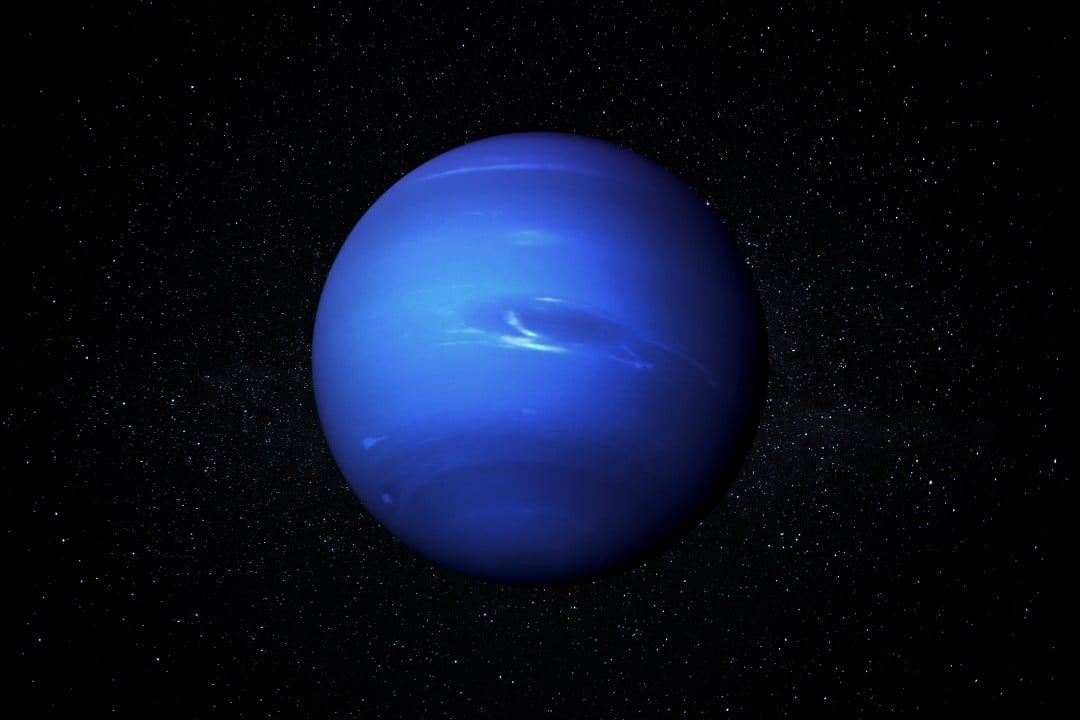
The destructive influence of Tritão on system architecture
Numerical models detail the first hundred million years after the consolidation of Netuno’s core. The scene was chaotic. Durante During this primordial phase, the protoplanetary disk housed a regular system of native satellites with predictable orbits. The capture of Tritão caused a true orbital catastrophe. Encroaching gravity destroyed most of the original moons through high-speed collisions, turning the region into a debris field.
Nereid found a rare point of dynamic balance during this violent reconfiguration of space around the gas giant. Tests carried out on supercomputers indicate that the satellite escaped annihilation by a minimal margin of gravitational tolerance. Qualquer’s subtle change in the density of the initial dust disk would have hurled the moon toward the surface of Tritão or toward Netuno itself. The celestial body ended up pushed to a border region. Nessa peripheral zone, the planet’s gravitational influence still manages to keep it trapped in a complex orbital dance.
Características physics and the extreme orbit of the satellite
Nereid’s orbital behavior differs drastically from the patterns observed in regular moons in our cosmic neighborhood. The satellite completes one revolution around the gas giant every 360 Earth days. Esse period is exceptionally long for a body tied to planetary gravity. The trajectory is more similar to the path taken by periodic comets than by conventional moons. Essa dynamics generate internal tidal forces that affect the physical structure of the object continuously, dissipating energy over billions of years.
The geometry of this orbit creates extreme variations in distance from the parent planet during the Neptunian year. At periapsis, the point of closest approach, Nereid is 1.4 million kilometers from Netuno. In apoapsis, the maximum distance reaches the impressive mark of 9.6 million kilometers. Esse constant orbit stretching represents an unparalleled natural laboratory for the study of celestial mechanics and long-range gravitational interactions.
- The orbital eccentricity reaches an index of 0.75, representing the highest value recorded among all the moons in the solar system.
- The diameter of the satellite measures approximately 340 kilometers, a dimension that places it among the average bodies in the external region.
- The average distance maintained in relation to the central planet orbits in the range of 5.5 million kilometers.
- Supercomputers processed data equivalent to 4 billion years of uninterrupted gravitational evolution to validate the models.
Astronomers calculate that this current configuration has guaranteed stability for the next billion years. The mathematical equations rule out risks of collision with the inner moons or the possibility of definitive ejection into interstellar space. The satellite’s stay in this boundary zone provides direct clues about the distribution of mass in the early solar system. Orbital isolation of Nereid preserved its primordial features intact. The satellite functions as a time capsule of planetary formation.
Composição chemistry rules out asteroid capture theory
A





