SpaceX’s Starship system resumes flight tests this Thursday with a focus on trips to Mars
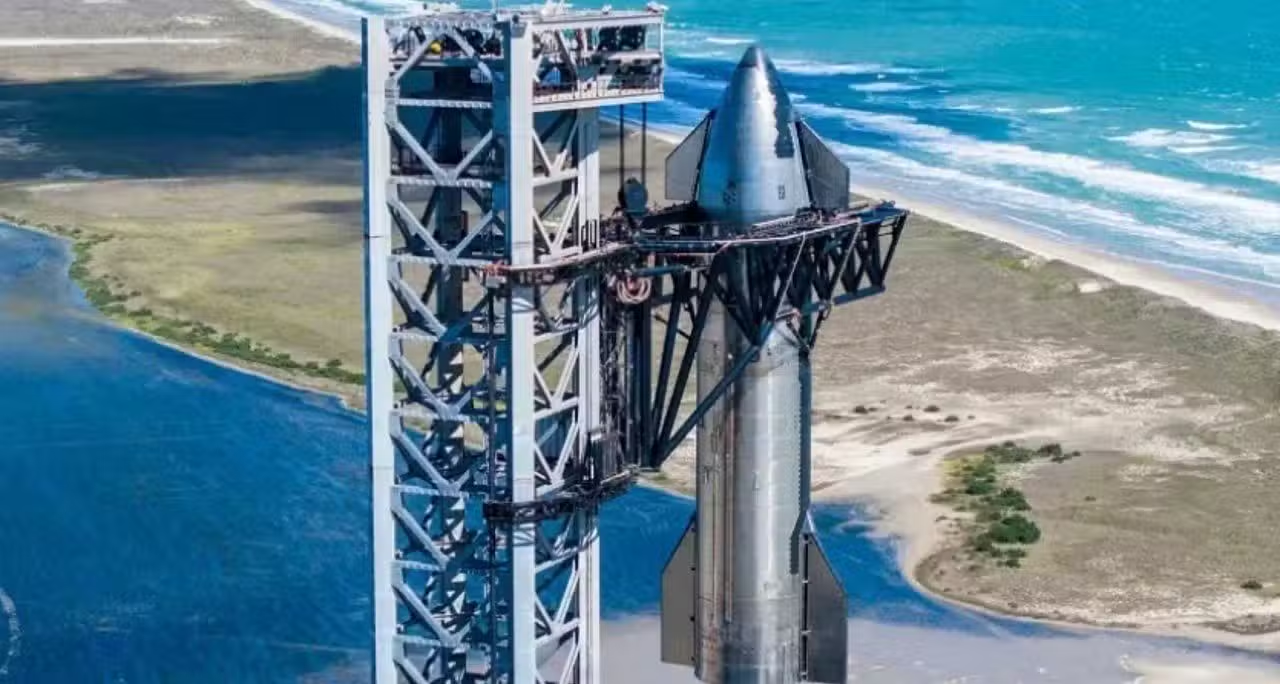
The aerospace company SpaceX scheduled the resumption of test flights for the Starship system for this Thursday. The takeoff of the largest space vehicle ever built is scheduled for 7:30 pm, according to Brasília time. The event ends a seven-month hiatus without launch operations for this specific model. The mission represents a fundamental stage in the schedule of the company founded by Elon Musk, which seeks to enable the transport of heavy loads and crews out of Earth’s orbit.
The central objective of the operation is to validate the technical updates implemented after the failures recorded in previous tests. The success of this testing phase directly affects the contracts signed with Nasa for the Artemis program. The American space agency depends on the full functioning of this equipment to return astronauts to the surface of Lua in the coming years. The project also serves as an engineering basis for future manned expeditions to Marte.
Arquitetura and launch vehicle capability
The mechanical assembly impresses with its unprecedented dimensions in the global aerospace industry. The equipment reaches a total height of 124 meters when mounted on the launch platform. Essa measurement is equivalent to a residential building of approximately 40 floors. The main structure uses stainless steel for its outer fuselage. The choice of this specific material aims to guarantee extreme thermal resistance during Terra’s re-entry into the atmosphere and keep production costs controlled on a large scale.
The project engineering divides the vehicle into two distinct operational parts to facilitate flight control. The upper stage, properly called Starship, measures 52 meters and houses the cargo compartment and the future crew area. The basis of the system is formed by the Super Heavy thruster, which is 72 meters long. The combination of these two structures allows the transport of a massive volume of materials into space.
- The complete system reaches 124 meters high on the launch pad.
- The upper stage measures 52 meters and carries cargo and astronauts.
- The Super Heavy propellant is 72 meters long and guarantees initial takeoff.
- The transport capacity exceeds 100 tons for Terra’s orbit.
- The fuselage uses stainless steel to withstand high friction temperatures.
The fundamental premise of the equipment is the complete and rapid reuse of all its structural components. Traditional rockets discard valuable parts into the ocean or atmosphere after use. The SpaceX model predicts that both the spacecraft and the thruster will return to the ground intact after fulfilling their functions. Essa’s technical capability promises to drastically reduce the financial value of each space mission, changing the commercial dynamics of the sector.
Propulsão based on methane and liquid oxygen
The force needed to lift the colossal structure comes from a set of 33 Raptor engines installed on the base of the Super Heavy. Perfectly synchronizing all these thrusters during ignition is the biggest mechanical challenge of takeoff. A chain failure at this stage compromises the stability of the vehicle and could result in the total loss of the equipment. Engineers revised the fuel supply systems to avoid the pressure problems seen in past attempts.
The Raptor engines operate on a mixture of liquid methane and liquid oxygen. The aerospace industry has traditionally used refined kerosene or liquid hydrogen in its large projects. The choice of methane meets a long-term strategy focused on exploring Planeta Vermelho. The Martian atmosphere has chemical elements that allow the local production of this fuel through industrial processes. Essa feature eliminates the need to carry all propellant for the return trip to the Terra.
The development of this propulsion technology required years of bench testing before installation in the main vehicle. Engines must withstand multiple start-up and shutdown cycles in the vacuum of space. The durability of internal parts is tested to the limits of factory specifications during vertical landing maneuvers. The company collects real-time telemetry data to adjust the flight control software with each new ignition at the test base.



Impacto on Nasa’s programs and Martian colonization
The Estados Unidos government monitors the testing schedule with increased attention due to the commitments made. Nasa chose a modified version of Starship to act as Human Landing System in the Artemis program. Este specific module will be responsible for transporting astronauts from lunar orbit to the surface of Lua. Atrasos in the development of the SpaceX rocket directly impacts the date of human return to the natural satellite.
Elon Musk maintains focus on utilizing the vehicle to establish permanent bases on Marte. The corporate plan calls for sending entire fleets of ships loaded with survival supplies and housing modules. The system’s unprecedented payload capacity makes it feasible to transport heavy machinery for extraterrestrial construction. The colonization project depends exclusively on the reduction in operational costs provided by the reuse of rockets.
The commercial satellite market is also awaiting certification of the vehicle for regular low-orbit operations. The Starship can place dozens of telecommunications equipment in space at once. The deployment of global internet constellations gains speed with the use of a large launcher. The company plans to fly frequently in the future to meet pent-up demand from the technology and communications sector.
International Competição and testing methodology
SpaceX’s development strategy is based on rapid prototype construction and rigorous practical testing. The company accepts the risk of structural failures during experimental flights as a way of accelerating the engineering team’s learning. Cada incident generates a massive volume of data that computer simulators cannot accurately predict. Lessons learned from previous flights resulted in reinforcements at the launch base and modifications to the stage separation system.
The project’s advancement occurs in an environment of strong geopolitical and commercial competition between nations. China accelerates its own space program with the development of super-heavy rockets and lunar exploration plans. The Chinese government plans to establish a research base on Lua in the coming decades. The operational availability of the Starship guarantees the Estados Unidos a decisive logistical advantage in this new phase of the international space race.
The American private sector also presents competing alternatives, although at different stages of technological maturity. Blue Origin, founded by Jeff Bezos, and the United Launch Alliance consortium work on their own new generation launch vehicles. Commercial pressure forces SpaceX to maintain a constant pace of testing at its facilities. This Thursday’s takeoff serves as a thermometer for the industry to assess the real progress in technology for the total reuse of heavy rockets.
Veja Tambem em Latest News (EN)

Italian Supreme Court confirms legality of hotel that offered only mineral water to customer

National Geographic Traveler Announces Travel Photography Contest Winners

Ferrari presents Luce, the first electric car, and receives harsh criticism from fans and the market

Yuki Yamada posts photo with beard and grimace on Instagram and surprises fans

Costco sees record demand at U.S. gas stations with lower prices

Passenger tries to enter cockpit and forces diversion of United Airlines flight to Madison
Astronomer explains white light recorded after meteor falls near volcano in Philippines

Comedian Sakamoto-chan reveals type 2 diabetes remission after lifestyle changes

Avi Loeb says discovery of alien intelligence can unite humanity amid global crises

Police investigate death of Hilde Ann Lynn Helphenstein in room at Rosewood São Paulo
Avi Loeb suggests that dark comet 1998 KY26 could be Soviet probe Phobos 1