

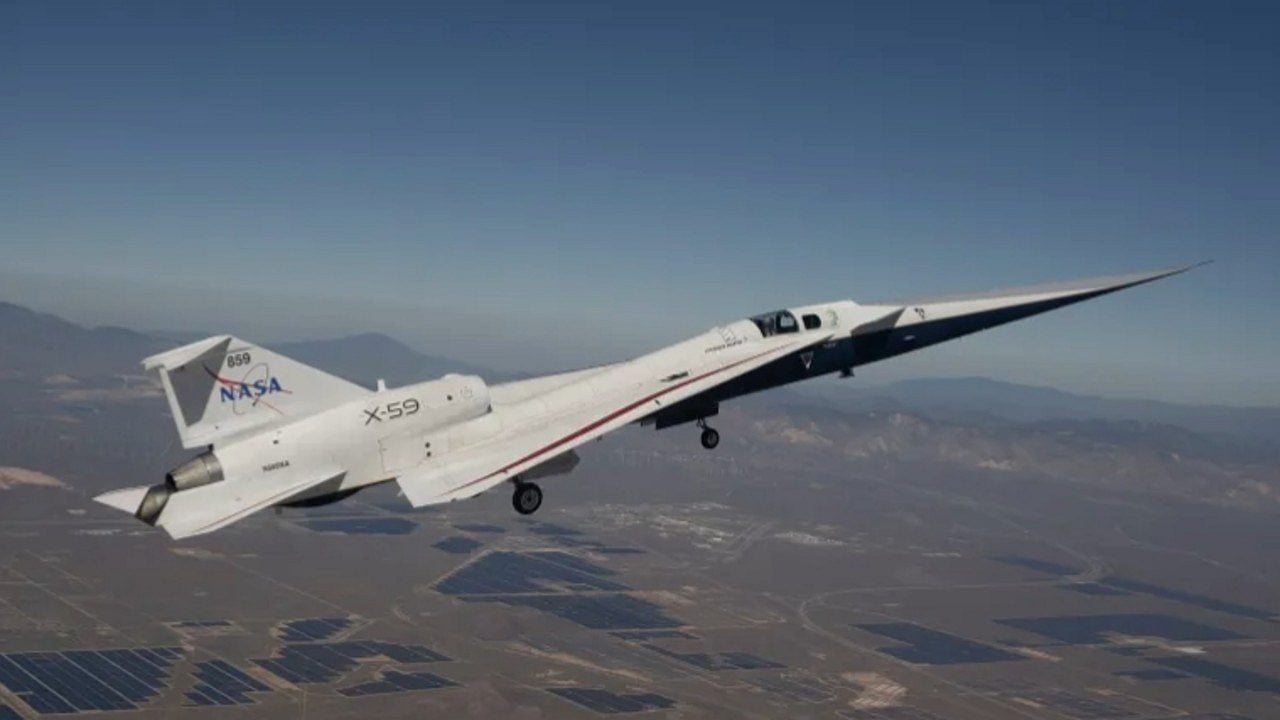
NASA’s X-59 experimental plane has reached a significant milestone in its test flight program, completing a series of operations spanning different speeds and altitudes. The aircraft, developed to revolutionize commercial supersonic transport, is undergoing a crucial evaluation phase that includes maneuvers at reduced speeds and low altitudes, complementing previous tests carried out in extreme conditions. Esses new flights consolidate the American space agency’s commitment to preparing technology for future operational missions.
Comprehensive Test Estratégia Redefines Performance Assessment
The NASA engineering team adopted a reverse methodology compared to traditional prototypes. Inicialmente, the X-59 was subjected to flights at high altitudes and speeds close to the sound barrier, allowing investigations of the most challenging conditions. Agora, engineers deliberately perform operations at reduced altitudes and lower speeds, mirroring real operating scenarios rather than extreme laboratory conditions. Esta systematic approach provides comprehensive measurements of structural loads, flutter performance and handling qualities.
Cathy Bahm, NASA’s Low Boom Flight Demonstrator project manager on Centro of Pesquisa of Voo Armstrong, explained the operational logic: “Our priority was to reach maximum height and speed to allow the team to investigate the highest risk portion of the flight envelope, then work through the region of reduced altitude and speed while the team processed the findings.” Esta dual strategy ensures that each phase of flight, from takeoff to supersonic cruise, is rigorously evaluated for safety and operational precision.
The current tests represent a paradigmatic shift in experimental aviation engineering. Rather than just pushing extreme limits, NASA is validating the aircraft’s behavior under conditions that pilots and operators will regularly face. Essa approach reduces risks identified during preliminary phases and provides critical data for design optimizations. Cada flight contributes information that refines computational models and structural performance predictions.
Low-Altitude Manobras Reveals Critical Aerodynamic Characteristics
Engineers conduct specialized tests that include flights just 500 feet above the runway, with the landing gear both retracted and extended. Essas low-altitude operations are essential for air data system evaluations, providing detailed information about how the X-59 reacts under different aerodynamic forces. In several cases, previously performed tests are repeated with strain gauges, sensors that monitor the distribution of stress throughout the aircraft structure.
Measurements derived from these flights allow engineers to understand subtle effects on the aircraft. Entre them, the way it handles smaller speed fluctuations, how the wings and fuselage respond to repeated stress, and how control systems behave in different aerodynamic regimes. Dados vibration, downforce and structural responses are recorded continuously, creating a comprehensive performance archive.
The instrumentation equipment inside the X-59 is sophisticated. Centenas sensors measure parameters ranging from aircraft skin temperature to microscopic movements of internal structures. Estes data is transmitted in real time and also stored in embedded recording systems, ensuring redundancy of critical information. Analistas work immediately after each flight to process telemetry and identify anomalies or unexpected patterns.
The X-59 airframe incorporates advanced composite materials and innovative designs. The wings feature optimized aerodynamic shapes to minimize pressure disturbances that generate sonic booms. The aircraft’s compact size, with extremely aerodynamic fuselage, reduces the acoustic signature during supersonic flights. Compreender how these elements respond under variations in speed and altitude is critical to validating the operational viability of the concept.
Preparação for supersonic operations in populated areas
Data collected during these slower, lower-altitude flights will inform the next phase of X-59 testing, which will include full supersonic runs over populated areas. The ultimate goal is to produce a low-boom aircraft capable of traveling at supersonic speeds without the disruptive sonic boom traditionally associated with speeds beyond Mach 1. Esta capability would fundamentally transform international commercial aviation.
Civil aviation regulators require new aircraft technologies to demonstrate performance in real-world operating conditions. The X-59 must meet stringent requirements for noise, structural safety, and maneuverability in diverse scenarios. Current systematic testing documents that the aircraft responds predictably to pilot controls, maintains structural integrity under operational loads, and produces acoustic signatures within acceptable limits. Cada flight adds scientific credibility to the concept.
NASA’s Quesst (Quiet SuperSonic Technology) program represents a collaboration between government agencies, aeronautical companies and research institutes. The goal is not just to demonstrate technical feasibility, but to establish regulatory standards that enable sustainable commercial supersonic operations. Essa integrated approach recognizes that technical innovation alone is not enough; public acceptance and regulatory compliance are equally critical.
Structural Performance Análise in Logical Progression
Engineers document minimal changes in structural responses as the X-59 transitions between different flight regimes. Variações dynamic pressure, lift load, and inertial forces produce cascading effects on the structure. Extensômetros strategically placed along the fuselage, wings and control surfaces capture these responses with nanometer precision. Dados previous flight histories are compared with new measurements, identifying any deviations from model predictions.
NASA’s iterative testing approach ensures that risks are managed progressively. Nenhum flight advances to a higher risk envelope until preliminary tests validate safety and performance. Limites operations are expanded incrementally, with detailed analysis intervals between each phase. Este deliberate method, although longer than aggressive testing, significantly reduces the likelihood of catastrophic events.
X-59 test pilots receive extensive training in simulators that incorporate real data from previous flights. Familiaridade’s handling characteristics, vibration patterns, and control system responses enable faster reactions to any unusual behavior. Continuous Comunicação between in-flight pilots and ground engineers creates additional layer of operational safety.
Implicações for future commercial aviation
The X-59’s comprehensive trials lay the groundwork for a potential resurgence of commercial supersonic travel over land. Durante decades, the Concorde demonstrated technical feasibility of supersonic flight, but economic limitations and noise pollution concerns ended operations. Modern Tecnologia offers opportunities to solve these historic challenges.
A silent supersonic aircraft would open up previously inaccessible air corridors. Rotas transatlantic and transpacific routes could be flown in half the current time, connecting global markets with unprecedented efficiency. Cidades interiors and regions without access to international airports could benefit from an expanded air transport network. Implicações economics are substantial, especially for high-value business and luxury tourism sectors.
Órgãos environmentalists closely monitor the development of the X-59. Regulatory Certificação will require demonstration of compliance with noise and emissions standards. NASA collaborates with agencies such as Administração Federal and Aviação (FAA) and Estados Unidos to establish appropriate metrics. Testes specialized acousticians measure the sonic boom generated by the X-59 and compare it to proposed regulatory limits.
Canadian, European and Japanese Pesquisadores also develop alternative silent supersonic aircraft concepts. Competição International accelerates innovation, with multiple approaches being explored simultaneously. The X-59 remains the most advanced prototype in the experimental testing phase, offering valuable data to the international aviation community.
Cronograma and next steps for the program
The completion of current tests will mark the transition to the final demonstration phase. Voos supersonics over selected communities will allow real acoustic data collection in an operational environment. Instrumentação on the ground will record how the sonic boom affects homes and commercial areas. Surveys with local population will document social acceptability of the technology. Esses data will inform recommendations for review of aeronautical noise regulations at an international level.
Cronograma’s program has been modified over the years in response to technical challenges and budgetary priorities. Agência maintains flexibility to adjust testing sequence as learnings emerge. However, commitment to full demonstration of the concept before transfer to the commercial sector remains firm. Parcerias with aircraft manufacturers like Lockheed Martin ensures that innovations developed on the X-59 can be scaled into viable commercial production.




