

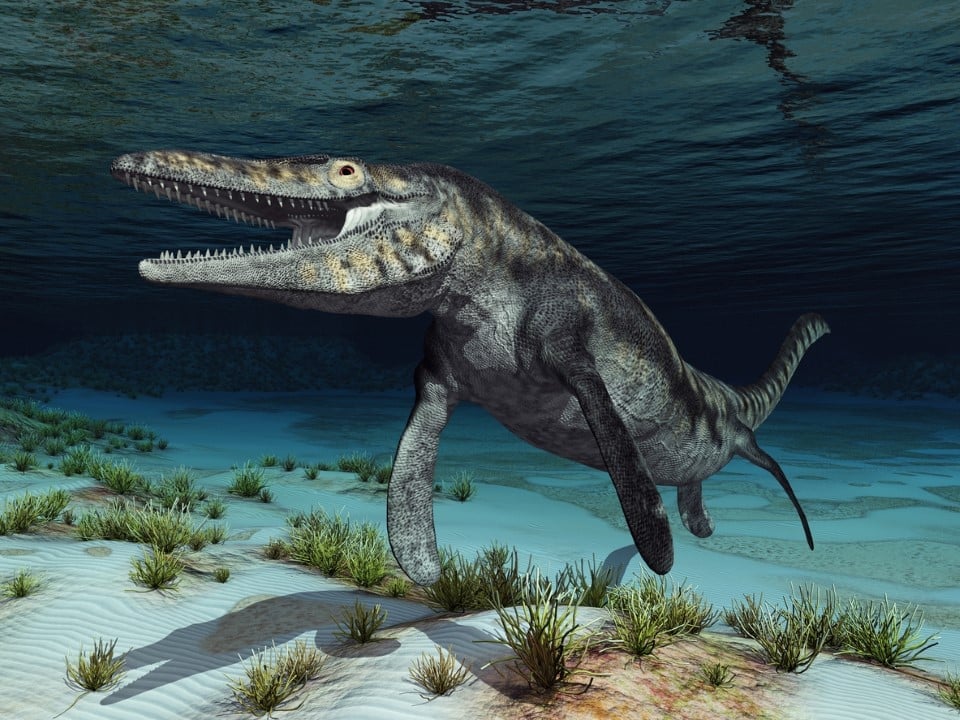
Cientistas of Museu Americano of História Natural identified a new species of mosasaur called Tylosaurus rex, a colossal marine reptile that measured up to 13 meters in length and dominated the oceans approximately 80 million years ago. The research, published in Boletim of Museu Americano of História Natural, reveals one of the largest mosasaurs ever discovered. Fósseis of the predator were found mainly to the north of Texas. The research team included scientists from Museu Perot of Natureza and Ciência in Dallas and from Universidade Metodista of Sul.
Amelia Zietlow, lead author of the study, began the investigation while conducting doctoral research in comparative biology at Escola of Pós-Graduation Richard Gilder of Museu Americano of História Natural. Ela noticed that a fossil in the museum’s collection had been incorrectly identified as Tylosaurus proriger, another species of mosasaur. Após compare the specimen with the original T. proriger fossil kept in Museu of Zoologia Comparada of Universidade of Harvard, the researchers confirmed that it was a completely different species.
Anatomical Diferenças between the two species of Tylosaurus
The new mosasaur had distinct characteristics that differentiated it from previously known species. Tylosaurus rex was significantly larger than T. proriger and had finely serrated teeth, an adaptation rarely seen in mosasaurs. Além Furthermore, the two species occupied different geographic regions and temporal periods. The majority of T. proriger fossils were found at Kansas and date to approximately 84 million years ago. The new predator lived mainly in what is now Texas about 80 million years ago.
Mais from a dozen similar fossils were later associated with Tylosaurus rex after reclassification. Esses specimens were stored in different museums and were analyzed as part of the comprehensive study. The discovery demonstrates the importance of periodically reviewing paleontological collections to identify misclassifications.
The T. rex holotype specimen is currently on display at Museu Perot in Dallas. Este fossil was discovered in 1979 near an artificial reservoir on the outskirts of the city. The piece represents one of the most significant finds for understanding the evolution of mosasaurs in the Cretáceo period.
Homenagem to paleontologist John Thurmond
The researchers chose the name Tylosaurus rex as a tribute to paleontologist John Thurmond. In the late 1960s, Thurmond observed that Texas’s giant northeastern tylosaurs appeared unusually large and could represent a species different from those already known. Thurmond informally called them “Tylosaurus thalassotyrannus”, an expression that means “tyrant of the sea” in Latin, indicating his awareness of the formidable nature of these predators.
The naming of the species recognizes the importance of Thurmond’s pioneering observations to modern paleontology. Seu work laid the groundwork for later investigations that led to the formal identification of Tylosaurus rex decades after its initial observations.
Adaptações physical signs indicate aggressive and predatory behavior
Pesquisadores believe that the Tylosaurus rex was evolutionarily adapted for extreme strength and aggression. The species had anatomical structures linked to especially powerful jaw and neck muscles, making it a formidable hunter in the ancient oceans. Ron Tykoski, study co-author and Museu Perot’s vice president of science and curator of vertebrate paleontology, described the animal as exceptionally vicious compared to other mosasaurs.
“In addition to being enormous, approximately twice the length of the largest great white sharks, T. rex appeared to be a much more vicious animal than other mosasaurs. Through our study and examination of well-preserved fossils collected throughout the northern region of Texas, we have evidence of violence in this species to a degree never before seen in other specimens of Tylosaurus,” said Tykoski.
Evidências combat between predators of the same species
Well-preserved Fósseis reveal signs of violence and aggression between individuals of the species. A famous specimen nicknamed “The Cavaleiro Negro”, currently at Museu Perot, has significant injuries. The fossil is missing the tip of its snout and has a fracture in the lower jaw. Pesquisadores state that these injuries were likely caused by another member of the same species during violent combat.
Evidence of intraspecific aggressiveness suggests territorial or competitive behaviors between individuals of Tylosaurus rex. Esse pattern of violence in fossils had not been documented in other mosasaurs with the same frequency and severity. The findings contribute to understanding the ecological dynamics of the late Cretáceo oceans.
Outros famous mosasaur fossils were reclassified after discovery. “Bunker,” a massive specimen on display in Universidade of Kansas, and “Sophie,” on display in Museu Peabody of Yale, were previously identified as T. proriger and are now being reclassified as Tylosaurus rex based on evidence presented in the new study.
Revisão of the evolutionary structure of mosasaurs
The study also addresses fundamental questions in paleontological research on mosasaurs. Scientists noted that the main dataset used to study evolutionary relationships among mosasaurs has remained largely unchanged over the past three decades. Para solved this problem, the team created a revised dataset and developed a new evolutionary framework for tylosaurs.
Zietlow emphasized the importance of the discovery for future paleontological research. “This discovery isn’t just about naming a new species. Ela highlights the need to revisit long-held assumptions about mosasaur evolution and to modernize the tools we use to study these iconic marine reptiles.”
The findings suggest that many previous studies on mosasaur evolution may need to be revised in light of the new information. Essa reassessment could significantly alter scientific understanding of the phylogenetic relationships between different mosasaur species.
Impacto on Understanding Ancient Marine Ecosystems
Michael Polcyn, co-author of the research by Universidade Metodista of Sul, said the discovery substantially expands understanding of both the animals themselves and the ancient ecosystems they inhabited. “These discoveries reshape both the physical and evolutionary picture of mosasaurs, highlighting Texas as a key region for understanding ancient marine ecosystems and signaling a new era of research into the evolutionary history of these formidable predators.”
Texas emerges as a region of critical importance for paleontological studies of the Cretáceo period. The state’s northern fossil deposits contain evidence of a diverse and complex marine fauna, providing insights into predator-prey interactions in the ancient oceans.
The findings demonstrate:
- The exceptional size of Tylosaurus rex compared to other known mosasaurs
- Adaptações specific anatomical features for predation and aggression
- Comportamentos intraspecific combat documented in fossils
- The need to review previously established evolutionary structures
- The importance of periodic reevaluations of museum collections
- Texas as a fundamental region for paleontological research on Cretáceo
The research continues to inform the scientific community about marine life during the late Cretáceo period, a geologically crucial time for understanding the evolution of marine reptiles before the mass extinction that ended the Mesozoic period.




