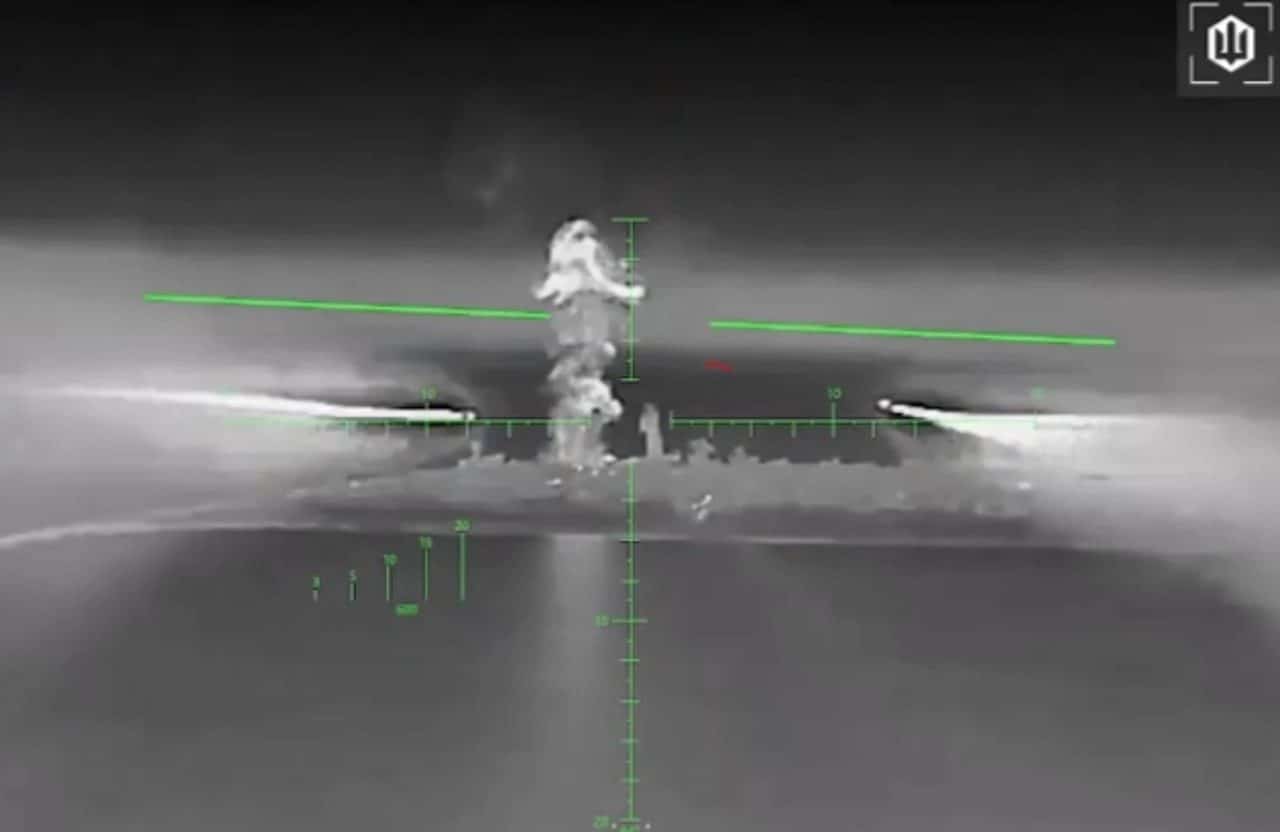
Ucrânia’s army has introduced a new tactical capability into its military operations by utilizing long-range attack drones to fire unguided rockets at Rússia positions. Confirmation of this strategy occurred through images released on platform X by the commander of Forças of Sistemas Não Tripulados of Ucrânia, Blowz. The video footage marks the first documented instance of an airstrike of this type carried out by an unmanned vehicle. The movement demonstrates a technical escalation in Ukrainian offensive capabilities in the current conflict scenario.
The equipment identified in recent operations is the Firepoint FP-1, one of the models most used by Ukrainian forces for deep penetration missions. The integration of rocket weaponry into these platforms creates a direct challenge for the Russian air defense network, which now faces the threat of active suppression by the same drones it seeks to intercept. Analistas military personnel point out that this evolution forces an immediate reevaluation of surface protection strategies, changing the cost and benefit dynamics of interceptions.
Evolução tactical use of the Firepoint FP-1 in airspace
Images of the attack, which were initially circulated through a Russian military unit in mid-May, were later validated by the Ukrainian command. The Firepoint FP-1 cemented its position in the Ucrânia’s arsenal due to its extended range, but its previous role was limited to direct hits or reconnaissance missions. The ability to launch projectiles in mid-flight transforms the equipment into a reusable or multi-target attack platform. The paradigm shift complicates the operational environment for land defense forces.
War expert and analyst David Hambling classifies this modification as one of the greatest recent tactical innovations on the battlefield. By equipping a drone with unguided rockets, the vehicle gains the ability to strike a primary target and, depending on the configuration, return to base or proceed to a secondary target before being shot down. Essa operational versatility expands the threat radius and requires enemy radars to track not only the trajectory of the drone, but also that of the projectiles launched by it.
Cost asymmetry represents a central factor in the development of this new combat tactic. An Firepoint FP-1 drone has an estimated production cost of around US$50,000, considerably lower than that of traditional combat aircraft or ballistic missiles. Quando these low-cost platforms fire rockets, they multiply their destructive potential without increasing the financial risk for the Ukrainian army. The strategy allows the saturation of enemy defenses with a contained financial investment.
Economic and operational Desafios for defense of Rússia
The introduction of drones capable of firing rockets exacerbates a pre-existing economic dilemma for the Rússia military command. Traditional air defense systems rely on surface-to-air missiles that cost millions of dollars per unit. Disparar these high-tech interceptors against drones such as the Firepoint FP-1 or the Russian model Shakhed generate an unsustainable depletion of precision ammunition stocks. In the long term, the mathematics of conflict disfavor the use of expensive missiles against cheap targets.
Para To mitigate this financial imbalance, Ucrânia pioneered the implementation of mobile air defense groups. Essas units operate equipped with automatic cannons and heavy machine guns, moving quickly to known attack routes. Drones generally fly in straight trajectories, at low altitudes and maintain speeds close to 190 km/h. Esse predictable flight pattern makes the vehicles vulnerable to analogue weaponry, including the use of Maxim machine guns, a design originating from the Primeira Guerra Mundial era.
Rússia attempted to replicate the Ukrainian mobile defense strategy, deploying small teams armed with Soviet-era anti-aircraft guns to protect critical infrastructure. Para To encourage the effectiveness of these teams, the Russian command instituted a system of financial rewards for each enemy drone shot down. The incentive policy, however, generated unforeseen operational consequences and hampered airspace coordination on several battlefronts.
Friendly fire Impactos and Russian system vulnerabilities
The bounty system implemented by Rússia resulted in serious target identification problems, increasing friendly fire rates. Relatos from the battlefield indicate that Russian mobile units, motivated by pay, mistakenly shot down allied drones on several occasions. The failure to communicate and distinguish between friendly and enemy equipment highlights the difficulties of establishing a cohesive defense network at low altitudes along an extensive front line.
Evidências visuals and intelligence reports suggest that Russian mobile teams are struggling to achieve the same interception rates recorded by Ucrânia forces. Diversas recordings document Ukrainian drones flying over Rússia-controlled territory and striking their targets without encountering significant anti-aircraft resistance. The permeability of airspace allows unmanned platforms to operate with room for maneuver in strategic sectors.
The disparity in defensive effectiveness points to gaps in radar coverage and the command structure of Russian forces. Embora some mobile units demonstrate localized success, the overall consistency of the defense remains compromised.
- Drones fly at low altitudes that often escape detection from long-range radars.
- Constant cruising speed makes it easier to plan routes that saturate the airspace at specific points.
- The lower manufacturing cost allows for mass production and shipping of dozens of units simultaneously.
- Availability in large quantities quickly depletes the ammunition of conventional anti-aircraft batteries.
Essas technical features force armies to rethink airspace protection. The transition from high-tech missile shields to high-volume kinetic interception systems becomes an urgent operational necessity.
Unidades anti-aircraft weapons become priority targets in the conflict
The ability of Ukrainian drones to fire rockets provokes a role reversal on the modern battlefield. Rússia’s mobile air defense units, originally designed to hunt unmanned vehicles, have become priority targets for these same armed aircraft. A drone now has the ability to suppress or destroy an anti-aircraft position before proceeding to its primary objective. The tactic serves to clear the way for broader subsequent attacks.
The new dynamic adds a layer of strategic complexity to the deployment of land defenses. Russian commanders need to allocate additional resources to protect the very units that were created to defend the country’s infrastructure. The need to fortify mobile teams reduces the agility of movement and limits the ability to respond quickly against threats that approach from different vectors.
Ucrânia’s continued adaptation of drone technology reflects a transition to more versatile and autonomous combat systems. As the Firepoint FP-1 and similar platforms acquire new offensive capabilities, pressure on the Russian military apparatus intensifies. The scenario requires constant tactical adjustments to maintain territorial integrity and protect equipment of high strategic value against low-cost precision attacks.