Renault launches SUV Koleos in Brazil for R$ 289,990 to compete in the hybrid market with BYD and GWM
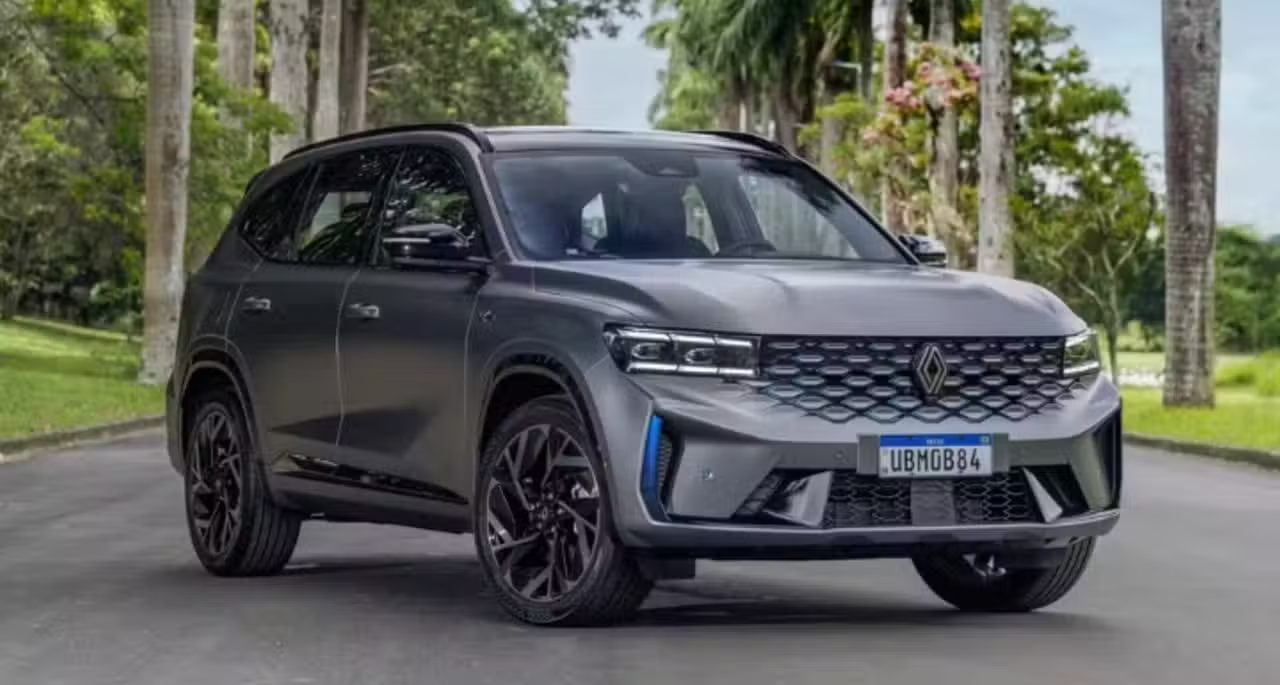
Renault confirmed the start of pre-sales of the Koleos sports utility vehicle in the Brazilian market, with the first units scheduled for delivery in the second half of April 2026. The model arrives at dealerships with a suggested price of R$289,990. The French manufacturer is betting on the luxury segment to attract consumers interested in electrification. The vehicle represents a change in the company’s commercial strategy in the country. The main goal is to establish a direct alternative to the utility vehicles from eastern brands that dominate current sales.
The car project is the result of a global partnership that integrates Swedish engineering and the assembly line located at Coreia of Sul. The car uses the CMA modular platform. Essa is the same framework developed by Volvo and Geely for high-end models. Essa technical base provides levels of safety and drivability adjusted to the requirements of the European market. The mechanical package and driver assistance systems have been calibrated to cope with diverse road conditions. The automaker seeks to deliver a product with a refined finish to justify the price charged on the label.
Detalhes Mechanical Assembly and Utility Energy Efficiency
The operation of the Koleos is based on the full hybrid system, known by the acronym HEV. The technology does not require power cables. Essa configuration uses a 1.5-liter turbo combustion engine in conjunction with electric thrusters, generating a combined power of 245 hp. Maximum torque reaches 56.1 kgfm. Isso guarantees enough strength for quick overtaking and speeding on highways. The main characteristic of this format is the absence of a socket for external battery recharging. The vehicle’s own operation and regenerative braking take care of replenishing energy in the electrical system.
Choosing this technology simplifies the routine of drivers who do not have chargers installed at home or at work. Motive force management takes place via a three-speed DHT automated transmission. The on-board computer decides the exact moment of change. The system switches between electric traction and combustion imperceptibly. Official factory data indicate urban consumption of around 13.1 km/l. The engineering focus was to provide a smooth and silent drive during daily commutes in large cities.
The French model’s main competitors take a different mechanical approach. The BYD Song Plus and GWM Haval H6 PHEV35 use plug-in hybrid systems. Esses models require plugging in to charge larger capacity batteries. The Haval H6, for example, delivers 393 hp and four-wheel drive. The car reaches 100 km/h in just 4.9 seconds. The Renault utility does not seek to compete in pure acceleration with Chinese rivals. The proposal for the European vehicle focuses on linear power delivery and acoustic comfort for passengers.
Dimensões cabin and luggage compartment capacity
The car’s architecture favors space for occupants, especially those traveling in the rear seat. The distance between the axles measures 2,820 mm. Este is one of the highest numbers recorded in the medium and large SUV category. Essa measured exceeds the dimensions of the BYD Song Plus, which is 2,765 mm, and the GWM Haval H6, with 2,738 mm. The free space for the legs allows tall adults to sit comfortably during long journeys. The internal configuration makes the car suitable for executive transport and for large families.
The vehicle’s suspension has an independent system on all four wheels, using a multilink arrangement on the rear axle. The calibration of the shock absorbers focuses on absorbing the irregularities of the Brazilian asphalt. The utility vehicle has a ground clearance of 211 mm. The elevation makes it easier to navigate speed bumps, ditches and low-difficulty dirt roads. The 20-inch alloy wheels come equipped with 245/45 tires. The undercarriage contributes to directional stability and reinforces the car’s robust visual appearance.
The focus on cabin comfort had a direct impact on the model’s cargo transport capacity. The Koleos’s trunk holds 431 liters. The measurement follows the international VDA standard. The available volume is below the capacity offered by direct competitors, which exceed the 550 liter mark in their respective compartments. The project indicates that the automaker prioritized the ergonomics of the seats to the detriment of space for large suitcases. Users who make frequent trips with a lot of luggage will need to optimize the organization of items in the luggage compartment.



Pacote embedded technology and interior comfort features
The instrument panel and entertainment system form an extensive digital set at the front of the cabin. The arrangement encompasses three 12.3-inch screens positioned side by side. The design creates a panoramic interface for users. The front seat passenger has a unique display to control media and navigation functions independently. The OpenR multimedia system offers wireless connection to the main smartphone applications on the market. The sound quality of the environment is provided by premium equipment provided by the Bose brand.
The list of standard equipment includes items aimed at the comfort and safety of occupants on long journeys. The automatic air conditioning has three distinct temperature zones. The feature allows individual adjustments for the driver, passenger and rear passengers. The front seats have electrical adjustments, position memories, a ventilation system, heating and a lumbar massage function. The cabin’s acoustic insulation is aided by active external noise cancellation technology. The protection package includes seven airbags spread throughout the cabin.
The French manufacturer added several practical features to make the driver’s routine easier. The list below details some of the technologies present in the sport utility vehicle:
- Projeção provides driving information on the windshield via a 9.3-inch head-up display.
- Retrovisores indoor and outdoor with automatic dimming to avoid glare at night.
- Sistema engine hood opening supported by double gas springs.
- Pacote advanced with nearly thirty electronic driving assistance and autonomous braking systems.
The finishing of the dashboard and doors uses rubberized materials and coverings that imitate high-quality leather. The assembly of internal parts follows the standard required by consumers in the European luxury market. Ambient LED lighting allows customization of cabin colors through the multimedia center. The physical air conditioning controls were kept on the center console to facilitate quick access for the driver. The ergonomics of the buttons and levers were designed to minimize distraction for those behind the wheel.
Strategic Posicionamento of the automaker in the national market
The introduction of Koleos into Brasil is part of a plan to restructure Renault’s image among the local public. The company seeks to move away from the perception of a manufacturer focused only on popular and fleet cars. The new sports utility vehicle acts as a technological showcase. The objective is to demonstrate the engineering capacity of the automotive group. The sales volume projected for the model is considered niche, with no intention of leading registrations in the segment. The dealership network will undergo specific training to meet the customer profile in this price range.
The electrified vehicle market in Brasil shows accelerated growth in the year 2026. Consumers demonstrate greater familiarity with the different propulsion technologies available in stores. The commercial clash between traditional brands and new Asian manufacturers defines the pace of launches and price adjustments. The French model uses the capillarity of its technical assistance network as a selling argument against newly arrived companies. The factory warranty and the availability of spare parts weigh on the purchasing decision of the most conservative customers.
The competition for consumers of premium SUVs requires the offer of increasingly complete equipment packages. The Koleos combines European design with the practicality of a hybrid system that does not require power cables. The commercial success of the vehicle will depend on the brand’s ability to convince the public about the added value of its exclusive technologies. Competition with the BYD Song Plus and GWM Haval H6 will keep the segment hot over the next few months. The automotive sector is closely watching the acceptance of this new strategy by the French automaker on Brazilian streets.
Veja Tambem em Latest News (EN)

Galaxy S26 line gains automatic integration with Apple’s AirDrop through Quick Share

HyperOS 3.1 system with Android 16 arrives on Xiaomi cell phones without public testing phase

Accident on BR-116 leaves 16 dead in a family in Santa Terezinha, Bahia

IOS 26.4 update arrives on iPhone with advanced security and playlists generated by artificial intelligence

Iván Cepeda backs down and denies evidence of irregularities in Colombia’s elections

Chris Robinson responds to boos from fans at The Black Crowes concert in Florida

Manufacturer OnePlus prepares portable Android console with exclusive physical controls for shooting games

Apple releases iOS 26.4 for iPhone with new emojis and advanced audio features

New Anker 300 W and 26,250 mAh portable battery hits the Chinese market with high compatibility

Disney confirms releases of Avatar 4 and 5 for 2029 and 2031 after sales of Fire and Ash

James Webb Telescope maps web of primordial gas that connects galaxies after the Big Bang