Astronomer from the Federal University of Itajubá details the simultaneous formation of the Blue Moon and micromoon on May 31
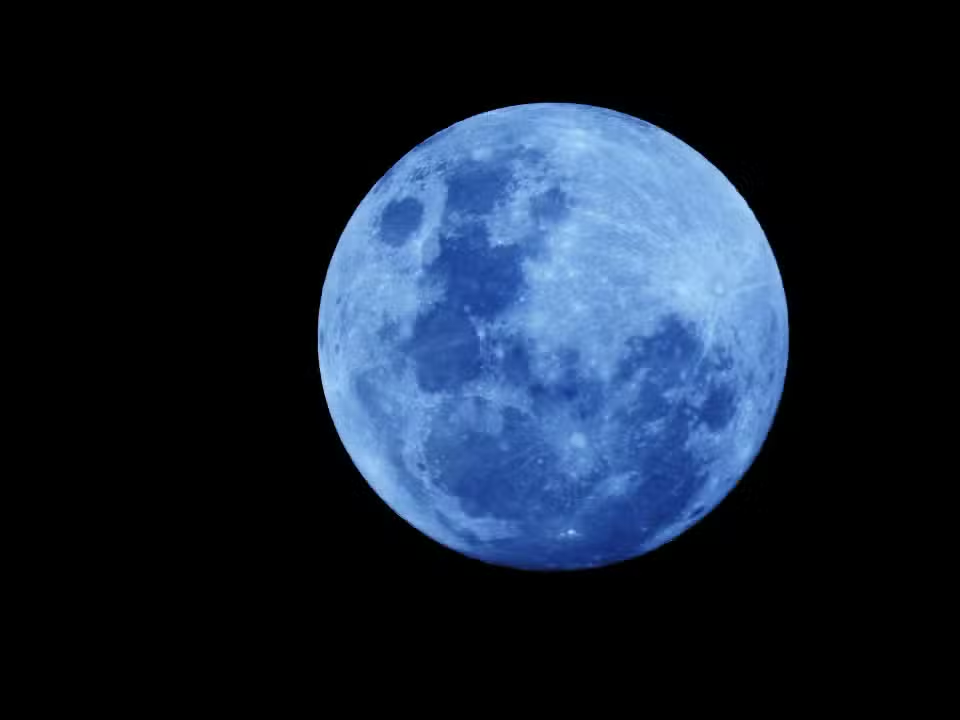
The night sky on May 31st will record the combination of two distinct astronomical events involving the natural satellite Terra. The date will mark the simultaneous occurrence of a micromoon and an Lua Azul, phenomena that alter the visual perception and classification of the star on the calendar. The alignment of these two conditions on the same night generates interest for observation and scientific dissemination in the country.
Astronomer Gabriel Hickel, professor of Universidade Federal and Itajubá, will lead technical explanations on the topic. Detailed analysis of the satellite’s orbital and temporal characteristics integrates the programming of Ciência into Rádio. The scientific communication project results from a partnership established between Observatório Nacional and Rádio MEC to democratize access to astronomical information.

Definição Technique and Lua Azul Calendar
The nomenclature Lua Azul is not related to a change in the visible color of the satellite in space. The term establishes a specific marking in the lunar calendar and follows mathematical criteria for counting cycles. The astronomical community adopts two main definitions to classify the phenomenon during the year. Correct understanding requires observation of the seasons and the traditional Gregorian calendar.
The first rule, considered the oldest and most traditional, defines the phenomenon as the third full moon within the same season of the year that records four occurrences of this phase. The normal pattern features only three full moons per season, making the fourth appearance a mathematical anomaly in the quarterly cycle. The second definition, popularized more recently, applies the term to the second full moon that occurs within the same calendar month.
The complete lunar cycle lasts approximately 29.5 days, a period known as the synodic month. The difference between this interval and the length of the Gregorian calendar months, which vary from 28 to 31 days, allows for the occurrence of two full moons in a period of 30 or 31 days. The temporal mismatch creates the exact conditions for the configuration of the astronomical event recorded at the end of May.
Distância orbital and the formation of the micromoon
The second phenomenon predicted for the date involves the orbital mechanics of the satellite around the planet. The lunar orbit does not describe a perfect circle, but rather an ellipse, which generates constant variations in the distance between the two celestial bodies. The micromoon happens specifically when the full phase coincides with the moment when the star reaches its apogee. The technical term designates the point of greatest separation on the orbital trajectory.
Durante the apogee, the natural satellite is positioned at a considerably greater distance compared to its closest point. The difference in path reaches around 50 thousand kilometers more than that recorded at perigee. The increased distance reduces the apparent size of the lunar disk in the night sky, resulting in slightly lower luminosity for observers on the Earth’s surface.
The visual condition of the micromoon establishes a direct contrast with the opposite phenomenon, widely known as a supermoon. Enquanto the supermoon occurs at perigee and presents an apparently larger and brighter lunar disk, the May event will deliver the smallest possible view of the star in its full illumination phase. The variation in apparent size demands attention from observers, although the exact difference is subtle to the naked eye.



Posição relative and lighting phases
The satellite view from Terra depends exclusively on the geometry formed by the system composed of Sol, Terra and Lua. Sunlight reflects off the lunar surface at different angles throughout the synodic month. The continuous change in position results in the four main phases recognized by observational astronomy. The complete cycle governs not only nighttime lighting, but also influences physical dynamics such as ocean tides.
The classification of lunar phases follows strict astronomical positioning criteria:
- Nova (satellite positioned directly between Terra and Sol, with the illuminated side hidden)
- Crescente (transition phase that displays a quarter of the disk’s total illumination)
- Cheia (satellite located opposite Sol, with its face fully illuminated)
- Minguante (visual reduction period showing the decreasing illumination room)
The simultaneous occurrence of the full phase with the apogee and with the anomalous count of the Gregorian calendar consolidates the rarity of the May 31st event. The combination of independent factors demonstrates the complexity of celestial cycles. Continuous monitoring of these variables allows research institutions to predict events decades in advance and prepare educational materials for the population.
Scientific Divulgação and the Ciência project on Rádio
The detailed explanation of celestial mechanics is part of the science popularization actions in Brasil. The Ciência program on Rádio acts as a platform dedicated to translating complex astronomical concepts for the general public. The initiative represents a joint effort between Observatório Nacional, an institution linked to Ministério of Ciência, Tecnologia and Inovação, and the communication structure of Rádio MEC.
The scientific dissemination project has a trajectory of 11 years of uninterrupted transmissions since its foundation in 2015. The initiative’s collection records almost 500 episodes produced with technical rigor and accessible language. The content covers Observatório Nacional’s three fundamental areas of research: astronomy and astrophysics, geophysics, and time and frequency metrology.
The distribution of educational material occurs on a multiplatform basis to reach different listener profiles. The complete programs remain available on the official Observatório Nacional website and make up the Spotify audio platform catalog. Professor Gabriel Hickel, from Universidade Federal of Itajubá, maintains regular collaboration with the project, also participating in other initiatives such as the Céu program in Sua Casa.
The presence of academic experts in the media strengthens the fight against misinformation about natural phenomena. The elucidation of events such as Lua Azul and the micromoon prevents the spread of myths and misinterpretations about the behavior of the universe. The continuous work of research institutions ensures that the Brazilian population receives verified data based on the principles of modern science.
Veja Tambem em Latest News (EN)

Future iPhone 18 Pro will integrate translucent back and hidden photographic lens in the display

Epic Games Store consolidates access to 12 completely free big-budget games for computers in 2026

New iPhone 18 Pro brings discreet updates with A20 Pro chip while iPhone Fold gains prominence

New Ebola outbreak in the Democratic Republic of Congo records 65 deaths and mobilizes healthcare

FIFA defines 2026 World Cup calendar with 104 games in the United States, Mexico and Canada

BYD Qin Plus DM-i 2026 hybrid sedan hits the market with a range of more than 2,100 kilometers

Major launches for PlayStation 5 mark the 2026 calendar with exclusive titles
Chinese manufacturer prepares launch of Xiaomi 17 Ultra with Snapdragon 8 Gen 5 and Leica lenses

Czech store code reveals high price of Valve’s new Steam Machine for the year 2026

Accessory specialist Jaos presents off-road modification package for Toyota RAV4 at Tokyo Auto Salon 2026

Automaker starts sales of the 2026 Jeep Grand Wagoneer with Hurricane engine and new illuminated grille