May records blue moon phenomenon and gradual approach between planets Venus and Jupiter
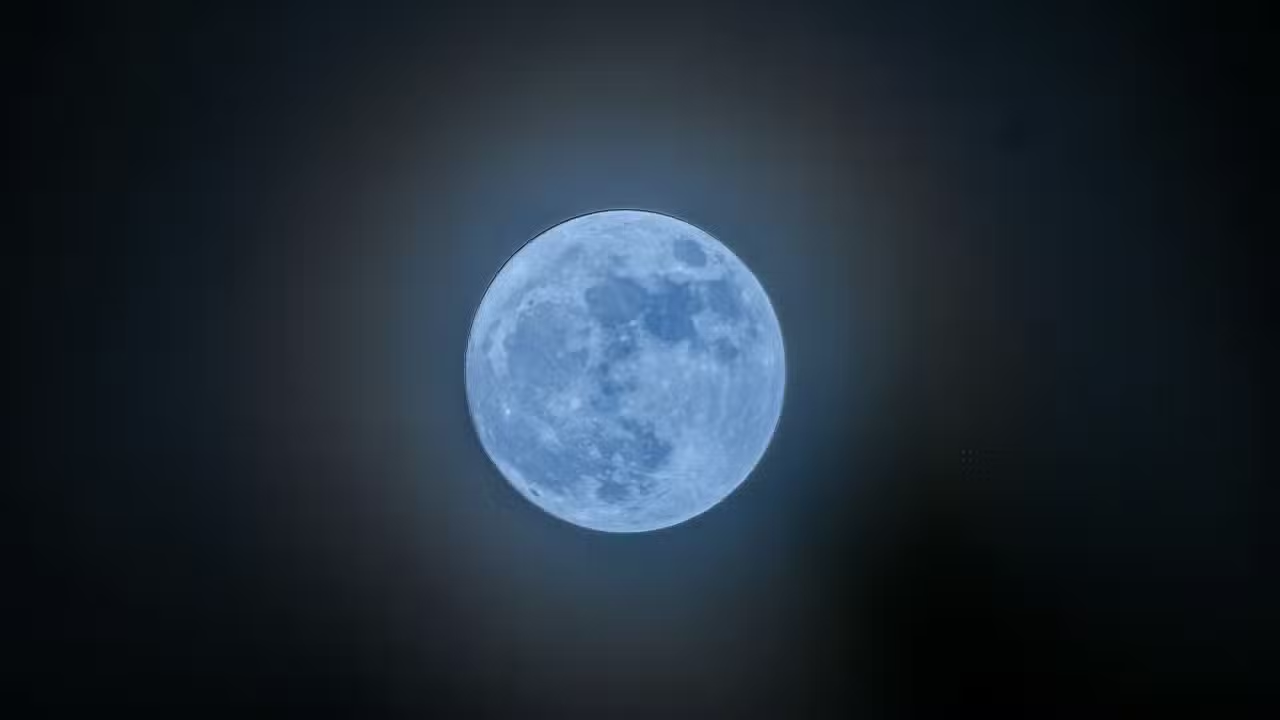
The astronomical calendar for May 2026 presents the occurrence of two full phases of the natural satellite of Terra within the same month. The first full illumination occurs on the 2nd, while the second complete phase occurs on the 31st, configuring the event known scientifically and popularly as the blue moon. The phenomenon results from the mathematical difference between the lunar cycle, which lasts approximately 29.5 days, and the Gregorian calendar. The temporal mismatch generates an accumulation of days that allows for double occurrences every two or three years.
Simultaneamente to the lunar event, observers in the southern and northern hemispheres follow the gradual approach between the planets Vênus and Júpiter in the afternoon sky. The orbital dynamics of the celestial bodies create a specific visual configuration during the last weeks of May, culminating in a conjunction at the beginning of the following month. Observation conditions depend on local meteorological factors and the absence of light pollution in large cities. Astronomy Institutos monitor trajectories to provide accurate data to research centers.
Efeitos atmospheric and optical illusion on the horizon
The full moon on May 31st rises in the southeast direction at a time almost simultaneous to the sunset on the western horizon. Durante In the first minutes of ascension, the star presents a color that varies between shades of orange and gold. The visual change results directly from the scattering of sunlight through the dense layer of the Earth’s atmosphere. The term blue moon has no relation to the actual color of the satellite. The nomenclature derives solely from an expression in the English language used to classify events of low temporal frequency.
Observing the satellite close to the horizon also causes a visual phenomenon known as the lunar illusion. Atmospheric refraction and visual reference with terrestrial objects make the moon appear up to 50% larger compared to its apparent size when it reaches the zenith. The zenith represents the highest point in the sky from the observer’s perspective. Especialistas recommend searching for locations with a clear view to the southeast and checking in advance the exact time of moonrise in the respective time zone.
The celestial mechanics that govern the satellite’s lighting keep the physical characteristics unchanged during the process. The light reflected by the lunar surface passes through a greater quantity of suspended particles when the star is low on the horizon. The natural filter blocks shorter wavelengths, such as blue and violet, allowing warm colors to pass through. The gradual rise of the moon reduces atmospheric interference and returns the traditional silvery-white glow throughout the night.
Dinâmica of planetary conjunction in the western sky
On the opposite side of the celestial vault, the movement of Vênus and Júpiter dominates the beginning of the May nights. Vênus holds the position of the brightest object in the night sky after the moon, often called the evening star. The planet is positioned close to the western horizon. Júpiter appears in the visual field on the left and at a higher elevation. The gas giant has a constant brightness that differentiates it from background stars, which tend to twinkle due to atmospheric turbulence.
The angular distance between the two planets progressively decreases with each 24-hour cycle, demonstrating the continuous orbital movement of Sistema Solar. Observation does not require optical equipment such as telescopes or binoculars. Monitoring with the naked eye in the direction of the west shortly after the end of civil twilight guarantees visualization of the event. The apparent trajectory of the stars follows a predictable pattern established by the laws of orbital physics:
- Vênus maintains the maximum apparent magnitude index in the western quadrant.
- Júpiter gradually moves from the top left position.
- The separation in degrees between the two celestial bodies reduces daily.
- The point of closest visual approach occurs on June 9th.
- The conjunction phenomenon allows viewing at different latitudes of the globe.
The apparent encounter arises from the different translation speeds of the planets around Sol. Vênus has an internal and smaller orbit, completing its journey in less time. Júpiter performs a slower movement in its outer orbit. The perspective from Terra creates temporary visual overlap, even though the planets remain millions of kilometers apart in outer space. The alignment serves as an educational tool for understanding the geometry of the planetary system.



Lunar Alinhamento with stars Spica and Antares
The moon’s transit through the night sky also promotes apparent encounters with high-magnitude stars. On Wednesday, May 27, the satellite with an 11-day cycle approaches Spica. The star represents the brightest point in the constellation Virgem. The alignment remains visible from early evening until the early morning hours of the 28th. The configuration serves as a reference point for amateur astronomers in identifying the zodiacal constellation in the night sky.
On Saturday, May 30, the moon reaches 14 days old and rises in the southeast accompanied by Antares. The red supergiant star dominates the constellation Escorpião. Cerca two hours after sunset, the star becomes sharp to the left and below the lunar disk. Antares acts as an astronomical marker of the summer period in the Northern Hemisphere and winter in the Southern Hemisphere. Visual proximity to the moon remains constant until dawn on June 1st.
Transição of constellations and June calendar
The end of May marks the last opportunities for clear observation of the Leão constellation before its seasonal occultation. The star cluster descends toward the western horizon shortly after dusk. The formation stands out for its shape that resembles a scythe. The star Regulus, the brightest of the group, defines the base of the geometric figure. A triangle of smaller stars forms the back of the feline representation, making it easier for beginners to observe the sky to locate.
The transition to June changes deep sky visibility conditions. The daily delay in the moonrise time provides progressively darker nights in the first fortnight of the month. The astronomical calendar predicts the culmination of the conjunction between Vênus and Júpiter between the 8th and 10th of June. Posteriormente, between the 14th and 16th, the new phase of the moon coincides with perigee. The event generates a new supermoon that guarantees total darkness for observations of galaxies and nebulae.
The end of the first half of June also brings the planet Mercúrio to a favorable position. On the 16th, the innermost planet of Sistema Solar reaches its greatest eastern elongation. The technical term defines the point of maximum angular separation of the Sol from the terrestrial perspective. The positioning makes it easier to locate the star on the western horizon during the minutes following sunset. The event completes the cycle of planetary movements that began with the blue moon at the end of May.
Veja Tambem em Latest News (EN)

Future iPhone 18 Pro will integrate translucent back and hidden photographic lens in the display

Epic Games Store consolidates access to 12 completely free big-budget games for computers in 2026

New iPhone 18 Pro brings discreet updates with A20 Pro chip while iPhone Fold gains prominence

New Ebola outbreak in the Democratic Republic of Congo records 65 deaths and mobilizes healthcare

FIFA defines 2026 World Cup calendar with 104 games in the United States, Mexico and Canada

BYD Qin Plus DM-i 2026 hybrid sedan hits the market with a range of more than 2,100 kilometers

Major launches for PlayStation 5 mark the 2026 calendar with exclusive titles

Chinese manufacturer prepares launch of Xiaomi 17 Ultra with Snapdragon 8 Gen 5 and Leica lenses

Czech store code reveals high price of Valve’s new Steam Machine for the year 2026

Accessory specialist Jaos presents off-road modification package for Toyota RAV4 at Tokyo Auto Salon 2026

Automaker starts sales of the 2026 Jeep Grand Wagoneer with Hurricane engine and new illuminated grille