Tourism in Rio’s favelas grows faster than Christ the Redeemer and attracts international visitors
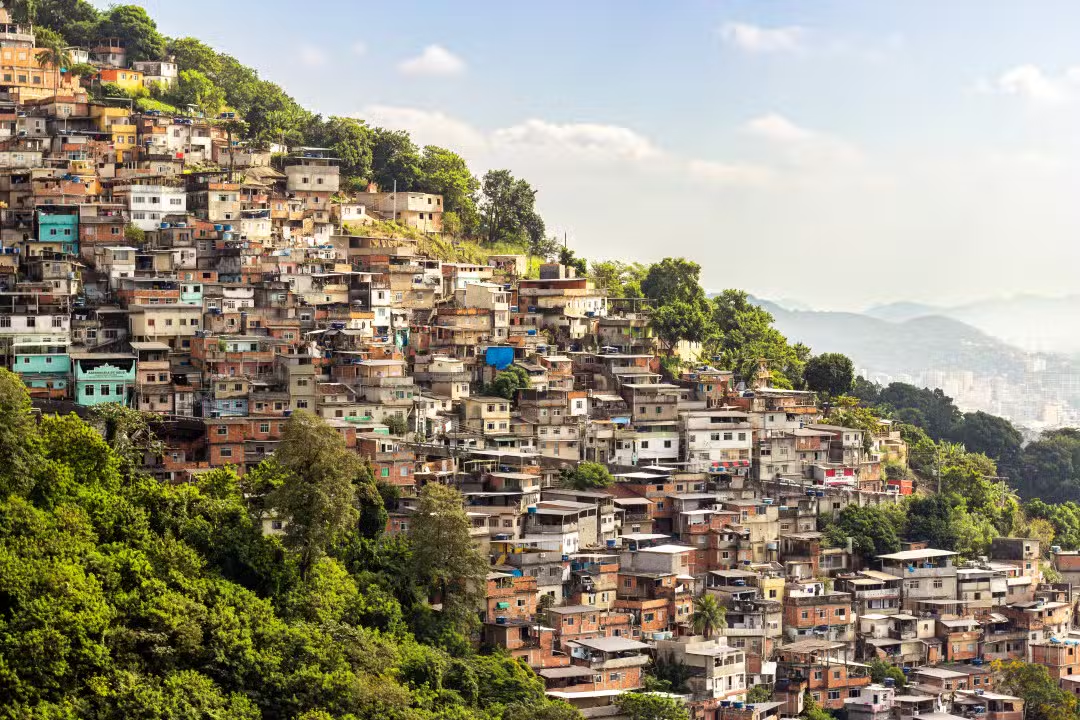
Comunidades lacking Rio of Janeiro surpassed traditional tourist attractions in number of international visitors. Official Dados from 2024 show that Vidigal and Rocinha received more foreign tourists than Cristo Redentor and Degraus of Selarón, historical landmarks that have been established for decades. The phenomenon marks a radical transformation in the perception of safety and cultural interest in regions previously avoided by visitors.
The rise of tourism in favelas began after police “pacification” operations began before Copa of Mundo of 2014 and Olimpíadas of 2016. Hoje, these densely populated communities act as attractions for immersive experiences, with trails at dawn, walks through graffitied alleys and capoeira classes. Global Celebridades such as Spanish singer Rosália and English gamer Jesse Lingard have been photographed exploring these regions in recent months.
Crescimento exponential tourist phenomenon
The May dawn in Rio of Janeiro attracts hundreds of visitors to the trail of Morro of Dois Irmãos, located inside Vidigal. Turistas of Inglaterra, França, Estados Unidos, Alemanha and Argentina wake up at 3:30 am to occupy motorcycle taxi engines without helmets on streets where houses are stacked vertically. The experience culminates at the top of the mountain, where they watch the sunrise over the Oceano Atlântico.
Social media has amplified the appeal of these tours. Tendências viral videos include drone photo shoots capturing tourists amid the uneven topography of the favelas. Hour-long Filas form on the rooftops of Rocinha, the largest favela in the country, for aerial recordings that circulate instantly on digital platforms. Visitantes pay to access private viewpoints and participate in events such as “Rave in Rio”, electronic parties organized within the communities.
Isabel Fernandes, a Portuguese visitor who explored Vidigal with local guide Ana Lima, described the motivation: it is not about superficial tourist curiosity, but about seeking realities beyond the surface. Ela visited community gardens and social programs, contrasting with stigmas perpetuated about favelas. “I felt safe and welcome,” she said.
Segurança: complex reality between residents and tourists
A shooting at Vidigal in April 2024 disrupted this positive narrative. Cerca of 200 hikers were trapped at the top of the mountain during a clash between police and alleged members of Comando Vermelho, a cartel involved in drug trafficking. Angel Njoku, a Canadian visitor, saw his planned travel week affected when friends canceled their hike out of fear.
Daria Kurpiewska, a Polish tourist who hiked the trail in March, described her shock upon learning about the incident. “It could have been my group of friends,” he said. The experience included a nighttime descent down the mountain while passing through a playground with children playing next to armed men. “It was a little disturbing,” he reported.
Mariana Cavalcanti, professor of urban studies at Universidade Estadual, Rio, Janeiro, has contextualized violence as an everyday reality for favela residents for decades. “These shootings have been happening every day for almost as long as I’ve been alive,” he said. Porém argues that the tourist presence significantly reduced violence in Zona Sul’s favelas, especially in Rocinha and Vidigal.
Paradoxalmente, Cavalcanti suggests that favelas may be safer for tourists than traditional tourist spots like Copacabana. Cartéis, according to her, prohibit crimes against foreigners so as not to impede the flow of tourism and income. “You won’t be robbed, you won’t suffer sexual assault and nothing bad like that will happen to you,” said the researcher.
Durante his tour, Fernandes has not faced security incidents. The experience included breakfast of bread and egg (bread and egg) in the alleys of Vidigal and exploring graffiti murals, offering contrast to widely circulated negative narratives about the communities.
Questões ethics on exploration and tourist gauze
The expansion of tourism in favelas has generated debate about ethics and cultural exploitation. Angel Njoku expressed concern: “Going to the slums to take photos and observe the people living there seems a bit troublesome.” Ela chose to skip the optional walking tour offered as an add-on to the dawn trail.
Kurpiewska faced a similar dilemma during an electronic party on Vidigal. Questionava-se: “There are so many people living here – is it acceptable to them for us to come?” Anxiety about inconveniencing residents reflected broader concerns about “poverty safari”, a term used to criticize 4×4 jeep tours during 2014’s Copa and 2016’s Olimpíadas.



Cavalcanti admitted to sharing these concerns initially. Porém, fieldwork in Morro by Providência changed his perspective when he found that residents did not show discomfort with visitors. Muitos actually depends on tourism for income: motorcycle taxi drivers, tour guides, souvenir sellers and restaurant owners like Bar of David thrive on the influx of foreigners.
“I really believe that favela residents are capable interlocutors, they know what they are doing,” said Cavalcanti. Modern visiting options – guided walking tours, drone experiences, paid observation points, capoeira classes and musical events – offer alternatives to the old model of passive and disrespectful observation.
Significância cultural and historical roots
Hugo Oliveira, researcher, guide and educational center director at Morro at Providência, argues that visits to favelas are ethically necessary to understand the history of Brasil and Rio. “If you want to talk about Brasil without knowing the favela, you can’t,” he said.
Morro of Providência, located in the “Pequena África” neighborhood of the center of Rio, was established in 1888 as the first Brazilian favela. Originalmente, housed formerly enslaved and impoverished people who settled without land ownership. Nas In the following decades, favelas faced an absence of municipal services such as electricity and sanitation. Entre 1960s and 1970s, dozens of favelas were demolished and hundreds of thousands of residents were forcibly displaced.
Oliveira argues that the rise of tourism in favelas proves that these communities have a legitimate place in the city like any other neighborhood. “Not promoting tourist activity is recognizing that we are not connected to the city”, he argued.
Favelas germinated and incubated globally recognized Brazilian cultural forms. Samba, baile funk and capoeira music originated in these communities and shaped the country’s cultural identity. Visitantes who explore the origins of these artistic expressions understand them in greater depth. Rosália, during a visit to the favela, received an impromptu lesson in passinho, a street dance born in Rio de Janeiro communities.
“Life in the favelas and outskirts of cities today shapes codes of aesthetics, language and fashion,” explained Oliveira. “If you want to be a nice person, the way nice people are in Brasil, you should visit a favela.”
Orientações practices for responsible visitation
Mariana Cavalcanti summarizes the central question: “The big question is not whether someone should go up to the favela, but how to get into the favela.” Seu advice includes seeking guides or local community associations, treating the favela as its own neighborhood where the visitor would reside.
The teacher advises avoiding photographing house facades and residents without explicit consent. “If people were taking photos outside your door, you wouldn’t like it, so why would you do it?” Respect for the privacy and dignity of residents constitutes the ethical foundation of visitation.
Favelas that openly welcome tourism include Vidigal, Rocinha, Morro of Providência and Chapéu Mangueira. Visitação does not necessarily require formalized historical tours. Oliveira recommends alternatives such as free cable car in Morro from Providência, pagoda shows, Carnaval blocks that cross communities and various community events.
- Plataforma recommended: App “Na Favela” offers tours with local guides recently launched
- Eventos insurance: Shows jazz in The Maze (Tavares Bastos), formalized capoeira classes
- Orientação photographic: Consultar local guide on safety and consent before shooting
- Transporte responsible: Tours on foot with residents instead of private jeeps
- authentic Imersão: Participação at real community events instead of scenic tours-only
Kurpiewska plans to return to Rio. If you revisit the favela, you would do so accompanied by a local resident. “I think it’s the best way, because it’s not performative and it’s the closest experience you can get to reality,” he said. Ela emphasizes that travel is about going out and genuinely experiencing things, as opposed to staying at home consuming Rio through digital screens. Real Experiências, even when they generate anxiety, constitute the authentic essence of cultural displacement and discovery.
Veja Tambem em Latest News (EN)

Court validates US$7.85 million settlement against Sony for monopoly on PlayStation Store

Microsoft system applies discount of up to 50% on Xbox Series X for engaged players

Microsoft digital system reduces Xbox Series X price by up to 50% for selected profiles

Microsoft algorithm reduces Xbox Series X value by up to 50% on old consoles panel

Avi Loeb discusses Project Galileo, UFOs, extraterrestrial intelligence, the transformation of humanity and the impacts of technological advances and cosmic discoveries

Salas opens the scoring for River Plate against Blooming in a duel for the South American

Military Police rescue 4-year-old boy abandoned by his mother on Antônio João state highway

New Forbes list points to 22 billionaire celebrities in 2026 with Steven Spielberg in the lead

PlayStation Plus catalog receives Warhammer 40K: Darktide and Destiny 2 ends in June

Author of La Casa de Papel exposes salary crisis for Brazilian screenwriters during Rio2C event

Streaming platforms confirm premieres of Avatar: Fire and Ash and final season of The Bear