Author of La Casa de Papel exposes salary crisis for Brazilian screenwriters during Rio2C event
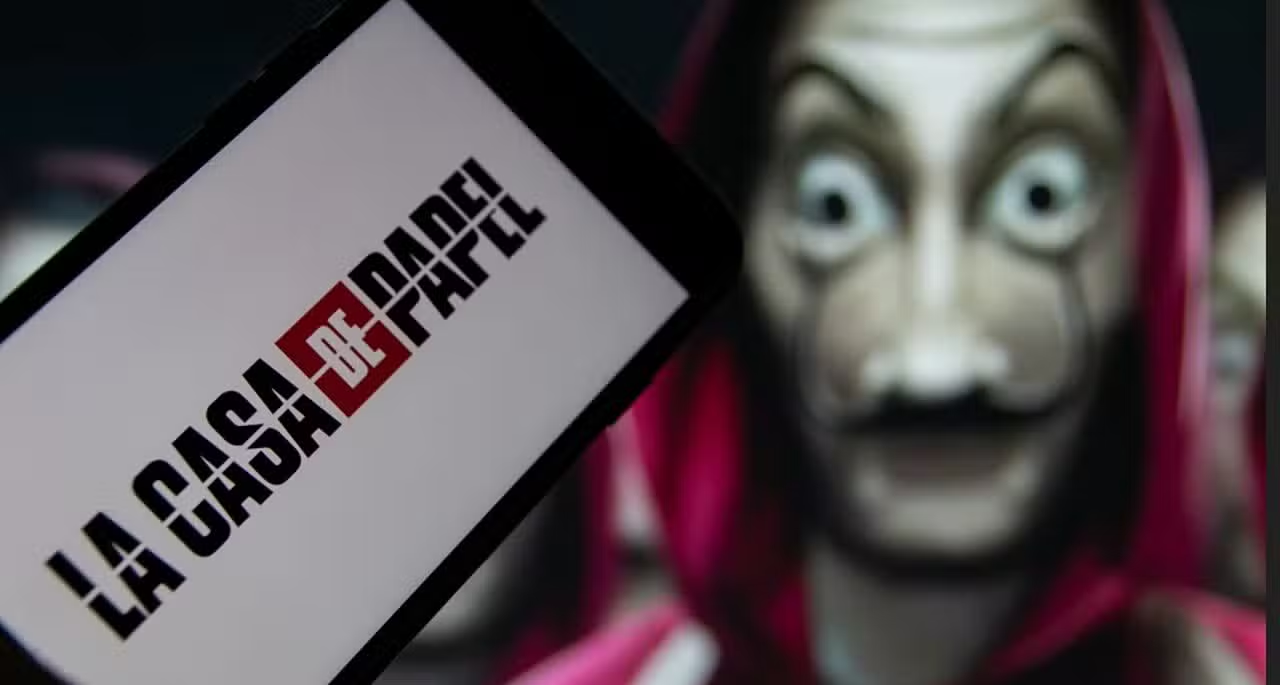
Spanish screenwriter Javier Gómez Santander, known for creating the La Casa series of Papel, used his participation in the Rio2C event to expose the financial conditions faced by authors in the audiovisual sector at Brasil. Durante the panel held on Wednesday, May 27, the professional pointed out the absence of residual payments to creators after the launch and success of the productions. The discussion raised questions about the sustainability of the profession in a market that moves large volumes of capital, but does not pass on profits proportionally to those responsible for the stories.
The writer’s central criticism focuses on the current business model, which ignores the global or national reach of works when it comes to paying screenwriters. In an interview with the newspaper Estadão, the Spaniard highlighted that the industry does not offer additional compensation even when projects reach millions of viewers. The debate gains relevance at a time of expansion of streaming platforms and national production, highlighting the need to review copyright policies to guarantee the financial survival of writing professionals.
Disparidade between the success of productions and the income of authors
Analysis of the Brazilian market reveals a precarious scenario that contrasts with the volume of productions carried out annually. Javier Gómez Santander highlighted that Brasil has one of the most robust film industries outside of Estados Unidos, which makes the lack of transfers even more evident. The author classified the lack of financial return on mass-audience works as a historical injustice to workers who dedicate time and intellectual effort to structuring complex narratives.
The industry numbers confirm the observations made during the event on Rio of Janeiro. A survey conducted by Gestão of Direitos of Autores Roteiristas (Gedar) shows that 85.1% of professionals in the field never received any type of remuneration after exhibiting their work in the national territory. Este data illustrates the flaw in the long-term compensation system, a common mechanism in other creative industries around the world.
The direct consequence of this single payment policy is the difficulty of maintaining a career in the long term. Gedar research shows that only 27.5% of Brazilian screenwriters are able to make a living exclusively from writing for audiovisual media. The vast majority of the category needs to resort to side jobs or other sources of income to guarantee basic sustenance, which affects the time available for the creation and development of new projects for cinema and television.
Propostas of new monetization and copyright models
Diante of the instability scenario, representatives of the category seek alternatives based on systems already consolidated in the digital environment. The president of Gedar Brasil, André Mielnik, defends the implementation of a remuneration format linked to the number of views of the works. The proposal uses YouTube’s business model as a reference, which passes on values to digital influencers according to the performance and reach of each video published on the platform.
The comparison with the music market also serves as a basis for the screenwriters’ claims. The music sector at Brasil has built a solid copyright protection structure, which allows composers and performers to receive ongoing payments for the performance of their tracks on radio, shows and audio platforms. Essa organization has resulted in a strong industry, where the public mostly consumes national artists.
Para illustrate the difference between sectors, experts point out the cultural impacts of the lack of financial protection. The president of Gedar Brasil mentioned that national cinema still faces difficulties in creating iconic figures with the same level of stability and lasting recognition that artists like Ivete Sangalo have in music. The absence of long-term guarantees prevents audiovisual creators from reaching the same level of professional security.
The main demands of the audiovisual sector for career restructuring include:



- Estabelecimento of contracts with residual payment clauses for display on platforms.
- Criação of transparent metrics by streaming services to account for real audience.
- Fortalecimento of class entities for collective negotiation of copyrights.
- Equiparação from audiovisual protection laws to the standards in force in the Brazilian music market.
The implementation of these measures requires complex coordination between producers, television channels, on-demand services and the legislative branch. The mobilization of workers aims to change the interpretation of current laws to include clear specifications on the continuous commercial exploitation of audiovisual works, ensuring that the screenwriter is recognized as having the right to share in the profits generated over the years.
International Perspectivas and the impact on the quality of works
The panel entitled Valor by Criação expanded the debate by bringing views from different global markets. The panel included the participation of French screenwriter Noémie Saglio and Brazilian Cauê Laratta, known for his work on Neblina’s Pico series. Mediation was carried out by Luisa Luna, manager of relations with creators of Confederação Internacional of Sociedades of Autores and Compositores (Cisac). The guests reinforced the discrepancy between the practices adopted abroad and the reality faced by professionals at Brasil.
The financial barrier acts as an exclusionary filter in the training of new talent for the national market. Cauê Laratta explained that the current structure allows entry into the profession only for individuals who have prior financial reserves. The author highlighted that the development cycle of a script can require months of exclusive dedication without any capital input, which alienates professionals from lower social classes and limits the diversity of narratives on screen.
The European vision on the topic reinforces the importance of financial support for creative excellence. Noémie Saglio used a concept from writer Virginia Woolf to illustrate that intellectual production requires adequate space and basic survival resources. The French screenwriter argued that copyright protection goes beyond immediate monetary gain, functioning as an essential tool so that the author can refuse purely commercial projects and dedicate time to more complex works, which can take a decade to complete.
Mobilização of the category due to new regulatory milestones
The advancement of discussions at Rio2C demonstrates a moment of transition in the stance of Brazilian audiovisual workers. The category goes through an internal organization process, seeking institutional representation to negotiate fairer conditions with large media conglomerates. Entidades and Gedar Brasil take the lead in formulating proposals that aim to align the national market with the standards established in Europa and América and Norte countries.
The expansion of the creative industry in the country drives the urgency of these structural reforms. With the increase in the consumption of content on multiple screens, the volume of capital generated by films and series reaches high levels, while the base of the production chain continues to operate under single-rate contracting models. The review of market practices is highlighted by professionals in the field as a viable way to keep talent focused on creating original scripts.
The dialogue established between national and international creators provides the technical basis necessary for the formulation of new work guidelines. The exchange of experiences shows that the screenwriter’s financial sustainability directly reflects on the quality of the final product delivered to the viewer. The consolidation of a continuous remuneration system represents a stage in the maturation of the Brazilian audiovisual sector in the global entertainment scenario.
Veja Tambem em Latest News (EN)

Chinese manufacturer Xiaomi’s financial results indicate a drop in profits due to component shortages

Horror classics School Ghost Stories and Tsukikomori get versions for Nintendo Switch

Trivia! Canobbio takes advantage and scores the third goal for the Rio team in Fluminense x La Guaira in the Libertadores

Artificial intelligence Google Gemini starts executing complex commands on WhatsApp for Android

NVIDIA’s New Vera Processor Outperforms AMD, Intel Chips in Early Server Tests

Researchers map 92 multiple star systems close to the Sun to help search for planets

Community creates strategies to secure collector’s edition of the game Grand Theft Auto VI

Japanese automaker updates Honda City lineup with focus on hybrid engines and new technologies

Take-Two confirms the arrival of Grand Theft Auto 6 for November and postpones announcement about official price

Samsung’s One UI 8.5 system update leaves Galaxy S23 devices without official support for the AirDrop feature

New look of the Ferrari Luce motivates digital projections with emblems of competing automakers