
James Webb Telescope reveals that moon Nereid survived historic impact on planet Neptune

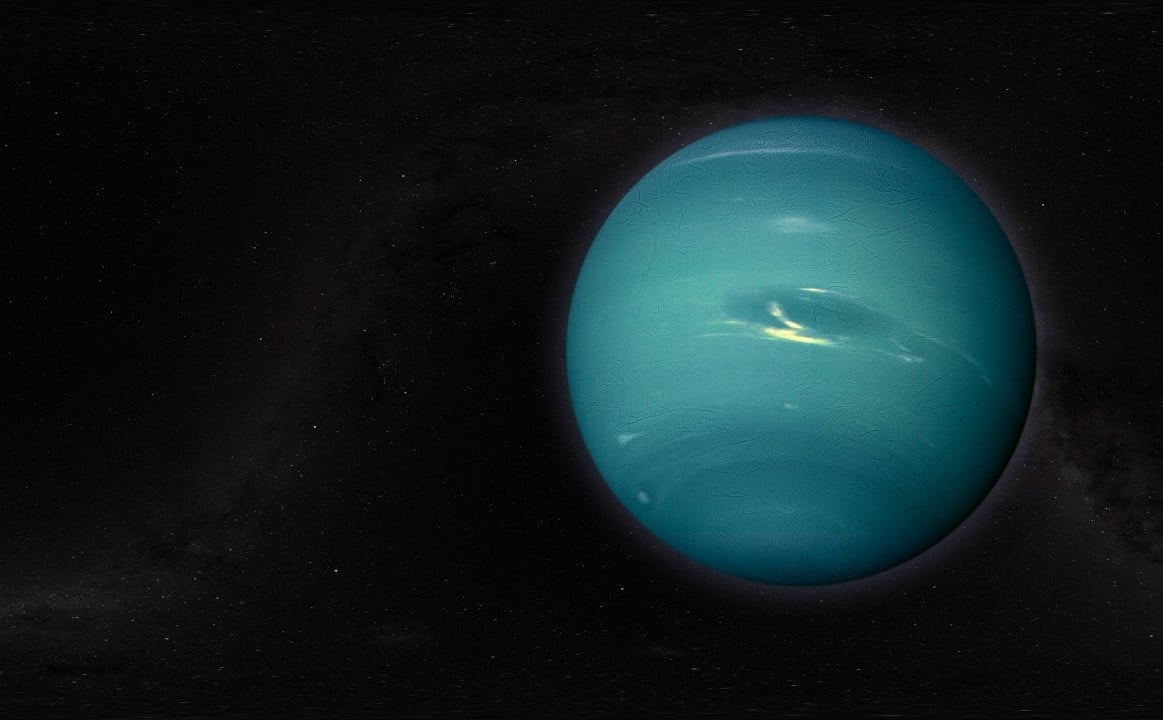
Recent Dados images captured by the James Webb space telescope indicate that Nereid serves as the only intact natural satellite remaining from the original formation of Netuno. The gas planet’s third largest moon survived a mass destruction event that occurred in the early days of the solar system. The scenario contradicts previous hypotheses about the origin of the celestial body. Astrônomos now reassess the evolution of orbits in the far reaches of our planetary system.
The study conducted by Matthew Belyakov, Instituto researcher of Tecnologia of Califórnia, was published in the journal Science Advances. The research details that the gravitational capture of Triton, Netuno’s largest moon, triggered a chain reaction. The process destabilized the region and fragmented almost all of the primordial satellites that orbited the ice giant more than 4 billion years ago. Nereid escaped total annihilation.
The chaotic architecture of the satellite system
Netuno has a distinct orbital configuration when compared to the other outer planets. Júpiter, Saturno, and Urano maintain highly ordered moon systems. Nesses planets, the most massive satellites orbit in the same direction as the rotation of the main body. The Neptunian environment exhibits a disorganized pattern and is home to considerably fewer moons.
Triton masters local gravitational dynamics. The satellite has dimensions similar to those of the terrestrial Lua and performs a retrograde movement, orbiting in the opposite direction to the rotation of Netuno. Essa unique feature in the solar system supports the theory that Triton did not form together with the planet. Cientistas point out that the celestial body migrated from another region.
Triton’s origins date back to Cintura of Kuiper, an area full of frozen objects located on the edge of the solar system. The approach with Netuno resulted in the gravitational capture of the intruding body. The abrupt entry of an object of this magnitude into the established system generated successive impacts. The collisions pulverized most of the original moons.
The seven innermost moons of Netuno represent debris from that event. Imagens recorded by the Voyager 2 probe shows that these smaller bodies function as clumps of debris. Eles contain the initial system material. Contudo, lost their structural integrity after severe mechanical shocks.
Características orbitals and celestial body physics
Observing Nereid poses technical challenges due to its low luminosity and extreme distance in relation to Sol and Terra. The only direct visual record from the satellite consists of a low-resolution photograph. The image was captured in 1989, during the passage of the American space agency’s Voyager 2 mission.
The celestial body has an estimated diameter of 338 kilometers. The measurement makes Nereid twice as large as Febe, an irregular satellite that orbits Saturno. The moon’s trajectory around Netuno is among the most eccentric in the entire known planetary system. The cycle requires 360 Earth days to complete.
Pesquisadores identified specific properties that differentiate Nereid from other space objects:
- The orbit maintains a relative proximity to the host planet, differing from the pattern of captured irregular satellites.
- The surface has higher reflectivity levels than those found in bodies originating from Cintura and Kuiper.
- The physical structure remains cohesive, without the signs of fragmentation seen in Netuno’s inner moons.
Essas anomalies have raised doubts about the classification of Nereid as an external object captured by Neptunian gravity. The absence of precise spectroscopic data prevented confirmation of its true nature. The gap persisted for decades until recent infrared analysis.
Análise chemistry and computer simulations
The James Webb telescope performed a targeted observation lasting ten minutes and forty seconds. Infrared instruments mapped the chemical composition of the satellite’s surface with unprecedented precision. The data revealed a crust rich in water ice. The sensors also detected the presence of carbon dioxide.
The spectral signature found is completely different from the typical composition of Cintura and Kuiper objects. The chemical profile of Nereid strongly resembles the regular satellites orbiting Urano. The research team compared the results with samples from 54 distant celestial bodies to validate the discovery.
Para To test the physical viability of Nereid’s survival, scientists ran advanced computational models. The simulations recreated the conditions of the early solar system during Triton’s invasion. The algorithms calculated the probabilities of collision, ejection and orbital stabilization.
The mathematical results demonstrated that, in scenarios where Triton is not destroyed, there is a 25% probability of an original satellite surviving the gravitational chaos. The event pushed Nereid into its current elliptical orbit. The interaction also dissipated Triton’s kinetic energy, allowing it to settle on a trajectory closer to Netuno.
Perspectivas for future space missions
Confirming the origin of Nereid opens new avenues for the study of planetary formation. Carolyn Porco, an astronomer who was part of NASA’s Voyager and Cassini missions, assessed that the research logically explains the current configuration of the Neptunian system. The satellite’s stay in a distant orbit protected it from direct annihilation by Triton.
Leigh Fletcher, professor at Escola of Física and Astronomia of Universidade of Leicester, highlighted the technical capabilities of the new optical instruments. The scientific community assumed that the violence of Triton’s capture had erased all intact traces of the primordial system. The detection of water ice reshapes understanding of the distribution of materials in the early solar system.
Further development of these discoveries depends on the collection of new spectrometric data. The space telescope will continue to monitor the region to identify variations in the satellite’s surface. Detailed mapping of the topography and internal geology would require sending a dedicated probe.
Atualmente, space agencies do not have approved missions targeting Netuno. The Voyager 2 probe, launched in 1977, maintains its status as the only spacecraft to cross the ice giant’s airspace. Astronomers rely exclusively on ground-based and orbital observatories to decipher the remaining dynamics at the edges of our planetary system.





