New era of Mortal Kombat in theaters reveals 10 crucial differences from classic 90s films

The arrival of *Mortal Kombat II* reignites intense comparisons between the franchise’s recent cinematic phase and the feature films released during the 1990s. The adaptations of NetherRealm’s famous game universe follow different paths, especially in relation to characters, level of violence, narrative development and the rules of the tournament itself.
Classic films, which started with *Mortal Kombat* (1995), were crucial in popularizing video game adaptations in Hollywood, establishing its own aesthetic. Já the 2021 *reboot* adopted a darker, more brutal approach and intrinsically linked to modern gaming elements, seeking improved visual and thematic fidelity.
Nova approach to iconic characters
Goro, one of the series’ most iconic characters, appears in both generations of films, but his representation has undergone notable changes. Nos films from the 90s, the warrior Shokan was presented as a nearly invincible threat, with a history of overwhelming victories in the Mortal Kombat tournament. In *Mortal Kombat* (1995), the character managed to defeat several Terra fighters before being overcome by Johnny Cage in a confrontation that prioritized strategy over Shokan’s brute strength.
Contudo, in *Mortal Kombat* (2021), Goro is defeated by Cole Young, a character who was created exclusively for the franchise’s modern cinematic universe. Essa change generated significant repercussions among fans, mainly because the combat failed to demonstrate the same level of power and invincibility consistently associated with the character in the original games. Cole Young, the new protagonist of the *reboot*, changed the central focus of the narrative. Enquanto feature films from the 90s focused on Liu Kang, the 2021 version followed the journey of Cole and his unexpected discovery of the universe of Mortal Kombat, dividing the public’s opinion.
Reptile has also undergone a striking visual and functional reinterpretation in the new productions. In the 1995 version, the fighter initially appears as an invisible creature, similar to a lizard, but eventually takes on a humanoid form during the clash with Liu Kang, reproducing the iconic look of the green ninja from the games. However, the 2021 *reboot* kept the character closer to a monstrous and reptilian creature, using his invisibility and animalistic attacks.
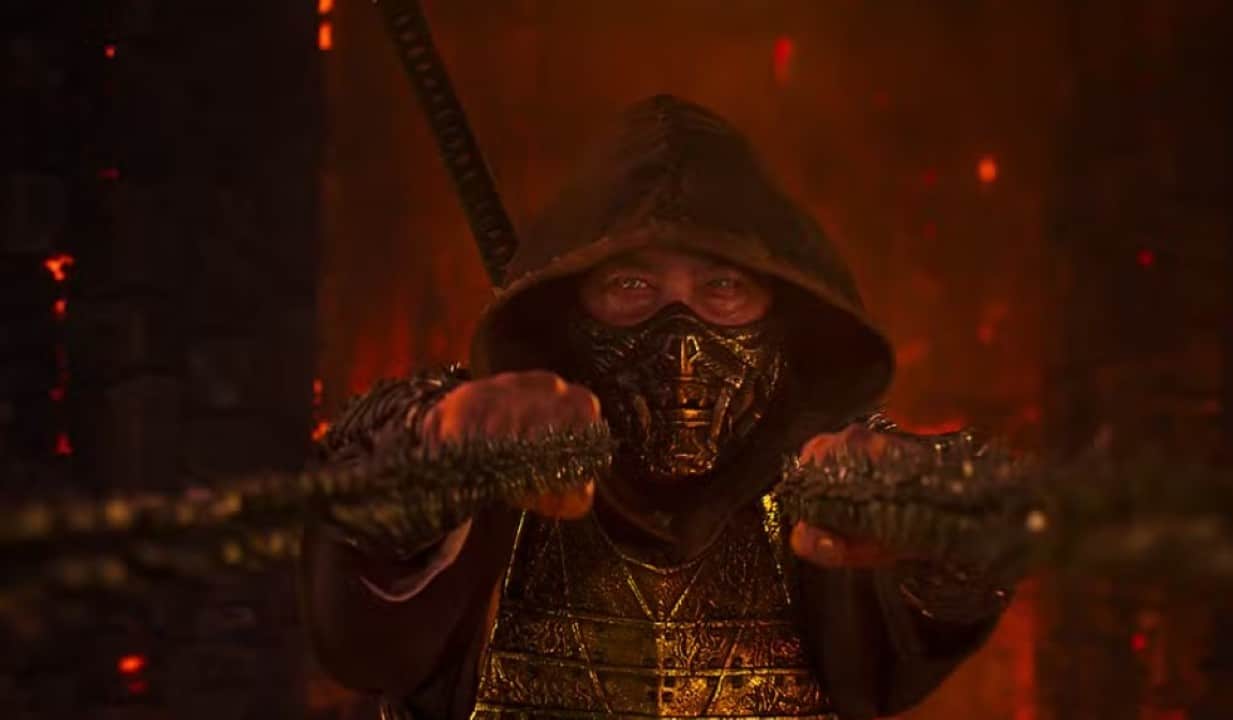
Scorpion’s interpretation, in turn, gained much greater dramatic depth in the *reboots*. Nos classic films, the character Hanzo Hasashi essentially functioned as a warrior subordinate to Shang Tsung, with a more secondary role in the main plot. Já in the new versions, his story of revenge and the family tragedy that affected him were widely explored, bringing the character closer to the more developed versions of the games. Hiroyuki Sanada’s performance was praised as one of the highlights of the new adaptation.
Impacto on the narrative and fighters’ powers
The concept of death and its consequences is another point of substantial divergence between the two cinematic eras. Nos classic films, death had a permanence character. One of the most notable examples of this approach occurred in *Mortal Kombat: A Aniquilação*, where Shao Kahn eliminates Johnny Cage right at the beginning of the plot, solidifying the fatality of the event.
In the new timeline, however, characters frequently return, following a logic more in line with the games, which are widely known for their multiple timelines, alternative realities and recurring resurrections. Kano, for example, reappears after his apparent death in the 2021 film. Da similarly, Kung Lao also returns later in a different form, amplifying the presence of supernatural elements and the fluidity of life and death in the narrative.
The fighters’ powers were significantly reworked, introducing a new concept into the cinematic universe. Enquanto the old films kept the Terra fighters relatively close to physical reality, with skills that were anchored more in athletic and combat capabilities, the *reboots* introduced the “Arcana”. Esta is a kind of hidden power that serves as a catalyst to awaken special abilities in combatants, giving them superhuman capabilities. The change completely transformed characters like Jax, who began to evolve his metallic arms through this new power system.
Os Deuses Anciões (Elder Gods) had a reduced prominence in more recent films compared to productions from the 90s. In *Mortal Kombat: Aniquilação*, they appear actively, intervening directly during the decisive confrontation between Liu Kang and Shao Kahn, influencing the outcome of the battle. In the new franchise, however, these entities are only mentioned by the characters. Shang Tsung, for example, makes the statement to Mileena: “Leave Deuses Anciões to me”, indicating that they are figures of power, but not visible. Até At the moment, the new films have not yet visually shown these divine entities, keeping them as hidden forces or in the background.
Redefinição of villains and the increase in violence
The interpretation of Cary-Hiroyuki Tagawa in *Mortal Kombat* (1995) immortalized Shang Tsung as one of the most memorable villains in video game adaptations, setting a standard. In the classic version, the sorcerer combined elegance, mastery in martial arts and constant physical intimidation, using his presence to dominate his opponents and the plot.
Já the Shang Tsung played by Chin Han in the current films adopts a strategy more focused on manipulation, arcane magic and stratagems, reducing the emphasis on hand-to-hand combat. Essa’s approach positions him as a more cerebral and cunning enemy, who orchestrates events behind the scenes rather than directly engaging in physical fights like his 1995 counterpart.
The biggest change between the film versions is perhaps the level of explicit violence. Films from the 90s were rated PG-13, which imposed significant limitations on the level of graphic brutality that could be displayed on screen, resulting in more restrained and suggestive combat scenes.
On the other hand, the *reboots* adopted an age rating of +18, which made it possible to reproduce the famous *fatalities* directly inspired by the games, without censorship. Entre’s most talked about and shocking scenes are the moment in which Kung Lao cuts Nitara in half using his spinning hat, in addition to several other graphic and viscerally detailed executions presented throughout the films. Essa’s new approach aligns the adaptation with the original identity of the franchise in video games, which is notoriously known for its extremely violent and bloody combat.
Principais points of distinction between productions
The comparative analysis between the two cinematic eras of *Mortal Kombat* highlights a series of fundamental differences that shape the viewer’s experience. Essas modifications range from character development to the graphic intensity of battles, directly influencing the narrative and fan reception.
- Goro lost his unbeatable threat status, being defeated by Cole Young in the 2021 *reboot*.
- Death is no longer definitive, with characters like Kano and Kung Lao returning in the new versions.
- Cole Young was introduced as the protagonist in the *reboot*, changing the narrative focus previously centered on Liu Kang.
- Reptile had a new visual interpretation, remaining as a monstrous creature in 2021, different from the humanoid form of 1995.
- The fighters’ powers have been revamped with the introduction of “Arcana”, which awakens special abilities.
- Os Deuses Anciões had less visual prominence in recent films, being only mentioned.
- Shang Tsung changed his profile, from martial arts master to strategist and manipulator.
- Liu Kang and Shao Kahn had different endings, with Liu Kang’s confrontation in the *reboot* being less conclusive.
- Scorpion received more dramatic depth, with his revenge story gaining greater relevance.
- The *fatalities* became much more violent and graphic in the *reboots*, rated +18, compared to the PG-13 of the 90s.