

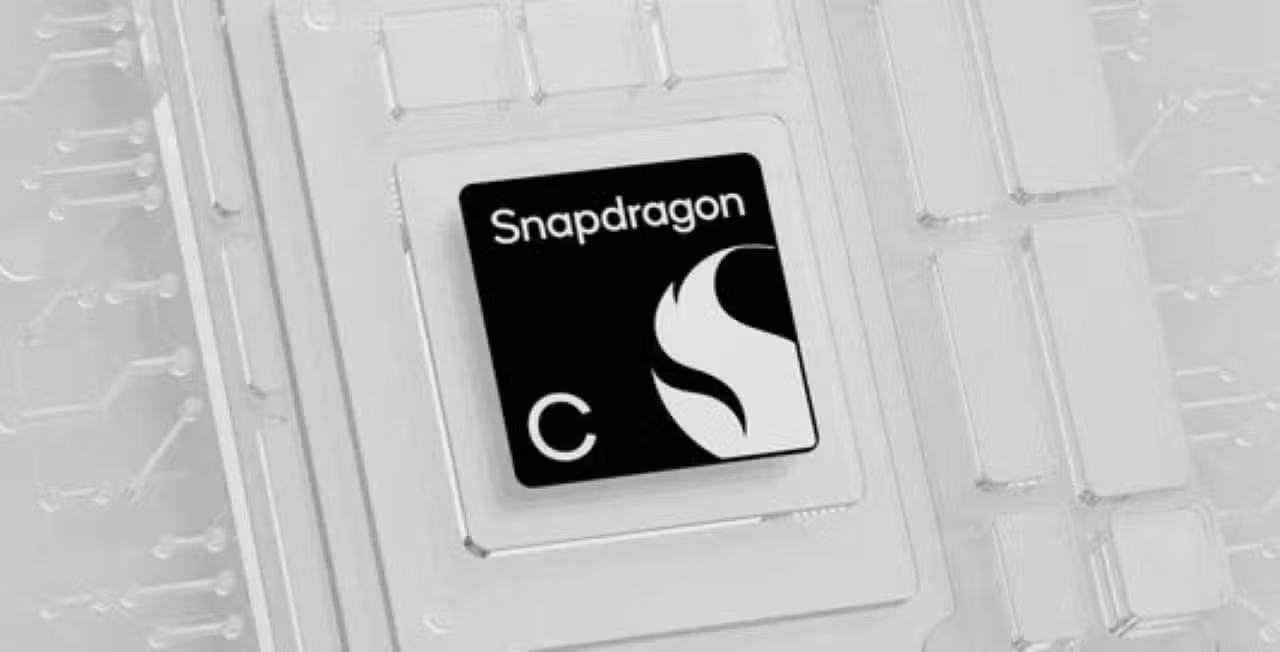
Qualcomm revealed the Snapdragon C at Computex 2026, a new bet for affordable ARM notebooks. Este chip was developed with the aim of popularizing devices costing around US$300 (equivalent to R$1,518.00), prioritizing mobility and high energy efficiency. The launch represents a strategic move to challenge the traditional market, dominated by more expensive laptops with x86 architectures.
The initiative comes in a scenario where the industry is intensely searching for efficient and low-power alternatives, inspired by the notable success of the Apple Silicon chips. Embora Although the main announcement of Qualcomm was made from the perspective of the Windows ecosystem, Snapdragon C also generated great expectations in the Linux and Open Source community. Desenvolvedores, students, and Linux users have long wanted affordable, robust ARM machines for programming, browsing, and everyday use.
Snapdragon C and Qualcomm’s new strategy
The Snapdragon C represents Qualcomm’s latest foray into the entry-level computing segment. Diferentemente from the premium Snapdragon
Segundo the official positioning presented during Computex 2026, the chip has been optimized to offer a satisfactory experience in various applications. Sua architecture is ideal for common activities that many users perform on a daily basis. The strategy is to create an ARM alternative that is efficient and economical, aiming to replace entry-level laptops that still use older processors from Intel and AMD.
- Snapdragon C capabilities include:
- Navegação fluid web
- Streaming video without interruptions
- Office Applications Uso
- Ferramentas educational
- Recursos basic artificial intelligence
- Trabalho in the cloud
Este launch comes at a crucial time for the technology market. The industry has struggled to respond to the success of the Apple, which demonstrated the ability of ARM devices to deliver excellent battery life without compromising performance on common tasks. Fabricantes also seek to reduce production costs, given the constant pressure on the global semiconductor chain. A simpler, more cost-effective and efficient chip such as the Snapdragon C could prove extremely attractive to original equipment manufacturers (OEMs).
Arquitetura mobile and benefits without Oryon cores
One of the most significant details about the Snapdragon C is the absence of Oryon cores, which are a hallmark of Qualcomm’s premium chips. Isso suggests that the company has adopted a strategy based on architectures derived from its traditional mobile chips. Reusing more economical designs reduces manufacturing costs and simplifies energy consumption, making the chip more affordable.
In practice, this indicates that the new processor probably looks more like an evolved smartphone SoC (System-on-a-Chip) than a premium chip aimed at intensive productivity. Contudo, this characteristic does not necessarily represent a problem. Apple itself has shown interest in exploring similar concepts, with recent rumors pointing to a possible MacBook Neo based on adapted versions of the A18 Pro, focused exactly on reduced cost and high energy efficiency.
Para the end consumer, the consequences of this approach can be quite positive. Menos heating, quieter operation, longer battery life and less need for active cooling are some of the expected benefits. Additionally, the Além architecture allows for the creation of lighter and more compact devices. Todos these factors make a considerable difference for Linux users who use notebooks when traveling, studying or for remote development.
Acer Aspire Go 15: The first with Snapdragon C
The first officially announced device to incorporate the new Snapdragon C was the Acer Aspire Go 15. Este notebook is clearly aimed at the entry-level segment, aiming to offer an affordable option to consumers.
- Technical specifications released during Computex 2026 include:
- 15.6-inch Tela
- Até 8GB RAM
- Internal Armazenamento up to 512GB
- Conectividade Wi-Fi 6E
- Portas USB-C
- Construção focused on energy efficiency
Mesmo is not a premium notebook, the set of features of the Acer Aspire Go 15 draws attention due to the balance between price and features offered. Historicamente, many budget laptops often sacrificed build quality, battery life, or storage capacity. The Qualcomm movement can transform this scenario, by delivering a modern and more efficient ARM platform for this segment.
Outro A relevant point is the tendency of notebooks with ARM architecture to have excellent standby time and almost instantaneous resumption. Essas are features that users already accustomed to smartphones and tablets consider essential. Para For those using lightweight distributions of Linux, such as Fedora, Ubuntu ARM, Debian ARM, Arch Linux ARM or even minimalist projects focused on productivity, the potential of Aspire Go 15 is very promising.
Relevância from Snapdragon C to the Linux ecosystem
The launch of Snapdragon C may have even greater relevance for the Linux ecosystem than for Windows. Isso occurs because the Open Source scenario has already demonstrated significant advances in supporting ARM platforms in recent years. Atualmente, Linux already operates successfully on a wide range of devices, including Raspberry Pi, ARM servers, Chromebooks, mobile devices, Apple Silicon notebooks and Qualcomm’s own development boards.
The main obstacle to the popularization of Linux on ARM machines has always been the lack of affordable and widely available ARM laptops on the market. If the Qualcomm is successful in making ARM notebooks priced under $300 popular, the Linux could gain a new generation of extremely affordable machines. Esses devices would be ideal for study, programming and everyday use, expanding the platform’s user and developer base.
Desafios support on Kernel Linux and collaboration
Qualcomm has a mixed track record when it comes to supporting Open Source and the community. Apesar’s support for Kernel Linux has evolved considerably in recent years, especially with efforts focused on Snapdragon vs. Elite, there are still some major hurdles.
- Entre the technical challenges that may arise are:
- Drivers graphics
- Gerenciamento power
- Firmware owner
- Funcionalidades Suspend and Resume
- Aceleração video
- Compatibilidade from Wi-Fi and Audio
The good news is that the Linux community has already demonstrated enormous adaptability and engagement with recent ARM chips. Important Projetos, such as Mesa, LLVM, Qualcomm Adreno DRM, Linux ARM, UEFI EDK2, and the mainline Linux, have been working to make support increasingly mature and comprehensive. If Qualcomm collaborates minimally, providing documentation and integrating more actively with the upstream community, there is a real chance these notebooks will turn into excellent low-cost Linux machines.
Nova category of cheap Linux notebooks on the market
Durante For many years, Linux users have had to choose between high-cost notebooks or models with extremely limited quality. The Snapdragon C has the potential to change this balance, ushering in a mid-tier category in the market.
Estes new devices promise to be cheap, silent, efficient notebooks with good battery life and, potentially, ideal for running Linux distributions. Essa feature is particularly relevant for students, beginner programmers, cloud computing users and professionals who rely more on the browser and terminal than on heavy and demanding software.
Além Furthermore, the continued growth of browser-based computing favors modern ARM devices. Ferramentas like VS Code Web, GitHub Codespaces, Docker remote, SSH and diverse cloud environments dramatically reduce the need for extremely powerful hardware to perform many professional and educational tasks.
The announcement of the Snapdragon C underscores Qualcomm’s intention to aggressively expand its presence in the affordable ARM laptop market. The company seeks to replicate the energy efficiency experience that allowed Apple to redefine the notebook industry. Para the Linux universe, this initiative could represent the arrival of a new generation of cheap, modern and efficient computers, capable of running Linux distributions with excellent autonomy. Contudo, success will depend on hardware support and Qualcomm’s level of openness with the Open Source community.