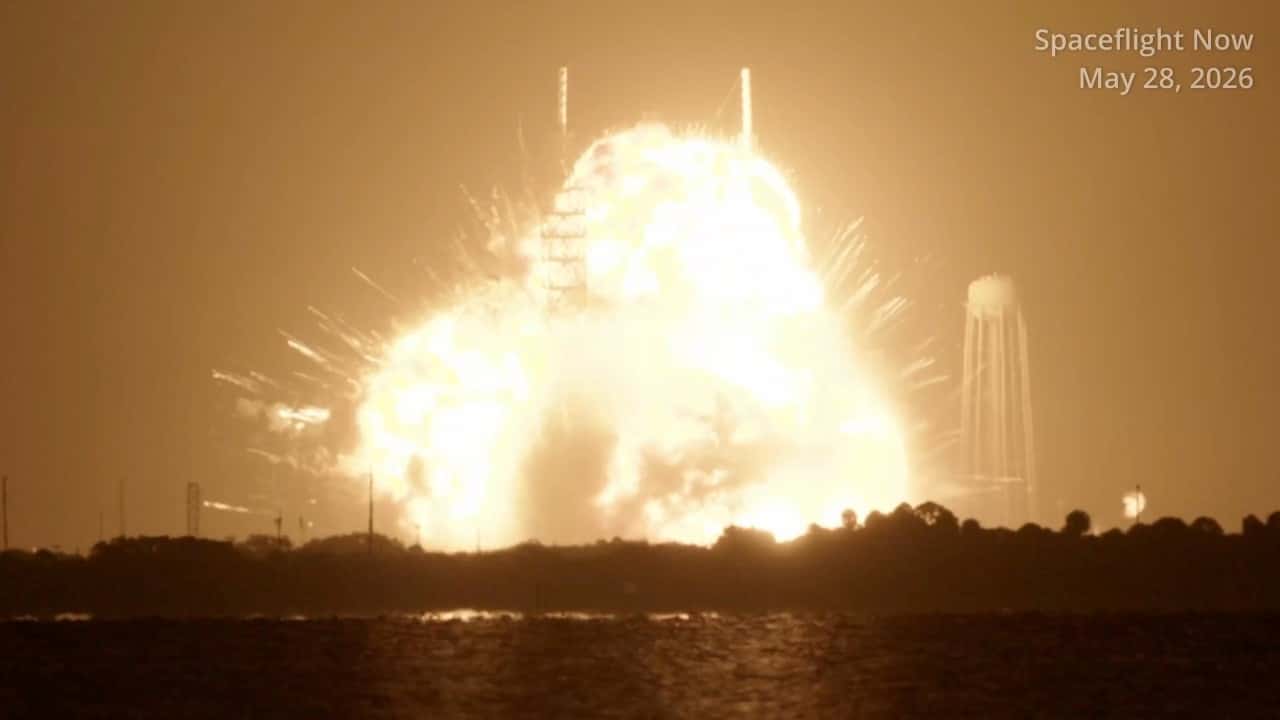
An New Glenn launch vehicle from Blue Origin suffered a complete detonation during a ground ignition test procedure. The event took place at night on platform 36, located at the Cabo Canaveral Space Force Station facilities, in the state of Flórida. The aerospace company confirmed the loss of the equipment and classified the episode as an operational anomaly on its official communication channels.
The static drive involved the engines of the first stage of the 98-meter-high equipment. The unexpected combustion generated a visible flash in several areas of the North American coast, accompanied by physical tremors reported by residents of regions neighboring the complex. Equipes military base emergency personnel cordoned off the perimeter immediately after the failure. The management of Space Force confirmed the absence of victims or injuries among the employees and soldiers present at the scene.
Impacto structural at launch facility
The force of the shock wave resulted in the complete destruction of the lower portion of the space vehicle. Partes metal and propulsion components were scattered throughout the platform’s containment area. A large lightning rod tower, designed to protect the complex against severe lightning strikes, gave way and toppled onto the concrete structure after the detonation.
Engenheiros of Blue Origin began the process of assessing damage to ground support infrastructure. Rehabilitation of the site will require the replacement of supply pipes, acoustic cooling systems and telemetry cables melted by the extreme heat generated by burning propellant. Especialistas of the aerospace sector projects that launch pad repairs could require months of continuous work before release for new fueling operations.
Investigadores of Federal Aviation Administration took over supervision of the analysis of telemetry data collected in the milliseconds before the mechanical failure. The federal regulatory body requires the completion of a detailed technical investigation to authorize the resumption of the company’s flight schedule in the region. The collection of fragments at the scene of the incident makes up the first phase of the government audit.
Características technical equipment destroyed
The affected model represents the company’s main bet for the market for transporting heavy loads to Earth orbit. The project incorporates advanced reuse concepts to reduce the logistical costs of missions. The vehicle seeks to compete directly with the Falcon Heavy and Starship systems, operated by SpaceX in the same market segment.
The propulsion system architecture relies on specific combustion technologies developed over the last decade. The rocket’s mechanical arrangement has the following main configurations:
- The first stage uses seven BE-4 engines manufactured internally by the company.
- The system consumes a mixture of liquid methane and liquid oxygen as the main propellant.
- The second stage operates with the BE-3 engine variant optimized for space vacuum maneuvering.
- The payload capacity meets demands for low orbits and transfers to geostationary routes.
The adoption of methane as a fuel reflects a consolidated trend in modern aerospace engineering. The substance offers a cleaner burn compared to traditional jet fuel. Essa technical feature facilitates cleaning and maintenance of the propellants after the stage returns to the Earth’s surface, accelerating the preparation process for the next flight.
Consequências for trade mission schedule
The loss of hardware directly affects planning for the mission designated as NG-4. The flight’s main objective was to transport a batch of communications equipment to the Project Kuiper constellation. The initiative, funded by Amazon, envisages the installation of thousands of satellites to provide broadband internet on a global scale in the coming years.
The company’s Representantes confirmed that Amazon’s satellites were not attached to the top of the rocket at the time of the ignition test. The practice of performing static triggering without the payload represents a standard industry safety protocol. The measure is adopted precisely to avoid additional financial losses in the event of catastrophic failures on the launch platform.
The company’s founder, Jeff Bezos, spoke about what happened and reiterated the teams’ focus on identifying the root cause of the structural problem. The company has previous experience with the New Shepard suborbital model, used in space tourism missions. The development of an orbital-class vehicle, however, poses significantly greater thermodynamic and aerodynamic challenges to the engineering team.
Repercussão in the government and private market
Nasa follows developments in the ongoing technical investigation at Flórida. The North American space agency selected the heavy launch vehicle as one of the commercial options for sending supplies and logistics modules. The missions are part of the scope of the Artemis program, which aims to sustainably explore the lunar surface and build permanent infrastructure on the natural satellite.
The global space transportation market is registering a significant increase in demand for launch windows. Operadores’s Terra observation satellites, telecommunications companies and military defense agencies depend on the reliability of the vehicles to fulfill contracts with strict deadlines. The temporary stoppage of Blue Origin’s activities may force customers to seek alternatives from competing suppliers to maintain their network deployment schedule.
Incidentes during the ground engine testing phase are part of the development cycle of new aerospace systems. Performance validation in extreme conditions allows engineers to identify structural vulnerabilities before performing real flights. The procedure minimizes operational risks for future manned and unmanned missions.
The North American aerospace industry maintains strict contingency protocols to deal with high-energy anomalies. The preventive isolation of the test areas on the Cabo Canaveral guarantees the physical integrity of the ground teams. Redes de sensores de alta precisão capturam os dados necessários para o aprimoramento contínuo da engenharia de foguetes, transformando falhas de hardware em parâmetros vitais para a segurança dos próximos projetos.