Valued at US$9.5 billion, Real Madrid surpasses rivals and leads Forbes ranking in 2026
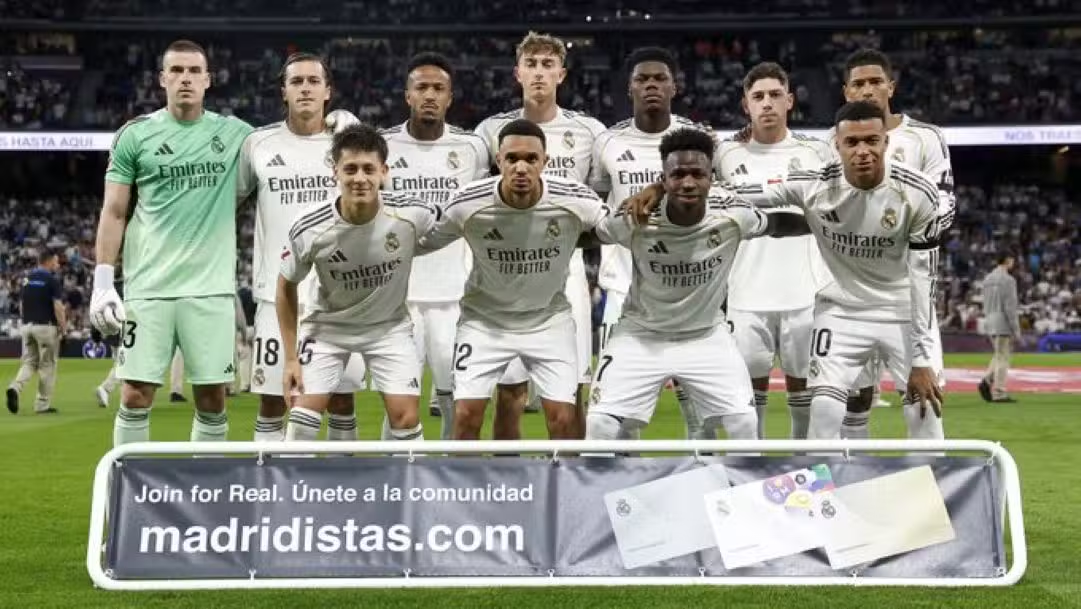
Forbes magazine released the annual survey of the most valuable sports institutions on the planet in 2026. Real Madrid maintained its first place alone. The Spanish team registered assets estimated at US$9.5 billion, which represents approximately R$47.8 billion in current currency conversion. The club secures the top of the financial market for the fifth consecutive year.
The international calculation considers the business value of each association, adding net equity and structured debts. Barcelona appears in second place overall with a valuation of US$7.5 billion. Manchester United completes the global podium with US$7.2 billion. Economic analysts base projections on television broadcast contracts, sponsorship deals and historical business transactions. Financial performance guarantees stability for operations.
Spanish Domínio contrasts with the collective strength of the English championship
Embora the absolute leadership belongs to a representative of Espanha, Premier League displays the greatest joint economic power today. The Inglaterra championship has 11 teams among the 30 richest in global mapping. The massive volume of revenue generated by international image rights explains British hegemony. English clubs also enter into aggressive commercial contracts with global brands.
Liverpool emerges as the main pursuer of the elite trio after reaching the US$6.2 billion mark. Paris Saint-Germain appears as the only França institution in the research. The team ranks fifth with US$5.8 billion. Bayern’s Munique represents the strength of Alemanha in sixth place with $5.7 billion. Manchester City appears close behind with a price of US$5.5 billion. Arsenal also surpasses the five billion barrier.
The ability to attract foreign investors transforms Inglaterra teams into global corporations. The modernization of stadiums and the expansion of brands in Asian and North American markets boost annual revenue. The British league’s television quota distribution model allows even medium-sized teams to accumulate fortunes. The scenario creates a financial barrier that is difficult for competitions from other countries to overcome.
Crescimento from the North American league surprises the financial market
The economic advancement of MLS represents the main change in the dynamics of contemporary football. The Estados Unidos professional league took second place in the number of representatives in the millionaire ranking. The North American tournament allocated seven franchises among the 30 most valuable in the world in 2026. The performance surpasses traditional competitions from the European continent, such as Série A from Itália and Bundesliga from Alemanha.
Inter Miami leads the Américas block with a valuation set at US$1.35 billion. The Flórida team surpasses Europa’s historical opponents in financial monitoring. LAFC comes next with a market value of US$1.32 billion. The construction of modern arenas and the hiring of internationally renowned athletes accelerate the appreciation of brands in Estados Unidos. The LA Galaxy and New York City FC also surpass the billion dollar mark.
The franchise format adopted in Estados Unidos protects investors against the risk of downgrade. The stability of the business model attracts investment funds and billionaires from the technology sector. Holding international tournaments on American soil increases the visibility of local teams. The continuous growth in box office revenue strengthens the cash flow of sports institutions.



Lista complete details heritage of thirty sporting powers
The Forbes survey exposes the disparity in resources between the main players in the sports industry. The numbers serve as a basis for negotiating mergers, acquisitions and fundraising in the financial market. Asset valuation dictates the pace of player transfers in market windows.
- Real Madrid: $9.5 billion
- Barcelona: $7.5 billion
- Manchester United: $7.2 billion
- Liverpool: $6.2 billion
- Paris Saint-Germain: $5.8 billion
- Bayern of Munique: $5.7 billion
- Manchester City: $5.5 billion
- Arsenal: $5.4 billion
- Chelsea: $4.2 billion
- Tottenham: $3 billion
- Atlético of Madrid: $2.95 billion
- Juventus: $2.4 billion
- Borussia Dortmund: $2.2 billion
- Milan: $1.85 billion
- Inter of Milão: $1.8 billion
- Aston Villa: $1.4 billion
- Inter Miami: $1.35 billion
- LAFC: $1.32 billion
- Newcastle United: $1.25 billion
- LA Galaxy: $1.08 billion
- New York City FC: $1.02 billion
- Atlanta United FC: $1 billion
- Benfica: $960 million
- Roma: $940 million
- Everton: $930 million
- Fulham: $920 million
- Brighton: $910 million
- Stuttgart: $880 million
- Seattle Sounders: $860 million
- Austin FC: $855 million
The presence of Italian and Portuguese teams demonstrates the resistance of traditional markets. Juventus leads Itália’s block with $2.4 billion, followed by Milan with $1.85 billion and Milão’s Inter with $1.8 billion. Roma completes the country’s list with US$940 million. Benfica represents Portugal in twenty-third place with $960 million. The Lisboa club sustains its operations through the sale of talent trained in the youth categories.
Capital Concentração restricts investments to specific hubs
The geographic distribution of the most valuable brands highlights the centralization of money in a few regions. Apenas seven national competitions managed to position their affiliates in the 2026 global ranking. The financial gulf makes it difficult for teams operating outside these commercial centers to be competitive. The scenario requires peripheral teams to adopt alternative survival strategies.
The exact division of associations by national federation illustrates the dominance of specific and consolidated markets:
- Premier League (Inglaterra): 11 clubs
- MLS (Estados Unidos): 7 clubs
- Série A (Itália): 4 clubs
- Bundesliga (Alemanha): 3 clubs
- La Liga (Espanha): 3 clubs
- Ligue 1 (França): 1 club
- Primeira Liga (Portugal): 1 club
The modern football ecosystem requires rigorous corporate management to maintain financial status. Boards need to balance sporting success with fiscal responsibility. Dependence on television revenue forces leagues to look for new transmission formats via streaming. Fans’ digital engagement becomes a fundamental metric for attracting new sponsors. The professionalization of marketing departments dictates the pace of institutional growth in high-performance sport.
Veja Tambem em Latest News (EN)

Clash of dates between Formula 1 and the World Cup makes Kimi Antonelli declare support for Brazil

Mauricio Pochettino opens talks with Milan to take over team after Massimiliano Allegri’s dismissal

Striker João Pedro guarantees that Cole Palmer would take over the number ten shirt for the Brazilian team

FIA decision prohibits activating the system in straight mode for cars on the Monaco circuit

Napoli agrees to sign Massimiliano Allegri with a two-year contract and millionaire salary

Champions League final pits Paris Saint-Germain and Arsenal in Budapest

Young Kimi Antonelli dominates Formula 1 season and father details inspiration in Ayrton Senna

Barcelona invests R$467 million in Anthony Gordon and negotiates with Julián Álvarez for the attack

Goalkeeper Marc ter Stegen negotiates departure from FC Barcelona after losing space in the main squad

Arsène Wenger points out Arsenal’s favoritism against Paris Saint-Germain in the Champions League final

Auckland FC goalkeeper cancels wedding after New Zealand’s World Cup call-up