Fire on Amtrak maintenance train at Penn Station injures five people and halts travel
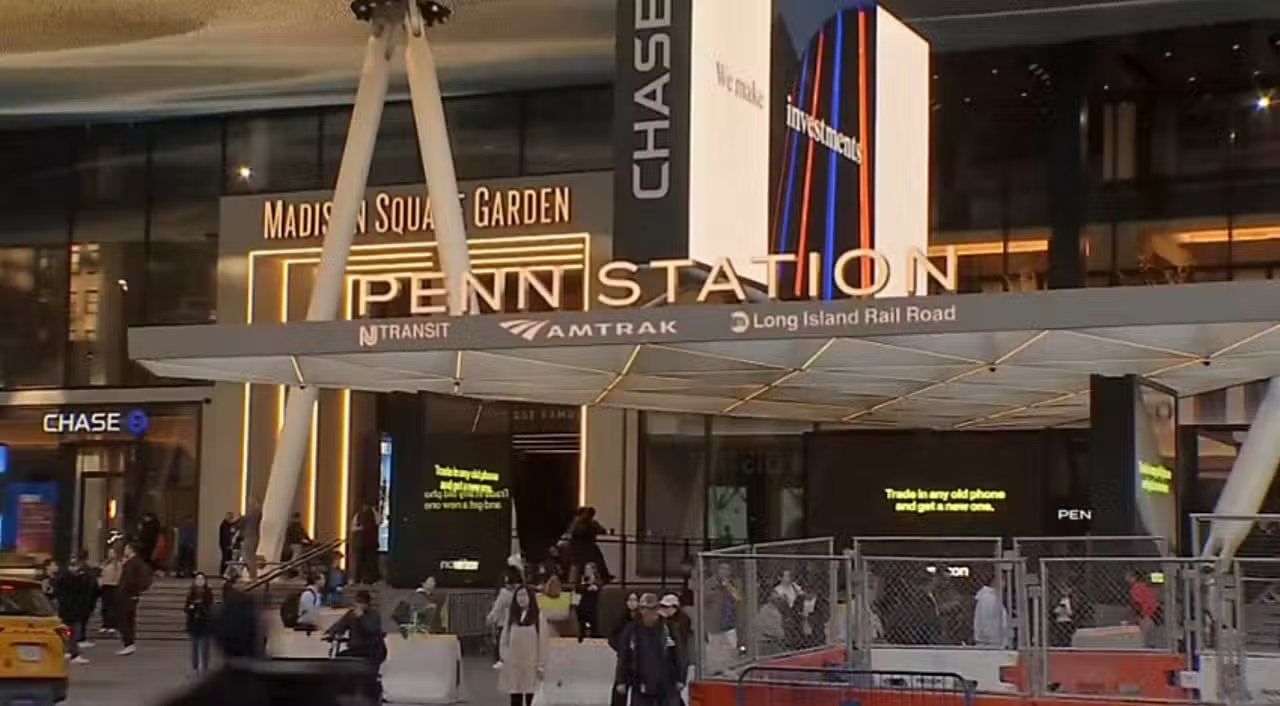
A fire on a maintenance train of Amtrak at Penn Station left five people injured on the morning of this Friday, May 29, 2026. The incident occurred on line 11 of the station located at Manhattan, Nova York. Duas victims suffered serious injuries from smoke inhalation. Rescue Equipes transported the injured to area hospitals as a matter of urgency. Outras three people received medical care at the scene and refused to be taken to hospital. The incident caused severe disruptions to the public transport system during the morning rush hour.
The volume of passengers at the station at the time of the incident required a quick response from security authorities. Dense smoke filled Penn Station’s underground platforms in a matter of minutes. Passageiros who were waiting for trains had to evacuate the terminal under the guidance of traffic agents. Station management activated standard security protocols to isolate the perimeter. The immediate blocking of access prevented a greater number of civilian casualties in the railway complex.
Fogo hits service vehicle in river tunnel Hudson
Departamento of Bombeiros of Nova York (FDNY) received the first emergency call just after 1:30 am. The flames started in an Amtrak service vehicle. The equipment operated inside the tunnel that crosses the Hudson river. The exact location of the fire source made initial access difficult for vehicles and tactical intervention teams.
The firefighting operation required specific strategies due to the confined environment and the depth of the location. Firefighters needed to ensure the structural integrity of the tunnel before moving forward with high-pressure hoses. Ventilating the underground space presented the biggest technical hurdle for FDNY crews. Profissionais used autonomous breathing equipment with long-lasting oxygen cylinders throughout the intervention.
Full control of the flames took several hours of continuous work. The burning of industrial materials present in the maintenance train generated toxic gases that took time to dissipate. Técnicos of Amtrak followed the operation closely to guide the safe shutdown of the high voltage power grid. The preventive measure prevented secondary explosions in the catenary system that feeds passenger trains.
Impacto directly on Nova York transport lines
The incident caused a ripple effect on urban mobility throughout the metropolitan region. Três of the main rail transport operators have suspended or drastically changed their services. The shutdown has affected hundreds of thousands of workers who rely on trains to get to offices in Manhattan at the start of their shift.
Operational changes implemented by the agencies included:
- Amtrak:The company has temporarily suspended all travel to the south of Penn Station. The disruption blocked train traffic in the area affected by the smoke and allowed rescue teams to work safely.
- Long Island Rail Road (LIRR):The operator recorded extensive delays and mass cancellations across its schedule. Traffic coordination diverted several trains to Grand Central Terminal and Atlantic Terminal.
- NJ Transit:The service between New York Penn Station and Newark Penn Station was completely stopped for an indefinite period of time. The fire damaged overhead cables essential for the locomotives’ electrical supply.
The outage of NJ Transit resulted in the highest volume of passengers stranded on outer platforms. The railway acts as the main connecting artery between the state of Nova Jersey and the city of Nova York. The company’s Engenheiros works to assess the damage and replace wiring melted by the extreme heat generated by the fire.



Rotas alternatives and integrated ticket acceptance
Transport agencies have implemented robust contingency plans to handle the backlog of passengers. NJ Transit diverted trains from the Midtown Direct line to the Hoboken station. The logistical maneuver allowed users to reach a safe connection point outside the exclusion zone established by firefighters.
A system of mutual ticket acceptance came into effect immediately after structural damage was confirmed. Bilhetes and NJ Transit passes are now accepted on buses from private companies operating in the region. The PATH system also provided free access for these passengers at the turnstiles at the Newark, Hoboken stations and on 33rd Street at Manhattan.
Emergency integration reduced overcrowding at neighboring bus terminals. Transit Fiscais guided the public on transfer routes on sidewalks and station entrances. The joint operation between different government agencies minimized the total collapse of the metropolitan transport system during the morning.
Orientações for passengers during the stoppage
Amtrak has issued official statements requesting that customers avoid the Penn Station region until further notice. The company recommends rescheduling non-essential trips scheduled for this Friday. Digital service channels offer ticket exchanges or full refunds without charging additional fees to consumers.
The LIRR has advised its users to monitor the TrainTime app before leaving home. The platform provides real-time updates on the exact location of trains and platform release status. The digital tool has become essential to avoid new crowds in already crowded waiting halls.
The engineering teams have not established a definitive deadline for the complete normalization of the affected railways. Repairs to the tunnel’s electrical infrastructure require rigorous technical precision and load testing. Transport authorities promise to release the lines gradually, only when safety reports confirm the absolute stability of the high voltage network.
Veja Tambem em Latest News (EN)

Italian Supreme Court confirms legality of hotel that offered only mineral water to customer

National Geographic Traveler Announces Travel Photography Contest Winners

Ferrari presents Luce, the first electric car, and receives harsh criticism from fans and the market

Yuki Yamada posts photo with beard and grimace on Instagram and surprises fans

Costco sees record demand at U.S. gas stations with lower prices

Passenger tries to enter cockpit and forces diversion of United Airlines flight to Madison
Astronomer explains white light recorded after meteor falls near volcano in Philippines

Comedian Sakamoto-chan reveals type 2 diabetes remission after lifestyle changes

Avi Loeb says discovery of alien intelligence can unite humanity amid global crises

Police investigate death of Hilde Ann Lynn Helphenstein in room at Rosewood São Paulo

Avi Loeb suggests that dark comet 1998 KY26 could be Soviet probe Phobos 1