

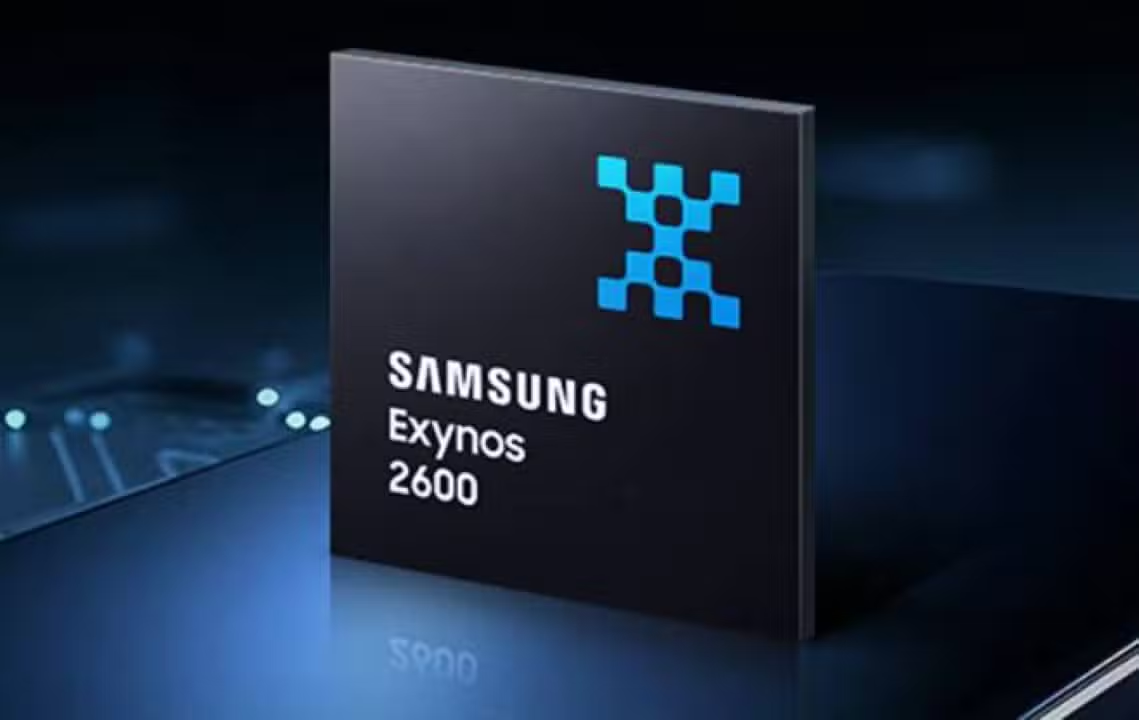
Samsung’s new Exynos 2600 chipset has achieved a historic milestone in the company’s semiconductor division. In recent stress tests aimed at evaluating sustained performance under extreme loads, the component outperformed the Snapdragon 8 Elite Gen 5 and Qualcomm. The feat gains impressive contours due to the direct confrontation scenario, with the rival chip under cryogenic liquid nitrogen refrigeration. The Samsung solution utilized only a passive silicon-integrated approach, demonstrating remarkable efficiency.
Esta’s turnaround in the performance dispute was revealed in practical tests conducted by the Geekerwan channel, with technical data quickly shared internationally by the Wccftech portal. The person directly responsible for this significant competitive advantage of the South Korean goes by the name of Heat Pass Block (HPB), an unprecedented and revolutionary thermal architecture. Ele was specifically developed to solve the chronic heat dissipation problem that has plagued the performance of mobile processors for years. HPB represents a substantial evolution compared to conventional approaches in the semiconductor industry, optimizing heat transfer much more efficiently.
Detalhes of the Heat Pass Block (HPB) architecture

The Heat Pass Block introduces a copper heatsink directly coupled onto the silicon die, a fundamental innovation in chip design. Essa dedicated thermal layer is integrated into the chip structure itself to accelerate heat transfer much more efficiently, going beyond conventional approaches. Diferente of traditional industry solutions, which rely on thermal paste and external vapor chambers to manage heat, HPB acts intrinsically, directly at the source of heating. Essa’s proactive and integrated approach makes a significant difference in thermal dissipation, offering a more robust solution to the overheating problem in mobile devices.
Essa engineering solves one of the biggest shortcomings of the current industry standard, known as Package-on-Package (PoP). In PoP, DRAM memory is stacked directly on top of the processor to save internal space, a common practice in the industry. However, the side effect of this configuration is the mutual overheating of the components, generating the phenomenon of early thermal throttling, which degrades performance. Isso severely limits the devices’ ability to perform sustainably under heavy loads. The Samsung’s HPB effectively bypasses this physical barrier, eliminating the need for direct stacking and allowing the CPU and DRAM to operate in more favorable thermal conditions. Essa architectural optimization is crucial to maintaining performance stability under intense workloads for prolonged periods. In short, the HPB approach offers a more robust and efficient solution for thermal management of mobile chips.
Comparativo performance and testing methodology
The practical results of the thermal efficiency of the Exynos 2600 are already reflected in synthetic evaluation platforms, confirming the robustness of the new architecture. In tests conducted by the renowned channel Geekerwan, and later reported internationally by the Wccftech portal, the Samsung chip demonstrated a superior capacity for sustaining operating frequencies. Mesmo under extreme liquid nitrogen cooling, the Snapdragon 8 Elite Gen 5 was unable to maintain its maximum frequencies on the main core for a long time. Já and Exynos 2600 maintained a stable and sustained clock rate, proving that raw external cooling is no substitute for a fundamentally efficient internal architecture. The sustained performance of the Exynos therefore highlights a significant advancement in mobile chip engineering.
- The Exynos 2600, on the other hand, maintained a stable and sustained clock rate, proving the superiority of its efficient internal architecture.
- No Geekbench 6, the Exynos 2600 topped in multithreaded tests, achieving 10,444 points.
- The Snapdragon 8 Elite Gen 5 recorded 10,207 points in the same test.
Exynos’s advantage is driven by Samsung’s native 10-core configuration combined with HPB’s ability to mitigate heat under prolonged stress. Contudo, Qualcomm still retains the lead in single-core, recording 3,588 points compared to 3,105 for the Samsung chip, indicating strengths in different performance domains.
Estratégia market and distribution of the Samsung chip
Apesar’s impressive performance, the Exynos 2600’s commercial landscape repeats a divisive Samsung market strategy already seen in previous chip generations. The new chip and its HPB technology will be restricted to the base versions of the Galaxy S26 and Galaxy S26 Plus. Esta distribution will be applied in selected markets, including Brasil, Europa, Coreia of Sul and Índia, following a pattern already known by the brand for regional differentiation.
The Galaxy S26 Ultra, the high-end model in the series, will continue to adopt the Snapdragon chipset globally, maintaining the tradition of using the Qualcomm solution in its flagship. As it is a slightly thinner model and does not have the same massive vapor chamber as the Ultra, the Galaxy S26 Plus may still show an increase in temperature on the display after consecutive hours of gaming, despite the improvements introduced by HPB.
The tests, however, point to a practical solution to this issue, which can be easily implemented by users. The use of a simple external ventilation accessory via a clip on the back of the device completely eliminates the problem. Esta alternative is considered much safer and more practical than the risks associated with handling liquid nitrogen in domestic environments, offering an affordable solution to optimize the user experience.
Repercussão in the sector and next steps in innovation
The success of Heat Pass Block has already begun to shape the competition’s future plans, indicating a paradigm shift in the global semiconductor industry. Esquemas leaks from Snapdragon 8 Elite Gen 6 Pro point out that Qualcomm plans to adopt a similar thermal solution in its first 2 nanometer chipset. Este movement is a tacit recognition of the effectiveness of the Samsung approach and the need for innovation in this field.
Outros major players in the global market, such as MediaTek and Apple, should also closely follow this trend, recognizing the importance of integrated thermal solutions. The expectation is that both will seek to integrate more efficient heat dissipation approaches directly into their future chip designs, aiming to improve the performance and stability of their own products. Essa change in the scenario indicates a validation of the Samsung strategy, which innovated with HPB. Enquanto rivals study the first generation of HPB implemented by Samsung to apply to their own products, the South Korean giant’s laboratories are already designing the Side-by-Side (SBS) architecture for the future Exynos 2700. Este advancement demonstrates Samsung’s intention to stay ahead in continuous innovation, ensuring sustainable technological leadership in a sector highly competitive and constantly evolving.
The goal of the new SBS design will be to position the CPU and DRAM memory sideways, expanding direct cooling for both components simultaneously. Essa strategy aims to break once and for all the temperature limitations that currently affect high-end smartphones. The promise is of a new era of sustained performance, where overheating will be an increasingly mitigated problem, directly benefiting consumers.