Scientists detect unprecedented signal in supernova explosion and review models of stellar physics
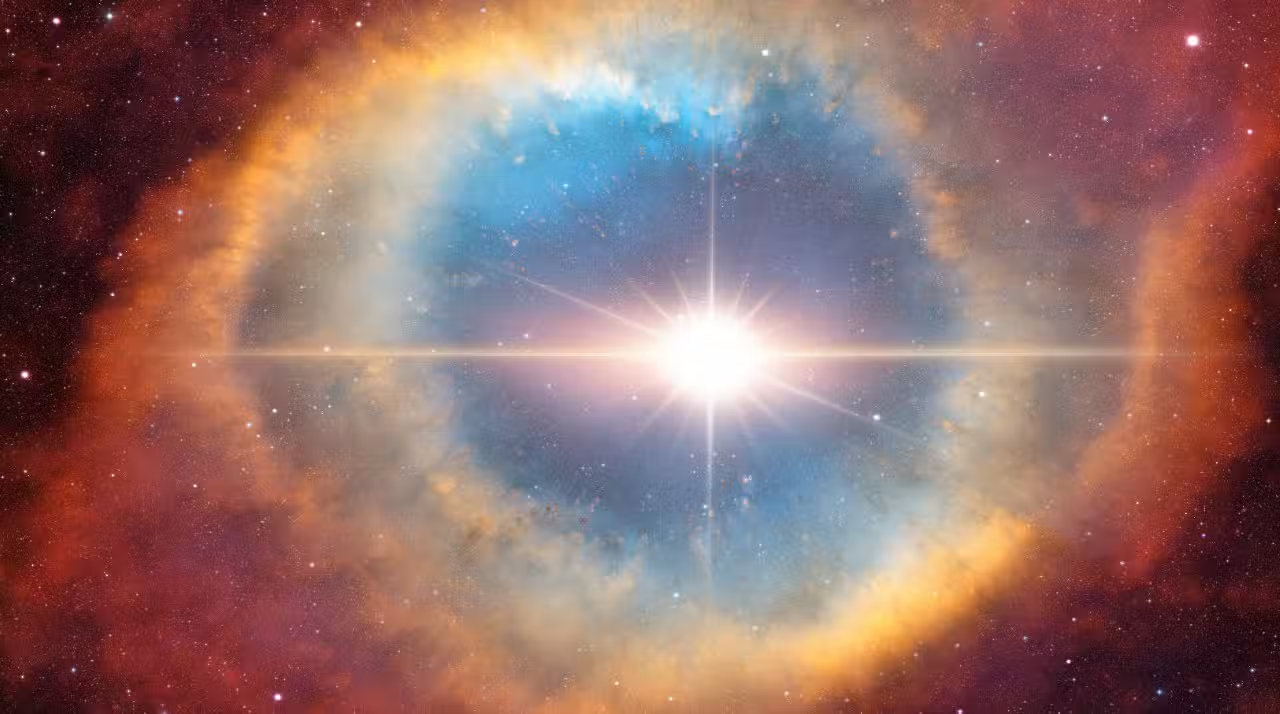
An international team of researchers has identified an unprecedented emission pattern, described as a “hiss”, originating from the explosion of a supernova located millions of light years from Terra. The anomalous signal was isolated from a vast astronomical database. Discovery requires the application of advanced processing techniques to confirm the authenticity of the record. The cosmic event provides direct data on the final stages of massive stars.
The detection of sound imperceptible to the human ear contradicts the predictions established by traditional astrophysics about the dynamics of stellar explosions. The phenomenon indicates the occurrence of complex physical processes during the collapse of the progenitor star’s core. Especialistas assess that the anomaly in signal frequency and duration may be associated with extreme instabilities. The finding opens a new field of investigation into the formation of heavy elements and the evolution of stellar remnants in the universe.
Sound Padrão challenges theoretical models of stellar collapse
The “hiss” analogy serves to illustrate a rapid and increasing variation in the frequency of the detected signal, a behavior similar to the sound emitted by an insect in nature. The atypical fluctuation manifests itself in gravitational waves and electromagnetic emissions captured by measuring instruments. Supernovas routinely release a wide range of signals during their burst phase. The specific pattern recorded now, however, finds no correspondence in the categories cataloged by modern science.
Current theoretical models describe the end of a massive star as a violent explosion that ejects matter into space and leaves a dense core as residue. The presence of the anomalous signal suggests that the matter transition involves unknown intermediate steps. Pesquisadores hypothesize that the collapse generates resonances of nuclear matter under extreme conditions of pressure and temperature. The revision of stellar evolution theories becomes necessary to accommodate the new physical variables observed in the event.
The study of the behavior of matter under intense gravity allows us to understand nucleosynthesis. The process is responsible for creating the heaviest chemical elements in the cosmos, many of which make up the structure of our planet. The dispersion of these materials occurs exactly during the explosive phase of supernovae. The newly discovered signal carries encrypted information about the exact mechanisms of mass ejection into the interstellar medium.
Rede global observatory validates anomaly in space
Confirming the event required the mobilization of a cutting-edge technological infrastructure distributed across different continents. The scientific team used an integrated network made up of radio telescopes and gravitational wave observatories, such as LIGO and Virgo. Data triangulation allowed the signal source to be characterized with millimeter precision. The multi-messenger approach ensures cross-validation of information collected in deep space.
The supernova’s host galaxy functions as an unreachable natural laboratory. The extreme energy and density conditions recorded at the site are impossible to replicate in terrestrial particle accelerators. Direct observation of the phenomenon offers a window into the study of the fundamental forces that govern the universe. The advancement of astronomical instrumentation in recent decades has made it possible to capture tenuous fluctuations in the fabric of space-time.
Collaboration between research institutions from different countries demonstrates the complexity of contemporary science. Processing terabytes of raw data demands massive computing power and trained algorithms to filter out cosmic noise. The global interconnection of financial and human resources accelerates the response time between detecting a transient event and publishing peer-validated results.



Formação of black holes and neutron stars in focus
The transition from a giant star to a compact object ranks among the most energetic events known to high-energy physics. The colossal release of energy occurs in fractions of a second during gravitational collapse. The “hiss” captured by the sensors could represent the direct signature of the formation of a neutron star. Outra analyzed possibility points to the birth of a black hole of stellar mass shortly after the implosion of the nucleus.
The gravitational waves generated in the process travel through the universe at the speed of light without being interfered by dark matter or cosmic dust clouds. The characteristic gives waves the ability to reveal the interior of explosions with absolute clarity. Traditional electromagnetic radiation, such as visible light and X-rays, ends up obscured by the debris ejected by the supernova. Gravitational monitoring acts as an in-depth imaging examination of the collapsing stellar structure.
Asymmetric Movimentos in the core of the dying star generate specific perturbations in spacetime. The wobble of a newly formed compact object also produces gravitational echoes detectable in Terra. Accurately measuring the amplitude and frequency of these waves allows us to calculate the mass, rotation and density of the stellar remnant. Current data indicate that the internal dynamics of supernovae have layers of complexity not yet mapped by astrophysicists.
Próximos steps towards decoding cosmic events
Identifying the subtle signal amid the background noise of the universe poses immediate technical challenges for the scientific community. The refinement of detection techniques guides the planning of future astronomical observation campaigns. The creation of computational models capable of simulating the extreme conditions of the “hiss” concentrates the efforts of theoretical astrophysics laboratories. The main objective is to predict similar emissions in future events.
The work fronts established for the coming years include specific guidelines for updating research protocols. The teams focus on optimizing available technological resources to expand deep-sky monitoring capabilities. The priority actions defined by the researchers involve:
- Aprimoramento of filtering algorithms to isolate high-frequency gravitational waves.
- Desenvolvimento from three-dimensional hydrodynamic simulations of stellar collapse.
- Coordenação for rapid cross-observatory alerts for multi-messenger capture.
- Mapeamento of ancient supernovae in search of previously unidentified sound patterns.
Multi-messenger astronomy is consolidated as the definitive tool for exploring the cosmos in the current century. The combination of data from photons, neutrinos and gravitational waves builds a detailed picture of the death of stars. The search for new anomalous signals continues uninterruptedly in the world’s main research centers. The record of each extreme event adds crucial information to understanding the origin and evolution of matter in the universe.
Veja Tambem em Latest News (EN)

Italian Supreme Court confirms legality of hotel that offered only mineral water to customer

National Geographic Traveler Announces Travel Photography Contest Winners

Ferrari presents Luce, the first electric car, and receives harsh criticism from fans and the market

Yuki Yamada posts photo with beard and grimace on Instagram and surprises fans

Costco sees record demand at U.S. gas stations with lower prices

Passenger tries to enter cockpit and forces diversion of United Airlines flight to Madison
Astronomer explains white light recorded after meteor falls near volcano in Philippines

Comedian Sakamoto-chan reveals type 2 diabetes remission after lifestyle changes

Avi Loeb says discovery of alien intelligence can unite humanity amid global crises

Police investigate death of Hilde Ann Lynn Helphenstein in room at Rosewood São Paulo

Avi Loeb suggests that dark comet 1998 KY26 could be Soviet probe Phobos 1