Study of 3-million-year-old Antarctic ice reveals impact of CO2 on global warming
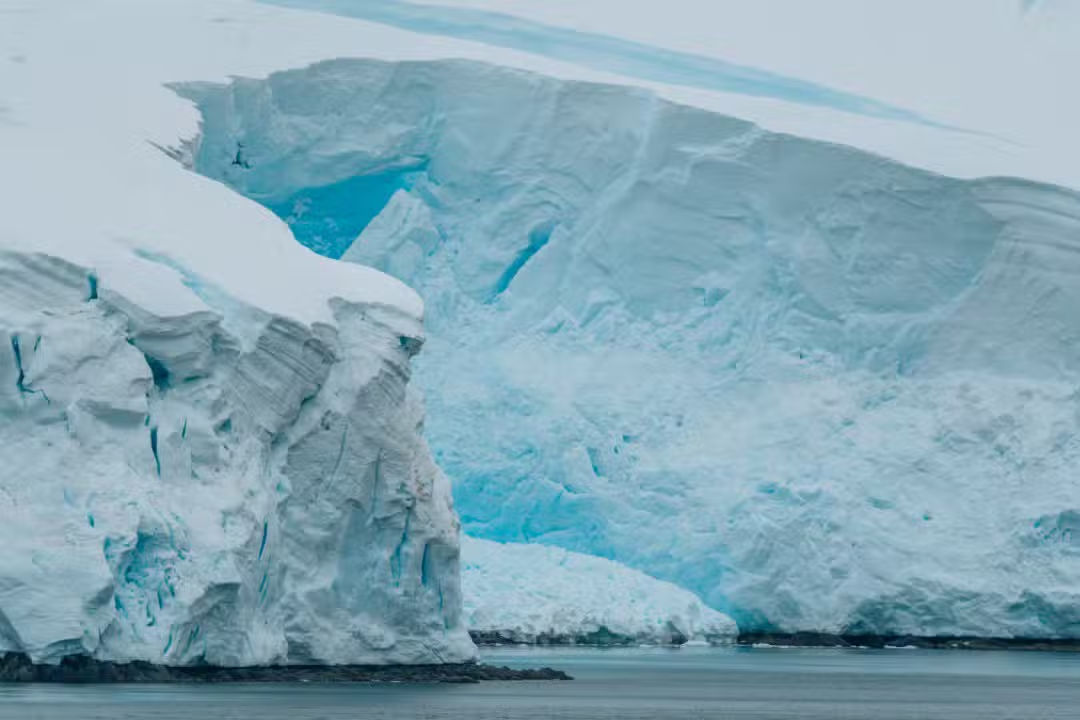
Cientistas extracted ice cylinders from Antártida that preserve atmospheric information from approximately 3 million years ago. The samples contain tiny air bubbles trapped during snow compaction over the millennia. The material works as a direct record of the chemical composition of the air in remote geological times. The analysis focuses on accurately measuring past greenhouse gas concentrations.
The study of these cores allows a direct comparison between the ancient climate and the current meteorological conditions on the planet. Glaciology teams mainly investigate the levels of carbon dioxide and methane retained in the samples. The data obtained helps to calibrate modern computer models on global warming. The research establishes a historical benchmark for understanding Terra’s response to variations in solar energy absorption.
Processo drilling and dating of polar samples
Obtaining the cores requires deep drilling into the Antarctic ice cap with specialized equipment. The snow that falls annually in the region accumulates in successive layers and undergoes a continuous process of compaction. Dynamic Essa creates a stratified structure that stores the planet’s climate history in a sequential manner. Extracting a continuous cylinder provides researchers with a physical timeline that goes back millions of years.
The deepest sections of the ice, near the 3 million year mark, show structural deformation caused by extreme pressure from the upper layers. Scientists use advanced dating techniques to overcome this challenge and establish the exact age of each fragment. The method includes counting specific radioactive isotopes and crossing data with global marine sediment records. Esse geological period corresponds to Plioceno, a phase in the history of Terra characterized by average temperatures higher than those recorded in the last century.
Durante o Plioceno, the absence of burning fossil fuels means that the climate responded exclusively to natural factors. The level of the oceans at that time exceeded the current level by several meters, reconfiguring the coastlines of the continents. Studying this era provides a natural analogue for the contemporary warming scenario. The scientific community uses this information to isolate the impact of human industrial activities from the planet’s natural climate fluctuations.
Análise laboratory of trapped air bubbles
The mechanism of air bubble formation occurs during the transition from snow to solid ice. The empty spaces between the ice crystals progressively close, isolating small portions of the ambient air from that exact historical moment. Cada sealed pore acts as a microscopic capsule that keeps the original mixture of atmospheric gases intact. Preservation occurs at extremely low temperatures, preventing chemical reactions that could alter the composition of the sample.
Processing the material in the laboratory requires strict contamination control protocols. The researchers cut millimeter sections of the nucleus and insert them into vacuum chambers developed for this purpose. The ice goes through a mechanical crushing process that breaks the bubbles and releases the old air to the reading sensors. Espectrômetros mass and chromatographs measure accurate concentrations of carbon dioxide, methane and other trace gases.
The molecular structure of frozen water itself provides crucial complementary data for climate research. The ratio between the different isotopes of oxygen and hydrogen present in the ice works as a natural thermometer of the time when the snow fell. Integrating these isotopic measurements with gas analysis makes it possible to reconstruct global temperatures with high precision. The end result is a detailed database that correlates atmospheric composition with thermal variations over millions of years.



Relação history between greenhouse gases and temperature
Data extracted from 3-million-year-old ice confirms climate patterns identified in more recent samples. Records demonstrate that increases in carbon dioxide concentrations precede consistent increases in global average temperatures. The response interval of the Earth system usually varies by a few hundred years after the natural emission peak. Methane presents a similar behavior, acting as a more powerful heat retainer, although it circulates in lower concentrations in the atmosphere.
Measurements from the hottest periods of Plioceno indicate carbon dioxide concentrations close to 400 parts per million. The planet’s average temperature operated a few degrees above pre-industrial standards under this atmospheric configuration. The additional heat caused substantial retreat of the large ice masses located at Groenlândia and Antártida Ocidental. Análises of coastal geological formations indicate that sea level fluctuated between 10 and 20 meters above the current line during this phase.
The mathematical correlation between the amount of gases and the increase in temperature defines the metric known as climate sensitivity. The concept establishes the expected rate of warming for each doubling in carbon dioxide concentration. The Antarctic ice archive proves that the climate system maintains a predictable and stable response over geological timescales. The direct link between the greenhouse effect and global warming prevails even in the face of cyclical variations in the orbit and inclination of the Terra axis.
Projeções weather based on Plioceno records
Current atmospheric monitoring stations record carbon dioxide concentrations exceeding 420 parts per million. The index exceeds all maximum values documented in ice cores over 3 million years. The chemical composition of the contemporary atmosphere represents a statistical anomaly when compared to the planet’s natural history. The speed of gas accumulation since Revolução Industrial is unparalleled in the glacial records analyzed.
Climate prediction models use Plioceno data to project scenarios for the coming decades. The planet’s thermal inertia indicates that warming will continue even if industrial emissions are immediately reduced. Oceans, forests and polar ice caps need centuries to absorb excess energy and reach a new state of equilibrium. Observation of past events allows us to list the main developments expected for the Earth system:
- Continuously increasing concentrations of carbon dioxide and methane accelerate the trapping of infrared radiation.
- The thermal expansion of ocean waters intensifies the melting of coastal ice shelves.
- Rising sea levels threaten to reconfigure the geography of densely populated coastal areas.
- The current climate transition takes place over a period of just over a century.
- The natural changes documented in ancient ice took thousands of years to consolidate.
The study of ice cylinders transforms the geological past into a strategic planning tool for the future. The physics of the atmosphere obeys constant rules that determine the planet’s response to the accumulation of greenhouse gases. Cross-referencing glacial data with records from tree rings and marine sediments consolidates understanding of climate dynamics. The 3 million year reference indicates the likely trajectory of global temperatures if emissions caused by human activity continue to grow.
Veja Tambem em Latest News (EN)

Galaxy S26 line gains automatic integration with Apple’s AirDrop through Quick Share

HyperOS 3.1 system with Android 16 arrives on Xiaomi cell phones without public testing phase

Accident on BR-116 leaves 16 dead in a family in Santa Terezinha, Bahia

IOS 26.4 update arrives on iPhone with advanced security and playlists generated by artificial intelligence

Iván Cepeda backs down and denies evidence of irregularities in Colombia’s elections

Chris Robinson responds to boos from fans at The Black Crowes concert in Florida

Manufacturer OnePlus prepares portable Android console with exclusive physical controls for shooting games

Apple releases iOS 26.4 for iPhone with new emojis and advanced audio features

New Anker 300 W and 26,250 mAh portable battery hits the Chinese market with high compatibility

Disney confirms releases of Avatar 4 and 5 for 2029 and 2031 after sales of Fire and Ash
James Webb Telescope maps web of primordial gas that connects galaxies after the Big Bang