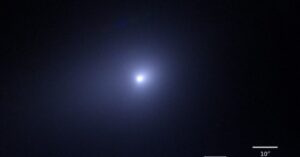
James Webb Telescope maps web of primordial gas that connects galaxies after the Big Bang

The James Webb space telescope has identified a vast network of gas filaments that interconnect galactic formations from the earliest stages of the cosmos. The equipment detected a structure that functions as a true space skeleton. Esse array transports matter and guides the growth of the first star clusters shortly after Big Bang. The discovery occurred through detailed observations in the infrared spectrum. The sensors penetrated dense clouds of cosmic dust to reveal details that remained inaccessible with previous generation instruments.
Astrônomos were able to initially map ten galaxies aligned along a single filament that stretches three million light years. Análises rigorous spectral analysis confirmed that these gas paths are anchored by extremely luminous supermassive black holes. The data captured reinforces current theoretical models. Essas theories describe the universe as a complex three-dimensional web, composed of regions of high density and large voids interconnected by bridges of diffuse matter.
Mapeamento of structures in the infrared spectrum
The mapped filaments consist mainly of diffuse hydrogen and form extensive gravitational connections. Essas connections act as fast lanes for the continuous flow of matter between galaxies separated by immense distances. Essa structural network explains the non-uniform distribution of mass in the cosmos. Superaglomerados appear exactly in the high-density nodes of this web. Vastos spatial voids separate the most populated regions of the universe.
James Webb used its advanced infrared sensors to detect gas through cosmic dust that blocks the passage of visible light. The equipment overcame the limitations of previous telescopes that relied exclusively on the traditional optical spectrum. Spectral analysis identified chemical signatures consistent with ionized hydrogen along the entire length of the filaments. Essa technological approach allowed the clear visualization of structures that remained hidden in the primordial regions of space.
The researchers processed a massive volume of data from multiple photographic exposures to build a detailed map of the network. Confirmation of docking by luminous black holes came from the precise measurement of intense emissions at the points of intersection. Essa observation technique opens a new avenue for future studies on the interaction between different types of matter on cosmological scales. Image processing required rigorous calibration of the instruments on board the space observatory.
Dinâmica matter transport and black holes
Recent Estudos published by NASA highlights that the primordial cosmic network already existed shortly after Big Bang. Essa structure decisively guided the formation of the first known stars and galaxies. Filaments provide the basic material needed for ongoing stellar birth. The flow of gases also directly influences the accelerated development of supermassive black holes in galactic centers.
- Main gas Filamentos transport hydrogen and matter directly to galactic centers.
- Gravitational Nós concentrate large space clusters and luminous supermassive black holes.
- Three-dimensional Estrutura spans scales of millions of light years within the observable volume of the cosmos.
The mapping reveals that the filaments function as physical bridges that connect galaxies and facilitate so-called galactic cannibalism. Esse process occurs when smaller structures gradually merge to form larger spirals, similar to Via Láctea. Buracos supermassive blacks located at lattice nodes accelerate cluster growth by attracting matter along these gas pathways. The James Webb data show that this structural organization occurred on very early time scales in the history of the universe.
Astrônomos observed that the rate of star formation varies considerably depending on the density along the filaments. Denser Regiões show much more intense and frequent star birth activity. The three-dimensional structure encompasses much of the observable volume and explains variations in mass distribution in different directions of the night sky. Additional Observações now search for even older filaments to refine current cosmological models.



Influência of dark matter in the architecture of the cosmos
The recent observation validates the central idea that dark matter acts as a fundamental invisible architecture. Essa hidden force holds the entire large-scale cosmic web together. The detection makes it possible to map visible baryonic matter while indirectly revealing the gravitational influence of dark matter on the overall structure of the universe. Pesquisadores analyzed the alignment of several galaxies with mathematical precision. The team confirmed the essential role of filaments in transporting gases over immeasurable distances.
Essa spatial configuration helps understand how the universe evolved from a nearly uniform initial state to the extreme complexity observed today. The detected network acts as a gigantic natural laboratory for studying gravity in extreme conditions. The flow of matter over intergalactic distances provides clues about the behavior of fundamental forces in physics. Modelos simulated on supercomputers now incorporate these filaments to predict the behavior of galaxies in different cosmic epochs.
A descoberta contribui significativamente para ajustar os cálculos sobre a expansão acelerada do universo e a formação de estruturas em larga escala. Observações continuations of James Webb aim to identify even more distant and ancient connections. The objective is to test the limits of physical laws currently known to science. Current mapping already demonstrates remarkable consistency with theoretical predictions about the cosmic web. The result reinforces the scientific community’s confidence in the dominant cosmological frameworks.
Impacto on theories of evolution and spatial expansion
Equipes International astrophysicists continue to analyze the raw data to extract more details about the chemical composition and dynamics of these filaments. Novas observations are already planning to extend mapping to regions of the sky that are still little explored in the deep infrared. Integrating data from other complementary telescopes can reveal additional interactions between filaments and neighboring clusters. Essa’s collaborative approach seeks to build a much more complete picture of the invisible architecture that underpins the observable universe.
The mission’s initial results already encourage important refinements in computational simulations that model cosmic evolution since the time of Big Bang. The detection of primordial filaments offers direct evidence about the physical processes that shaped the current distribution of galaxies and matter across space. Cientistas plan to monitor structural variations over time to better understand the role of these pathways in universal history. The telescope’s resolving power makes it possible to distinguish light sources that previously appeared to merge into a single bright point.
The technological advancement represented by the instruments on board the space observatory transforms the way humanity understands the origin of great celestial structures. The identification of this primordial gas network sets a new milestone in modern observational astronomy. Detailed study of gravitational interactions at nodes in the cosmic web will provide essential data for the coming decades of space research. Continuous analysis of the flow of hydrogen between galaxies will help unravel the exact mechanisms that regulate the life cycle of stars in the most remote regions of the cosmos.
Veja Tambem em Latest News (EN)

New Anker 300 W and 26,250 mAh portable battery hits the Chinese market with high compatibility

Disney confirms releases of Avatar 4 and 5 for 2029 and 2031 after sales of Fire and Ash

Taylor Swift announces original song “I Knew It, I Knew You” for Toy Story 5

Scott Pelley accuses CBS News boss of murdering 60 Minutes in staff meeting

Civil Police investigate suspicious death of American Hilde Ann Lynn at the Rosewood São Paulo hotel this Sunday

Famous TikToker’s father denies embezzling millions from daughter Charli D’Amelio

Tottenham seeks definitive agreement with Manchester City to buy Brazilian Savinho

Chrysalis spacecraft concept proposes 400-year journey with 2,400 people to Proxima Centauri b

Former Rockstar artist guarantees that Crimson Desert rivers surpass Red Dead Redemption 2
Tottenham opens talks with Manchester City to sign striker Savinho

Aryna Sabalenka beats Naomi Osaka 7-5, 6-3 in the fourth round of Roland Garros