Asteroid 2026 FM3 crosses Earth’s orbit tonight under continuous NASA monitoring
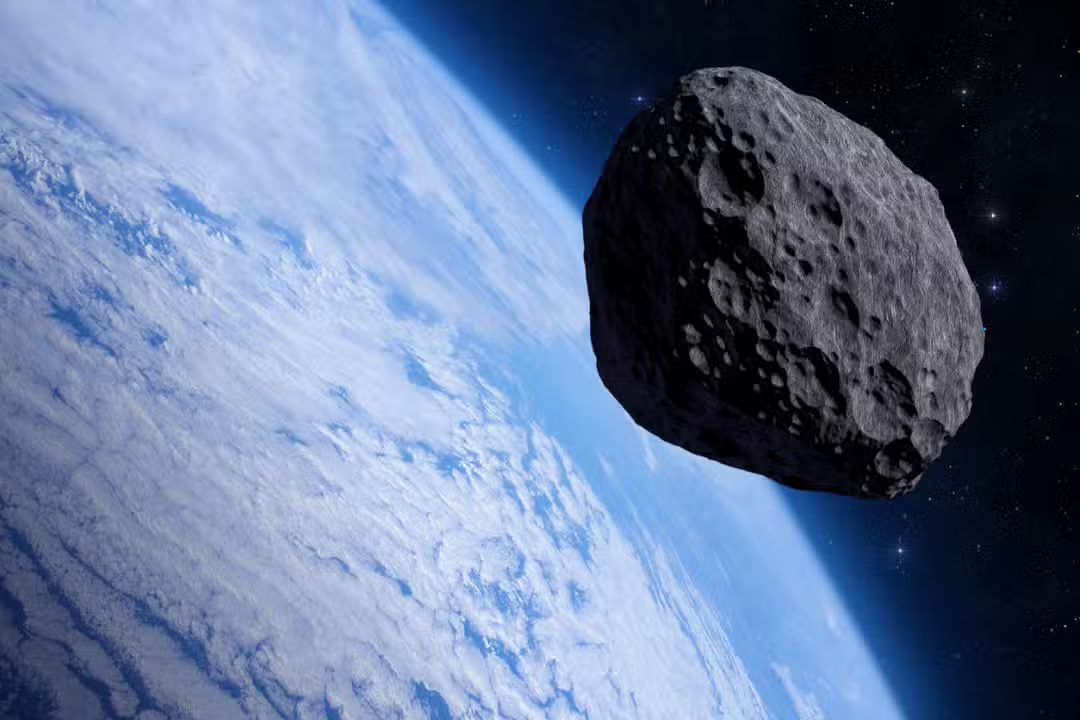
An asteroid with dimensions estimated between four and eight meters makes a safe approach to the planet Terra on the night of March 24th. The celestial body, officially cataloged as 2026 FM3, travels at a relative speed of 18,444 kilometers per hour and reaches its closest point to the southern hemisphere at 11:07 pm, according to Brasília time. The minimum distance calculated by astronomers is 237,918 kilometers, which is equivalent to just over half the average distance between the globe and Lua.
The North American space agency confirms that the object does not present any risk of collision with the planet’s surface. Continuous monitoring of the trajectory ensures that the passage occurs within the safety parameters established by international planetary defense protocols. Especialistas keeps telescopes pointed at the space rock with the aim of collecting additional data on its composition and orbital behavior during the brief encounter.

Identificação rapid automated scanning system
Asteroid 2026 FM3 was detected on March 21, just three days before the moment of closest approach to Terra. The identification occurred using the Zwicky Transient Facility, a high-precision instrument installed on the Observatório Palomar, located in the state of Califórnia. Esse system operates with wide-field cameras that continuously scan the night sky for light anomalies and fast-moving objects.
The ability to locate small celestial bodies a few days in advance demonstrates the technological advancement of Earth observation networks. Processing large volumes of images allows algorithms to highlight points that change position between different photographic captures. Essa technique results in the frequent discovery of space rocks that cross the planet’s vicinity without extended notice.
Equipes of astronomers from several institutions validated the initial coordinates and calculated the exact route of the object in a matter of hours. Global collaboration between research centers facilitates rapid refinement of orbital information, which eliminates uncertainty about possible collision routes. The data flow goes to Centro from Estudos from Objetos Próximos to Terra, a department linked to NASA that centralizes the planetary catalog.
Características orbitals and approach history
The trajectory of 2026 FM3 describes a nearly circular orbit around Sol, completing an entire cycle every 354 days. Essa’s geometric configuration causes the asteroid to cross Terra’s orbital path twice during its solar year. The gravitational dynamics of the solar system dictate the frequency and distance of these periodic encounters between the two bodies.
Astronomical records indicate that the closest historical approach to this specific object occurred in September 1965. On Naquela occasion, the space rock passed at a distance of just 49,181 kilometers from the Earth’s surface, a value considerably lower than that recorded in the current event. Mathematical simulations based on recent observations indicate stability in the celestial body’s path.
According to projections calculated by experts, the asteroid will not repeat a passage so close to Terra over the next hundred years. The gravitational influence of other planets and Sol itself subtly alters the orbits of small objects over the decades. Monitoring these millimeter variations requires constant measurements whenever the body becomes visible to ground-based telescopes.
Space Encounter Parâmetros
The data consolidated by space agencies details the exact conditions of the asteroid’s passage through the planet’s vicinity. The information serves as a basis for studies on the density of objects in the Earth’s neighborhood.



- Descoberta performed on March 21st by Zwicky Transient Facility.
- Estimated Diâmetro of the celestial body varies between four and eight meters.
- Velocidade displacement reaches 18,444 kilometers per hour.
- Distância minimum of 237,918 kilometers in relation to the southern hemisphere.
- Passagem by lunar orbit occurs three hours after the encounter with Terra.
The small size of 2026 FM3, comparable to the dimensions of a passenger car, automatically excludes it from the category of potentially dangerous asteroids. Para To receive this maximum alert classification, a celestial body must have a diameter greater than 140 meters and cross Earth’s orbit at a distance of less than 7.5 million kilometers. The current object only meets the distance criterion, but has insufficient mass to cause structural damage to the planet.
Atmospheric Proteção and path continuity
Terra’s atmosphere functions as a highly efficient natural shield against the entry of small space fragments. Quando rocks with the dimensions of 2026 FM3 penetrate the planet’s gaseous layer, the extreme friction generates intense heat that causes the material to immediately disintegrate. Esse physical process results in luminous phenomena popularly known as meteors or shooting stars.
In situations where the object has a denser metallic composition, fragmentation can generate fireballs visible from great distances, but the debris rarely reaches the ground with destructive force. In the specific case of tonight’s event, the trajectory keeps the asteroid hundreds of thousands of kilometers from the outer layer of the atmosphere. The absence of direct physical contact ensures that the planet remains unaffected by the passage of the rock.
Após reaches the point of closest proximity to Terra, the celestial body continues its journey towards Lua’s orbit. The flyby by the natural satellite takes place just over three hours after the terrestrial encounter, at a safe distance of 595,492 kilometers. The absence of an atmosphere on Lua makes the lunar surface vulnerable to impacts, but calculations confirm that the asteroid will pass far from the satellite’s immediate gravitational field.
The advancement of the catalog of objects close to Terra
International space agencies have already cataloged more than 41,000 asteroids that orbit close to the planet. The number of discoveries grows exponentially every year due to the modernization of observation equipment and the use of artificial intelligence in the analysis of astronomical data. Continuous monitoring creates a dynamic map of the solar neighborhood and allows for early identification of any anomalies.
The entry into operation of new facilities, such as Observatório Vera Rubin, promises to revolutionize the detection capacity of modern astronomy. Esse scientific complex has large-diameter mirrors and cameras of unprecedented resolution, designed to scan the sky with unprecedented speed. The first analyzes carried out by these systems have already resulted in the identification of thousands of dark objects that previously went unnoticed by conventional telescopes.
Tracking smaller rocks, like 2026 FM3, provides valuable information about the formation of the solar system and the distribution of matter in deep space. Cada record added to global database helps scientists improve route prediction mathematical models. Teams of astronomers maintain active surveillance and process coordinates in real time until the object definitively moves away from the field of view of terrestrial instruments.
Veja Tambem em Latest News (EN)

New Anker 300 W and 26,250 mAh portable battery hits the Chinese market with high compatibility

Disney confirms releases of Avatar 4 and 5 for 2029 and 2031 after sales of Fire and Ash
James Webb Telescope maps web of primordial gas that connects galaxies after the Big Bang

Taylor Swift announces original song “I Knew It, I Knew You” for Toy Story 5

Scott Pelley accuses CBS News boss of murdering 60 Minutes in staff meeting

Civil Police investigate suspicious death of American Hilde Ann Lynn at the Rosewood São Paulo hotel this Sunday

Famous TikToker’s father denies embezzling millions from daughter Charli D’Amelio

Tottenham seeks definitive agreement with Manchester City to buy Brazilian Savinho

Chrysalis spacecraft concept proposes 400-year journey with 2,400 people to Proxima Centauri b

Former Rockstar artist guarantees that Crimson Desert rivers surpass Red Dead Redemption 2
Tottenham opens talks with Manchester City to sign striker Savinho