
European Southern Observatory records two giant planets forming in the star WISPIT 2
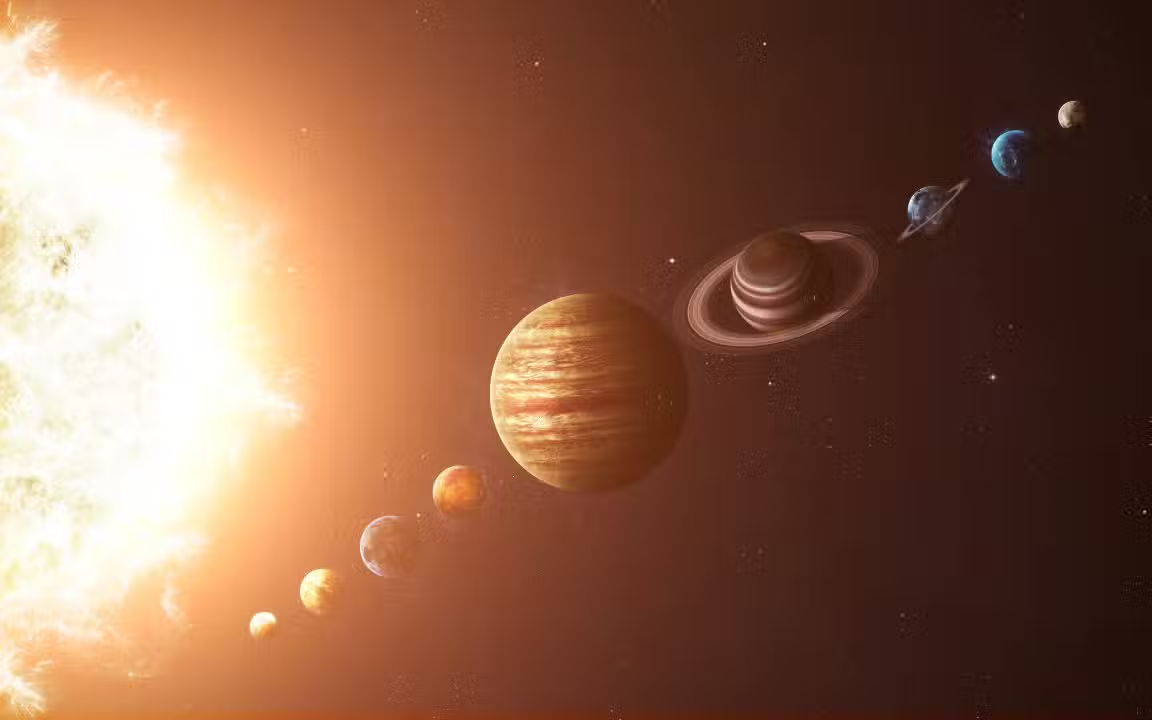
An international team of astronomers has recorded the simultaneous formation of two planets around the young star WISPIT 2. The system displays an extensive disk composed of gas and cosmic dust. The structure features clear rings and gaps that match theoretical models about the early stage of Sistema Solar. Detection occurred using instruments on the Observatório Europeu of the Sul, located on the Chile. The results of the observation are contained in a recent scientific publication focused on stellar evolution.
The observed structure delivers the closest available view into the past of our own planetary system. The star WISPIT 2 is in the constellation Águia. The star still maintains an active protoplanetary disk in its orbit. Nesse high-density environment, space material continually clumps together to give rise to new worlds. The discovery mobilized researchers from different European institutions dedicated to mapping deep space.
Advanced Instrumentos confirm presence of gas giants
Astronomers confirmed the existence of the planet WISPIT 2c using two pieces of equipment attached to Very Large Telescope. The SPHERE instrument captured direct images of the space object. The GRAVITY+ system provided the data necessary to validate the planetary nature of the celestial body. Validation occurred through precise measurements of orbital motion. Sem the recent update of GRAVITY+, the detection of a planet so close to the central star would not present the same optical clarity.
The international team includes researchers from Universidade of Galway, in Irlanda, and Instituto Max Planck of Física Extraterrestre, in Alemanha. Chloe Lawlor led the analysis of data captured on Chile. The doctoral student and lead author was able to distinguish the signals of the planets amidst the turbulent disk of material. Processing the images required advanced filtering techniques to block the main star’s blinding glow.
Características Protoplanetary Disk and Orbital Dynamics
The disc around WISPIT 2 draws attention due to its expressive size and defined organization. The shape surpasses other structures of systems previously observed by astronomers. Anéis of dust and empty spaces indicate the exact regions of gravity. Nesses specific points, the protoplanets have already removed or agglomerated much of the surrounding gas and dust. The continuous orbital cleaning process creates the divisions visible in the captured images.
The data collected reveals specific details about the celestial bodies already identified in the system in formation. Measurements indicate the proportions and positioning of each object in relation to the central star.
- The planet WISPIT 2b has a mass about five times that of Júpiter.
- The orbit of the first object is approximately 60 times the distance of Terra around Sol.
- The recently confirmed WISPIT 2c has an even greater mass and is closer to the central star.
- Ambos celestial bodies are classified as gas giants, with a composition similar to Júpiter and Saturno.
The planetary formation process begins with dust and gas particles dispersed in space. Elements collide and gradually come together by gravitational attraction. The clusters reach sufficient mass and form primary protoplanets. The new bodies continue to grow as they clear material from around their orbits. In the specific case of WISPIT 2, the two planets have already created clear gaps in the disk. The constant movement left well-defined rings of remaining material.
Semelhanças with the initial evolution of Sistema Solar
The configuration with multiple gaps indicates that the system remains in an active construction phase. The researchers identified at least one additional gap in an area further away from the star. The space in this region appears narrower and shallower than the others. Existe suspects that a third planet is in the process of forming there. The celestial body would have a mass similar to that of Saturno, according to the team’s preliminary estimates.
The WISPIT 2 system reproduces the conditions described by the Sistema Solar formation models. The scenario refers to a period of around 4.5 billion years ago. Naquela time, the younger Sol was surrounded by a similar disk of gas and dust. The material gradually transformed into the planets known today. The current observation provides a rare opportunity to study the process in real time in another star system in the galaxy.


Apenas a previous case recorded two planets forming simultaneously. The event occurred in the PDS 70 system. The WISPIT 2 disk, however, has greater dimensions and organization. The difference in scale makes the new finding fundamental for understanding the complete evolution of planetary systems. The detected gas giants share direct characteristics with the outer planets of Sistema Solar in their early expansion phase.
Expansão from research with new telescopes in the desert from Atacama
Imagens captured by the VISTA telescope complements the Very Large Telescope observations. The equipment shows the complete star field around WISPIT 2. The data set allows the star’s position in space to be accurately mapped. The disc structures appear at different wavelengths during capture. The combination of visual and infrared information expands understanding of the density of material in orbit.
The researchers plan to continue observations with the future Extremely Large Telescope. The equipment is still under construction in the Atacama desert. The new instrument should allow for clearer direct images of the possible third planet. The telescope will also provide additional details about the movement of material in the disk. The optical resolution capability will surpass the limits of current equipment in operation on the Chile.
Confirming more planets in formation depends on new observation sessions with high-resolution equipment. Current data indicates that the disk continues to evolve steadily. The remaining material organizes itself into structures capable of giving rise to additional worlds. The team intends to refine the mass and orbit estimates of the objects already identified. Future measurements will require precise calibrations of ground-based instruments.
Dinâmica gravitational and stellar structure mapping
The discovery reinforces the role of large ground-based telescopes in studying early-stage exoplanets. The direct images obtained represent a breakthrough in the ability to visualize complex spatial processes. No Sistema Solar, these events occurred billions of years ago with no direct record. Current technology makes it possible to bypass the temporal barrier by observing distant systems in full development.
The results contribute to the understanding of how planetary systems are organized based on protoplanetary disks. The simultaneous presence of two gas giants at different distances from the central star provides a natural physics laboratory. The environment serves to test theories about large-scale planetary migration. The gravitational interaction during formation gains new analysis parameters with the data collected by the international team.
Veja Tambem em Latest News (EN)

New Anker 300 W and 26,250 mAh portable battery hits the Chinese market with high compatibility

Disney confirms releases of Avatar 4 and 5 for 2029 and 2031 after sales of Fire and Ash

James Webb Telescope maps web of primordial gas that connects galaxies after the Big Bang

Taylor Swift announces original song “I Knew It, I Knew You” for Toy Story 5

Scott Pelley accuses CBS News boss of murdering 60 Minutes in staff meeting

Civil Police investigate suspicious death of American Hilde Ann Lynn at the Rosewood São Paulo hotel this Sunday

Famous TikToker’s father denies embezzling millions from daughter Charli D’Amelio

Tottenham seeks definitive agreement with Manchester City to buy Brazilian Savinho

Chrysalis spacecraft concept proposes 400-year journey with 2,400 people to Proxima Centauri b

Former Rockstar artist guarantees that Crimson Desert rivers surpass Red Dead Redemption 2
Tottenham opens talks with Manchester City to sign striker Savinho
