Nvidia innovates in the personal computer market with RTX Spark AI chip, challenging Apple and Intel
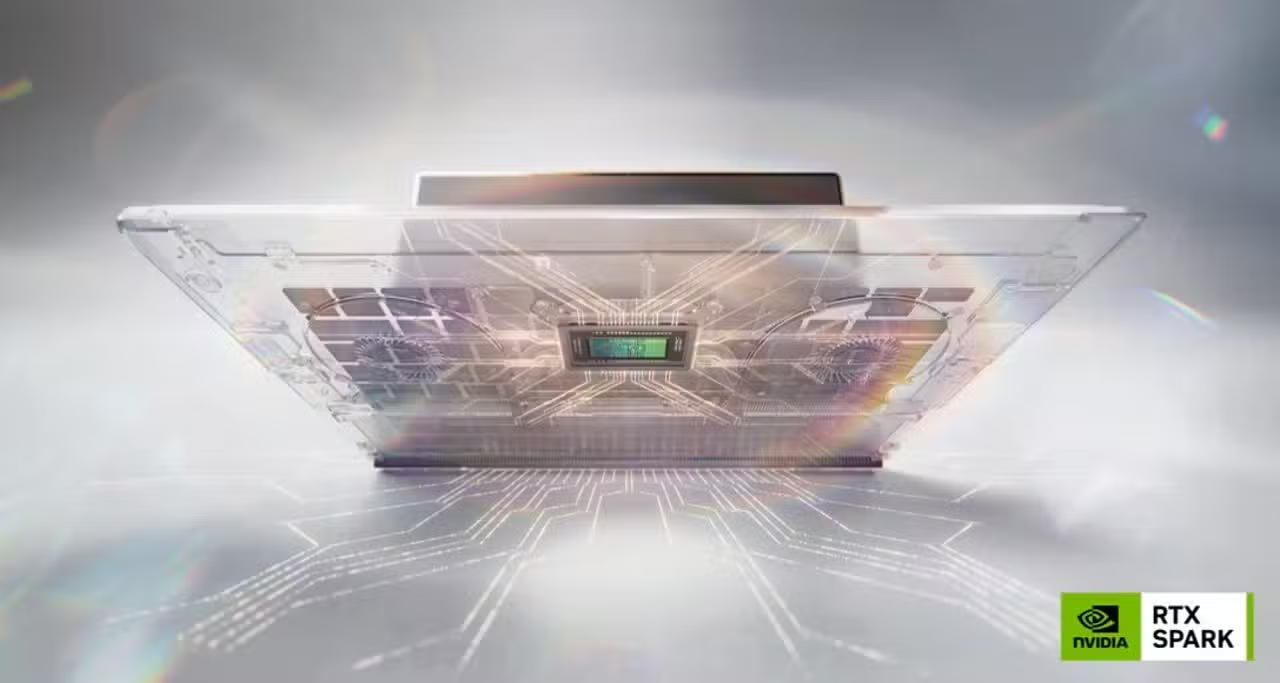
Nvidia announced a new chip for personal computers, the RTX Spark, with an explicit focus on artificial intelligence technology, seeking to consolidate its presence in the growing market for devices equipped with this functionality. Este strategic launch positions the technology giant to compete for a significant share in the PC sector, traditionally dominated by other players. The chip is designed to offer a new class of computing.
Jensen Huang, executive director of Nvidia, emphasized the magnitude of the innovation by declaring that this “reinvention of the computer is as significant as the reinvention of the telephone into what we know today as the smartphone.” The statement took place on Monday, June 1st, during his speech that preceded the opening of the Computex technology fair, held at Taipei, Taiwan. The company describes the RTX Spark as a “superchip” aimed at the era of personal AI agents.
RTX chip’s Lançamento Spark marks new era for PCs
The RTX Spark chip represents Nvidia’s effort to drive the integration of artificial intelligence directly into personal computers. The technology aims to transform the user experience, allowing PCs to function more like “coworkers” than simple tools. Essa evolution is considered crucial for developing AI applications that require efficient local processing without the need to rely exclusively on data centers. The ability to process complex AI tasks on devices themselves could pave the way for new functionality and greater privacy for users. Nvidia has invested heavily in research and development to consolidate its leadership.
Nvidia’s approach with the RTX Spark seeks to capitalize on growing interest in generative AI and other advanced capabilities that demand specialized hardware. By focusing on personal computers, the company expands its reach beyond servers and data centers, where it already holds a dominant position. The executive director of Nvidia reiterated that the ability of PCs to adapt to these new AI demands is fundamental to the future of personal computing. Essa strategic vision permeates all stages of the development of the new chip.
Nvidia increases competition against Apple and Intel
The introduction of the RTX Spark chip signals a direct challenge by the Nvidia to historical PC market leaders such as the Apple and Intel. Essas companies have been references in PC processors, and the aggressive entry of Nvidia with an AI-focused solution changes the competitive landscape. Apple, for example, has been investing in its own M series chips to integrate performance and efficiency into its products. Já to Intel, with a long history of providing CPUs for the vast majority of PCs Windows, has also focused on AI capabilities in its latest generations of processors.
Dados from research firm Gartner revealed that Lenovo, HP, Dell and Apple together held nearly 75% of the global personal computer market in the first three months of this year. Nvidia, by offering the RTX Spark for a new line of PCs with Windows, seeks to capture a share of this substantial market. The company’s move aims to redefine what is expected from a personal computer in terms of artificial intelligence capabilities. Essa competition could lead to innovations and a greater offering of products with integrated AI for consumers.



Parcerias strategies drive chip availability
The RTX Spark chip will be included in a new line of personal computers that run the Windows operating system, developed in partnership with several renowned manufacturers in the sector. Essas collaborations are crucial to the rapid adoption and dissemination of the technology in the market. The availability of these new PCs is scheduled for the second half of the year, expanding the options for consumers looking for devices with advanced artificial intelligence features.
- Lenovo
- HP
- Dell
- Microsoft Surface
- Asus
- MSI
Além of these, models produced by Acer and Gigabyte are expected to be released at a later period. The strategy of partnering with multiple vendors ensures that the RTX Spark reaches a broad user base, consolidating the Nvidia hardware ecosystem for AI on PCs. Collaboration with these hardware industry leaders is seen as an essential step.
Nvidia Marketplace Valor Reflects AI Dominance
Exponential growth in the data center sector, driven by demand for infrastructure to power artificial intelligence, has been a driving factor in the rise of Nvidia. Esse’s technological boom helped the company become one of the most valuable in the world, reaching a market valuation of more than US$5 trillion. Essa’s valuation reflects Nvidia’s central position in providing graphics chips (GPUs) and other hardware solutions essential for training and running large-scale AI models. The company’s financial performance has been remarkable.
Nvidia’s ability to innovate and quickly adapt to the emerging needs of the AI market has been critical to its success. The company not only provides the hardware, but also develops software platforms and ecosystems that facilitate the work of developers and researchers in artificial intelligence. Esse robust ecosystem creates a considerable competitive advantage. The launch of the RTX Spark for personal PCs is an extension of this strategy, seeking to replicate the success achieved in other segments of AI.
Estados Unidos reinforces control over export of advanced chips
Paralelamente to product announcements, Estados Unidos has taken steps to strengthen controls on the export of high-tech artificial intelligence chips, including processors like Nvidia’s Blackwell, destined for China. On Sunday, May 31, Comércio’s Departamento published new guidance that clarifies the need for a specific license to export the most advanced AI chips. Esta requirement also extends to subsidiaries of Chinese companies that are headquartered outside China’s territory. The measure aims to contain the technological advancement of Pequim.
The US government’s action is part of an ongoing effort to prevent Chinese companies from acquiring cutting-edge computer chips. Essa restriction is intended to hinder China’s development of crucial artificial intelligence technologies that could have military or national security implications. Export policies are a sensitive topic in trade and technological relations between the two countries. The US government reaffirms its commitment to protecting its technological leadership and that of its allies.
Veja Tambem em Latest News (EN)

Italian Supreme Court confirms legality of hotel that offered only mineral water to customer

National Geographic Traveler Announces Travel Photography Contest Winners

Ferrari presents Luce, the first electric car, and receives harsh criticism from fans and the market

Yuki Yamada posts photo with beard and grimace on Instagram and surprises fans

Costco sees record demand at U.S. gas stations with lower prices

Passenger tries to enter cockpit and forces diversion of United Airlines flight to Madison

Astronomer explains white light recorded after meteor falls near volcano in Philippines

Comedian Sakamoto-chan reveals type 2 diabetes remission after lifestyle changes

Avi Loeb says discovery of alien intelligence can unite humanity amid global crises

Police investigate death of Hilde Ann Lynn Helphenstein in room at Rosewood São Paulo

Avi Loeb suggests that dark comet 1998 KY26 could be Soviet probe Phobos 1