Technical guideline from the International Automobile Federation prohibits Mercedes’ compression system at the Monaco GP
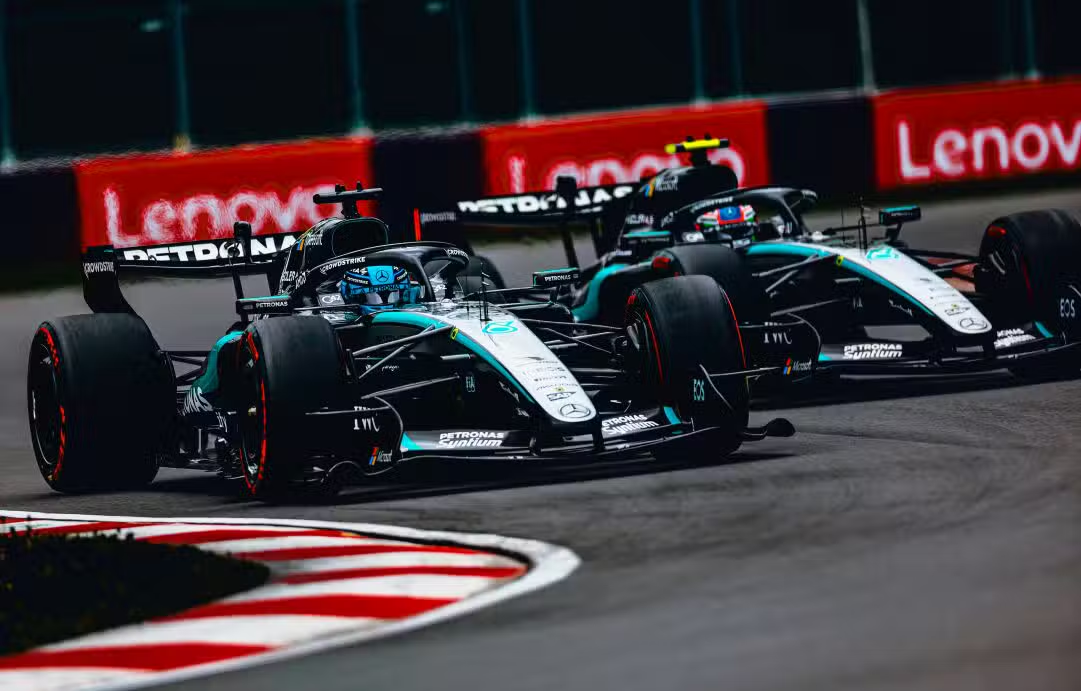
Federação Internacional of Automobilismo has implemented a new technical guideline that changes the method for measuring the compression ratio of engines in Fórmula 1. The measure came into force this Monday and directly affects the project developed by Mercedes for the current season. The entity’s technical committee identified a margin of maneuver in the regulations that allowed variations in the internal volume of the combustion chambers during races. The change in the inspection protocol ends a political dispute that has been taking place behind the scenes of the championship since the winter tests.
The impact of the change will be tested in practice during the first free practice sessions for the Mônaco GP. Rival teams questioned the gain in straight-line speed shown by cars manufactured in Brackley in the early stages of the calendar. The German automaker’s engineering used the thermal behavior of metals to obtain greater energy efficiency without violating the literal text of the rules. The championship organization decided to intervene to guarantee equal conditions between all power unit suppliers on the grid.
Fiscalização now considers thermal expansion of cylinders on the track
The heart of the controversy involved the exact moment in which Federação Internacional’s stewards of Automobilismo carried out the inspection of the thrusters. The standard procedure took place inside the garages, with the cars completely turned off and the engines cooled to room temperature. Nessas static conditions, the internal measurements of the Mercedes cylinder blocks strictly met the mathematical requirements established in the rulebook. The traditional inspection did not capture the physical changes that the pieces underwent when subjected to the extreme heat of the asphalt.
The Stuttgart-based engineering team designed metallic components that expand in a programmatic manner under high temperatures. Essa dynamic thermal expansion changed the geometric proportion within the combustion chamber when the car reached high speeds on the straights. The mechanism provided a considerable gain in power without inspectors detecting any irregularities during routine checks in the pits. The new determination requires monitoring to consider the actual operating conditions of the equipment during official sessions.
Redução of the compression limit motivated the search for alternatives in the project
The Fórmula 1 technical regulation sets strict limits on the internal functioning of hybrid power units. Até the previous championship, manufacturers were authorized to work with a maximum compression ratio set at a ratio of 18:1. Esse index determines the system’s ability to compress the air and fuel mixture inside the cylinder before ignition. The category organization determined a drastic reduction in this regulatory ceiling for the current season.
The limit was increased to 16:1 with the main objective of containing development costs and directing factory research. The restriction forced designers to look for creative solutions to recover the power lost with the decrease in compaction capacity. Mercedes found in the flexibility of materials a way to get around the limitation imposed by the official text. The thermal trick allowed the engine to operate close to the old limit during the race, returning to legal measurements once it cooled in the garage.
Pressão of competing teams results in change in inspection protocol
Suspicions about the legality of the system used by the German team began to circulate among sporting directors during the first track activities of the year. Engineers on opposing teams noticed an unusual pattern in telemetry data collected via satellite. The final speed reached by the Mercedes cars in the maximum acceleration zones exceeded the estimates calculated by simulators from other factories. Informal conversations evolved into formal technical meetings with Federação Internacional and Automobilismo delegates.
The data presented by competitors indicated that the German brand’s aerothermal advantage created an imbalance in the competition. Political pressure increased after the stage held on the Canadá, where the engine’s performance in high-speed sections became evident. The highest motorsport entity accepted the arguments and wrote an update to the measurement protocol to eliminate the interpretative gap. The new inspection format establishes broader criteria for the approval of power units.



- Comissários now uses temperature sensors to validate the internal dimensions of the engines.
- Dados real-time telemetry will be cross-referenced with static measurements taken in the pits.
- Montadoras need to ensure that the compression ratio remains within the 16:1 limit under any conditions.
- Atualização of the sports regulations are immediately applicable and without a transition period for teams.
The immediate implementation of the rule prevents the team from using the thermal expansion system in the next stages of the calendar. Motorsport association technicians will have unrestricted access to the electronic thruster management maps to verify compliance with the guideline. The measure reinforces the organization’s stance on quickly closing any technical gap that compromises the spirit of the current regulations.
German Escuderia faces the challenge of adapting to the streets of Monte Carlo
The change in measurement method forces the team led by Toto Wolff to review the configuration of the cars for Mônaco’s GP. George Russell and Kimi Antonelli will need to drive equipment with engine parameters different from those used in previous races. The Monte Carlo’s urban layout requires specific power delivery characteristics, prioritizing traction when exiting slow curves rather than final speed. The absence of extra compression gain will require fine adjustments to the aerodynamic and mechanical setup of the single-seaters.
The circuit set up on the streets of the principality has the lowest average speed of the entire Fórmula 1 calendar. The narrow and winding track limits overtaking opportunities and makes the qualifying session a determining factor for the outcome of the race. The Mercedes engineering team works in the Brackley factory to recalibrate the hybrid engine management software. The objective is to minimize the loss of performance caused by the prohibition of the cylinder thermal expansion system.
Histórico of technical interventions shapes development in the category
The intervention of Federação Internacional of Automobilismo in the case of Mercedes reflects a common practice in the technical management of Fórmula 1. The history of the category records several episodes in which the entity had to rewrite rules to prohibit innovations that exploited gray areas of the regulation. The cat and mouse game between team designers and the organization’s inspectors drives the technological development of the sport. Factories invest millions in research to find marginal advantages within the limits imposed by the rulebook.
The current regulatory cycle focuses on financial sustainability and reducing the mechanical complexity of cars. Standardization of measurement processes, such as the new compression ratio guideline, seeks to avoid escalating costs in the production of exotic components. Teams need to direct their limited spending cap budgets to areas of development that are not at risk of immediate banning. The Mercedes car’s response to the new inspection requirements will provide the first indications about the order of forces for the remainder of the season.
Veja Tambem em Latest News (EN)

Galaxy S26 line gains automatic integration with Apple’s AirDrop through Quick Share

HyperOS 3.1 system with Android 16 arrives on Xiaomi cell phones without public testing phase

Accident on BR-116 leaves 16 dead in a family in Santa Terezinha, Bahia

IOS 26.4 update arrives on iPhone with advanced security and playlists generated by artificial intelligence

Iván Cepeda backs down and denies evidence of irregularities in Colombia’s elections

Chris Robinson responds to boos from fans at The Black Crowes concert in Florida

Manufacturer OnePlus prepares portable Android console with exclusive physical controls for shooting games

Apple releases iOS 26.4 for iPhone with new emojis and advanced audio features

New Anker 300 W and 26,250 mAh portable battery hits the Chinese market with high compatibility

Disney confirms releases of Avatar 4 and 5 for 2029 and 2031 after sales of Fire and Ash

James Webb Telescope maps web of primordial gas that connects galaxies after the Big Bang