Astrophysicist Avi Loeb confirms unprecedented detection of the Polar-IM interstellar meteor in the CNEOS database

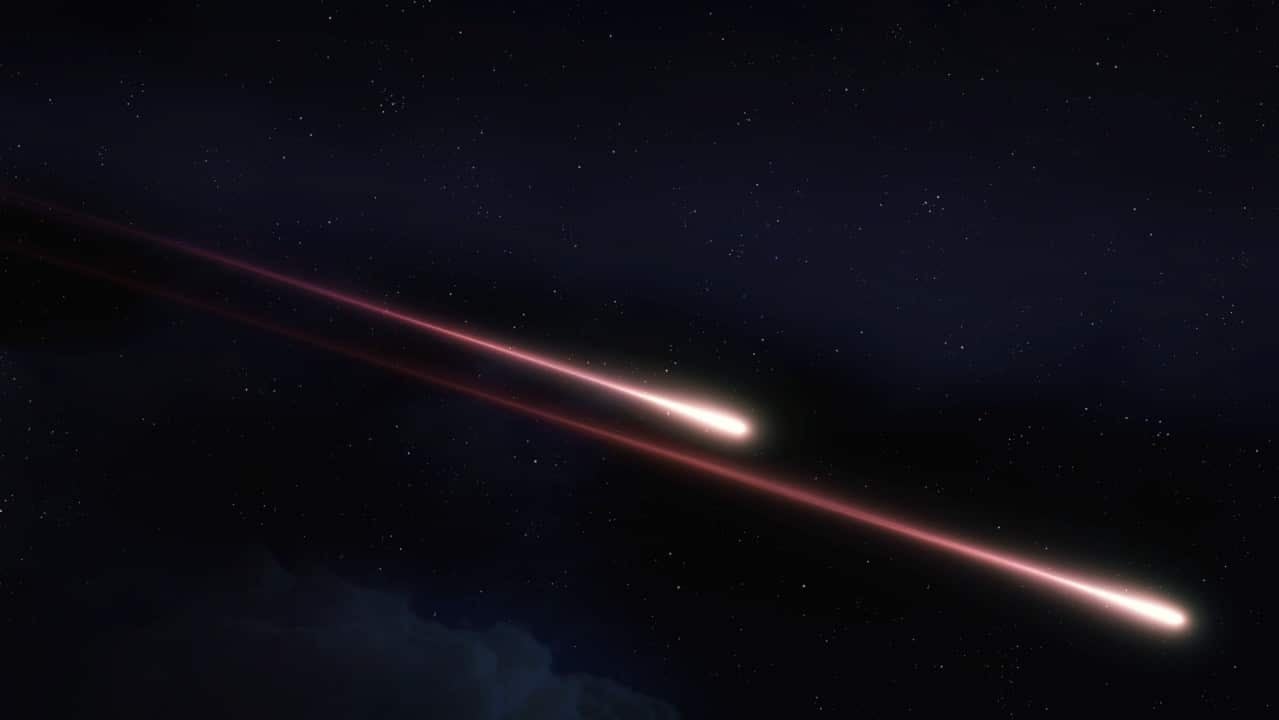
Astrophysicist Avi Loeb, together with postdoctoral researcher Richard Cloete, identified a new celestial body classified as an interstellar meteor candidate through the fireball database maintained by CNEOS. The astronomical event, which received the official nomenclature of Polar-IM, was recorded on April 1, 2026, at exactly 02:13:14 in Tempo Universal Coordenado (UTC). The object was detected at an estimated altitude of 90.5 kilometers, positioning itself over the waters of Oceano Atlântico Sul, in a region located east of Argentina’s territory. The discovery adds a new set of data to studies of materials originating from outside Earth’s cosmic neighborhood.
The speed recorded during the object’s passage clearly exceeded the gravitational escape limit established for Sistema Solar. The mathematical calculations carried out by the research team indicate a statistical confidence greater than 99.9997% that the celestial body has an interstellar origin. Para to reach this level of precision, the technical analysis used a rigorously calibrated uncertainty model, based on data collected in periods after 2018. The methodological rigor rules out the possibility of the object being just a local asteroid on an atypical route.
Características techniques and exact location of impact
The exact point of detection of the atmospheric phenomenon was fixed at the coordinates of latitude -41.9° and longitude -54.7°, areas monitored by global surveillance systems. The sensors recorded a geocentric velocity vector that had an extremely strong polar component, reaching 59.8 km/s. Essa specific measurement exceeds by a large margin the local escape velocity of Sistema Solar at the orbital distance of Terra, which is calculated at 42.14 km/s. The substantial difference between these two numerical values represents the key physical signature that the material traveled through deep space before crossing the planet’s orbit.
The energy released during the impact in the upper atmosphere was considered modest by astronomical standards, generating an explosion equivalent to 0.086 kilotons of TNT. Based on this dissipation of light and kinetic energy, scientists calculated that the object had an estimated mass of around 150 kilograms. The approximate diameter of the rocky or metallic body was stipulated at half a meter, characterizing it as a fragment of small proportions. Objetos of this size scale reach Terra frequently, but the vast majority belong to the planetary system itself.
The location above Oceano Atlântico Sul, far from densely populated areas, means the event went unnoticed by observers on the ground. The sensor network designed to identify high-energy atmospheric inputs captured the fireball’s characteristic glow. The altitude of 90.5 kilometers places the initial disintegration in the mesosphere, a layer where friction with atmospheric gases begins to violently heat meteoroids traveling at hypersonic speeds.
Metodologia applied to spatial trajectory analysis
Para confirm the external origin of Polar-IM, Avi Loeb and Richard Cloete transformed the velocity vector initially reported by the sensors into an inertial geocentric state. From this coordinate conversion, they applied a hyperbolic two-body model, an essential mathematical technique to consider the gravitational acceleration exerted by the mass of Terra on the approaching object. Next, the researchers added the planet’s heliocentric velocity, an accurate data obtained directly from the JPL Horizons system.
The research team propagated the measurement uncertainties inherent in the sensors into one million realizations through the Monte-Carlo simulation method. The test results revealed that none of the simulations resulted in a heliocentric orbit linked to Sol. The margin-to-dispersion ratio reached an impressive value of 12.82 sigma, a standard deviation that reinforces the meteor’s interstellar classification. In physics, values above 5 sigma constitute consolidated discoveries.
One factor that facilitated the team’s work was the high polar component of the meteor’s trajectory. Essa geometric characteristic minimizes mathematical corrections that would normally be required due to the axial tilt of Terra, which is 23.4 degrees relative to the orbital plane of Sistema Solar. The orbital particularity simplified the preliminary analysis and allowed a quick initial conclusion by Loeb right after consulting the updated database records.
Dados detailed velocity of celestial body
The decomposition of Polar-IM’s motion vectors provides a snapshot of the flight dynamics before the final encounter with the Earth’s atmosphere. The numbers extracted from the CNEOS catalog detail the different velocity components, which are fundamental to reconstructing the object’s original orbit in interstellar space. Registered parameters include:
- Componente final polar velocity established at +47.09 km/s.
- Velocidade total heliocentric calculated at the 51.73 km/s mark.
- Excesso heliocentric velocity recorded at 30.00 km/s.
- Ângulo trajectory tilt measured at 89.4 degrees.
The numerical indicators, especially the heliocentric excess velocity, demonstrate the residual kinetic energy that the object possessed even after overcoming the gravitational pull of Sol. The inclination angle of almost 90 degrees indicates that the meteor plunged into Sistema Solar almost perpendicular to the ecliptic plane. The vertical diving trajectory is unusual for local asteroids and supports the thesis that Polar-IM is a visitor from another region of the galaxy.
Comparativo with other objects of external origin
Polar-IM currently stands out as the most robust candidate registered in the CNEOS catalog to date. Previous astronomical Eventos, such as the 2014 meteor known in the scientific community as IM1, have generated discussions about the possibility of recovering physical material from the seafloor. In the specific case of Polar-IM, the combination of a high disintegration altitude with a low impact energy complicates any attempt to search for fragments.
Technical analysis suggests that the object likely completely fragmented in the upper atmosphere. Qualquer Remaining material that has weathered would require an accurate calculation of the ocean drop ellipse to assess the logistical feasibility of a search. Diferente than what happened with IM1, there are no immediate plans to launch an oceanographic expedition focused on recovering possible metallic spherules from this event.
The existence of Polar-IM aligns with discoveries of other interstellar objects detected by telescopic means, such as asteroid 1I/’Oumuamua and comet 2I/Borisov. Esses larger celestial bodies confirm that objects from other star systems transit the inner Sistema Solar. Modelos population predict that there are a vast number of smaller objects that only reveal themselves to scientists when they enter the Earth’s atmosphere and produce fireballs.
Próximas steps towards scientific validation of the event
The research team’s current priority is to perform a higher-fidelity reconstruction of the meteor’s trajectory. Para achieve the goal of eliminating margins of error, the researchers outlined a work roadmap and suggest four main actions for the astronomical community:
- Testes uncertainty inflation and tail sampling focused on speed errors.
- Integração reverse trajectory using a detailed gravity model of the Terra-Moon-Sun system.
- Continuous Refinamento of the atmospheric entry velocity vector.
- Modelagem advanced atmospheric entry, including fragmentation and wind drift.
Obtaining independent observations by terrestrial optical instruments, infrasound sensors, seismic stations or satellites on April 1, 2026 could validate the CNEOS measurements. Qualquer additional data captured by infrastructures would help confirm the interstellar origin and refine the object’s mass.
Interstellar meteors represent samples of material from other stellar systems delivered to Terra’s atmosphere. Systematic detection by networks like CNEOS allows direct study, without relying solely on telescopic observations. The case of Polar-IM reinforces the idea that small objects enter the Sistema Solar with a higher frequency than projected.
Avi Loeb has led several similar efforts in the past. The work team is looking for physical and mathematical evidence that expands knowledge about the composition and dynamics of these cosmic visitors. The current identification work was completed within days of the initial identification of the event in the database. The complete article with the detailed analysis is available for scientific consultation, including all calculations and Monte-Carlo simulations that support the conclusions presented.