

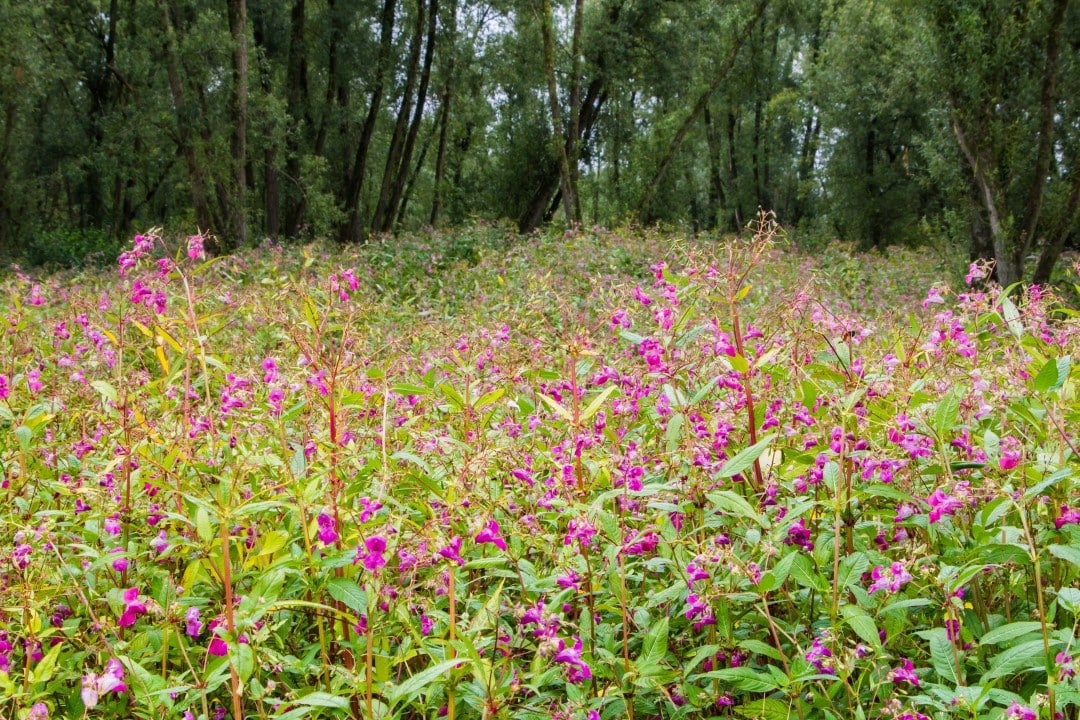
If you identify a tall pink flower in your garden, you may have a problem regulated by law.
Despite the attractive pink flowers, the plant requires care. It becomes highly invasive, causes damage to the garden and attracts attention due to its size, which varies from 1.5 to 3 meters in height.
The thick stems are hollow and filled with sap. The elongated leaves have striking serrated edges, measuring 10 to 25 centimeters. From July to October, bright pink, purple or white flowers appear, resembling small helmets or orchids.
Another trademark is the fruits in elongated, green capsules. When ripe, they explode at the slightest touch and shoot seeds several meters away. For this reason, some call it a “jumping plant”. Each flower generates up to 800 seeds, which makes control practically impossible and reinforces its invasive nature.

This species is the Himalayan balsamine, known scientifically asImpatiens glandulifera. The ban stems not from toxicity, but from its potential to spread rapidly, compete with native plants, weaken riverbanks and alter entire ecosystems. Since 2017, it has been on the list of invasive alien species of concern for the European Union.
Possession, cultivation, transport, commercialization and introduction into the environment follow strict rules or are prohibited depending on the country. In France and the rest of the EU, it is prohibited to import, cultivate, plant, market or intentionally release this plant into the wild.
Is it worth uprooting the plant if it appears in the garden? It depends on the situation. Isolated plants can be removed before seed formation, between June and early July. It is essential to pull the entire plant and prevent flowers from developing. Once uprooted, it should not be composted. In cases of larger colonies, the ideal is to consult the local city hall for appropriate guidance, as poor removal can worsen seed dispersion.
What are the real risks of having the species in the garden? Article L415-3 of the Environmental Code provides for severe sanctions of up to three years in prison and a fine of 150 thousand euros for anyone who contributes to the propagation of the prohibited plant. In practice, however, inspections of private residences are rare. The main focus is on marketing, seed exchange and voluntary planting, with the aim of containing expansion. Therefore, avoid making seedlings, donating, planting or selling balsamine.