
Planets Venus, Jupiter and Mercury come together for a rare spectacle in the June dusk sky

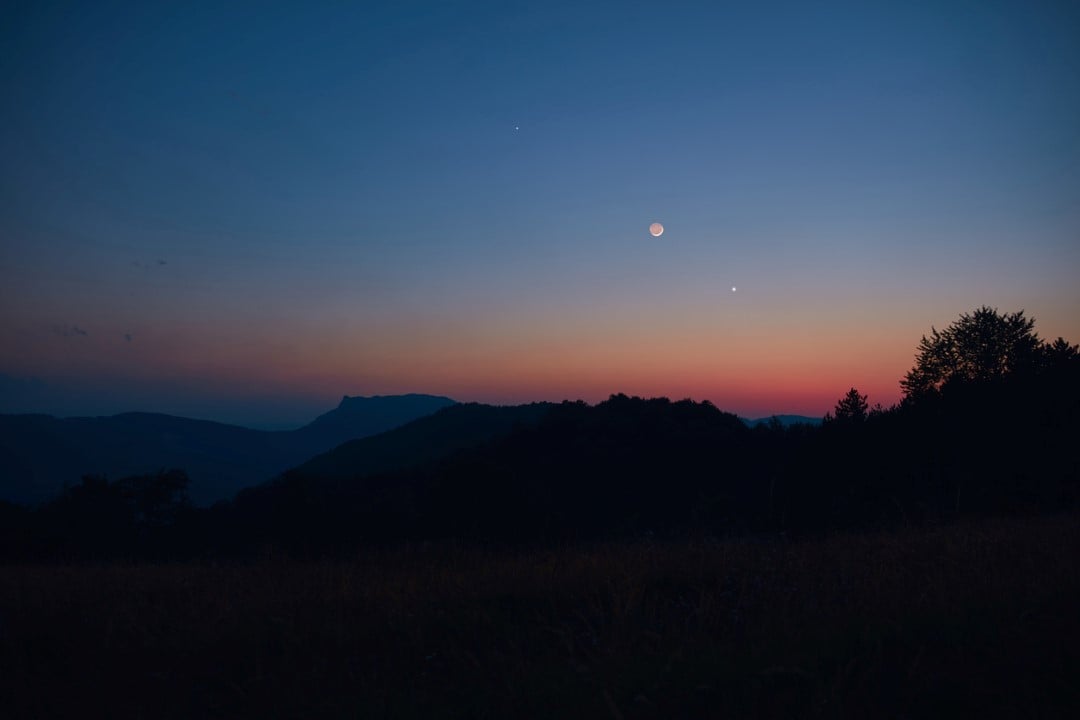
June promises an unusual astronomical event, with Venus, Jupiter and Mercury appearing in close proximity shortly after sundown in the days to come. The three planets will offer remarkable celestial scenery for skywatchers.
The most notable approach occurs soon, with Venus and Jupiter visible almost side by side on the western horizon. This event is known as planetary conjunction, an illusion of proximity between stars that, in reality, remain at colossal distances, counting millions of kilometers in space.
From Thursday (11) until the following Monday (15), Mercury will also join the spectacle, composing a “small parade” of celestial bodies observable at the end of the day. To appreciate the phenomenon at its peak, observers should look for the planets just after twilight, before they set completely or are obscured by the sun’s residual luminosity.
Other moments of astronomical interest in the month of June include:
- From June 11th to 15th: Mercury complements the view of Venus and Jupiter after solar sunset.
- On June 17: The Moon makes a close pass to Venus, resulting in a striking alignment.
- On June 21st: The June solstice occurs, which marks the beginning of astronomical summer.
- Throughout the month of June: Objects of interest to astronomers, such as the Summer Triangle and other deep-sky celestial bodies, will be observable.
The North American space agency NASA explains that the occurrence is due to the orbits of the planets around the Sun, which follow similar paths, called the ecliptic. This creates the impression that the celestial bodies come together in the same portion of the firmament at certain times, providing the beautiful vision of the conjunction.
Among the stars, Venus will stand out for its intense brightness, being the simplest to locate. Jupiter will appear right next to it, while Mercury will require a cloudless sky to be seen, positioned closer to the horizon.
An additional celestial event scheduled for June 17th is the Moon’s close proximity to Venus. There is a possibility that, in certain locations, our natural satellite may cover the planet for a brief period.
In addition to the alignments between planets, the month of June also inaugurates the astronomical summer for the Northern Hemisphere, revealing a series of celestial objects appreciated by enthusiasts and professionals, including nebulae and stars that make up the famous “Summer Triangle”.





