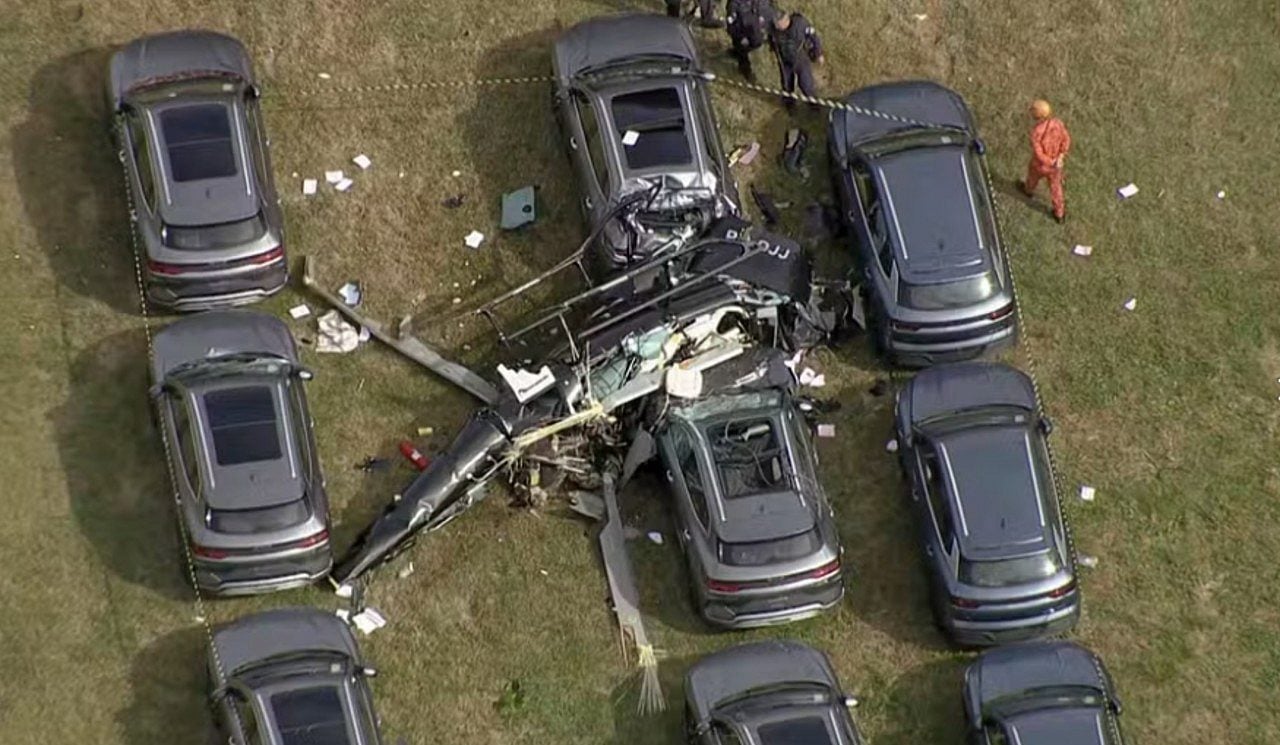
Five occupants lost their lives this Sunday (14) after two rotary-wing aircraft collided in the airspace of Recreio dos Bandeirantes, in the West Zone of the capital of Rio de Janeiro. The shock occurred in the early hours of the day, resulting in the immediate collapse of equipment in a densely populated urban area. Surrounding residents reported a loud bang before seeing dark smoke rising near the neighborhood’s main roads.
Dynamics of the fall and the impact on the Avenida das Américas region
The wreckage directly hit the perimeter formed by Avenida das Américas and Beth Lago and Rivadávia Campos streets. This stretch has a large flow of vehicles and pedestrians during weekends. The abrupt interruption of local routine required a quick response from traffic agencies to divert the flow and avoid secondary incidents on the expressway.

The military barracks were activated at exactly 8:59 am, mobilizing flame-fighting vehicles and advanced ambulances. The point of impact was identified as land previously occupied by a religious institution, currently under lease from the car manufacturer BYD. The presence of dozens of cars stored at the site drastically changed the severity of the incident.
Spread of flames and the challenge with vehicle batteries
Shortly after touching the ground, one of the aerial equipment suffered a severe detonation, spreading burning fuel across the property. The extreme heat quickly reached the electric cars parked in the yard. Lithium-ion batteries, when exposed to high temperatures, enter a thermal runaway process that generates new ignitions, requiring specific continuous cooling techniques from the military.
Despite the chemical complexity of the burning material, the crews managed to confine the fire to the affected lot. At around 10 am, the operation command declared full control of the fire. This quick containment prevented the flames from advancing to neighboring residential and commercial buildings.
Emergency procedures adopted by traffic authorities
To ensure the safety of the professionals involved in the rescue, the side lane of Avenida das Américas had to be completely blocked. City hall agents installed physical barriers and advised drivers to use alternative routes through the internal streets of Recreio dos Bandeirantes. The perimeter isolation also serves to keep out onlookers and preserve the integrity of the scene.
Maintaining the road blockage remains essential until the initial investigation is completed. Public safety experts highlight that removing the bodies of burned-out aircraft and electric vehicles requires heavy machinery and strict toxic waste disposal protocols.
Factors analyzed during in-flight collision investigation
The Aeronautical Accident Investigation and Prevention Center (Cenipa) assumes responsibility for investigating the factors contributing to the collision in the air. Investigators work with multiple hypotheses in events of this nature, seeking to understand how two routes crossed without having enough time for evasive maneuvers.
- Collection of electronic components and navigation instruments that resisted fire.
- Analysis of radio communications between pilots and control towers in the region.
- Checking meteorological conditions, such as visibility and winds at the exact moment of the impact.
- Assessment of the maintenance plan and mandatory documentation for both aircraft.
The capital of Rio de Janeiro has one of the busiest airspaces in the country for rotary wing traffic. Coexistence between scenic flights, executive travel and police operations requires extra attention from commanders, especially in visual corridors that fly over the coast and neighborhoods of the West Zone.
Logistical developments for the release of the affected area
The official identification of the five victims now depends on the technical work of the Legal Medical Institute (IML). Forensic dentistry and forensic genetics teams will work on the recognition, considering the state in which the bodies were recovered after prolonged exposure to high-intensity flames.
While the legal procedures progress, the energy concessionaire and urban cleaning services prepare the infrastructure to normalize the surrounding area. The complete release of the roads and land leased by the automaker will only occur after formal authorization from aeronautical and civil experts.