ALMA telescope detects gas essential for star formation in early galaxies in the universe
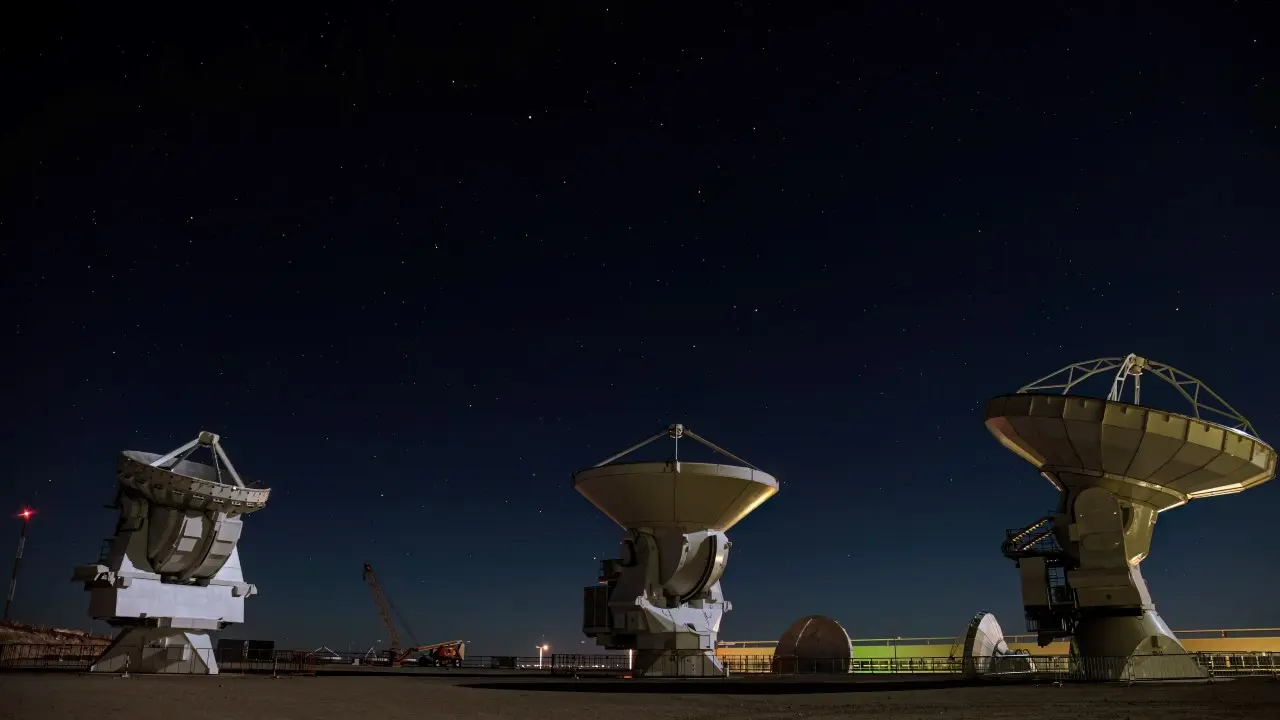
Using the capabilities of the Atacama Large Millimeter/submillimeter Array (ALMA), researchers were able to identify a faint oxygen signal originating from galaxies observed between 700 and 800 million years after the Big Bang. This unprecedented detection offers a direct look at the raw material that fueled the formation of the first generations of stars, representing a crucial advance in understanding cosmic origins.
Unraveling the mystery of the formation of the oldest galaxies in the universe
For several decades, astronomers have been able to examine stars and hot ionized gas in distant galaxies, allowing them to reconstruct important chapters of cosmic history. However, one of the most critical elements for galactic evolution has remained largely hidden: neutral gas, which acts as a direct fuel for star formation. This gas is the reservoir from which new stars are born, and is central to understanding how the first galaxies formed and evolved. Although observatories like the James Webb Space Telescope (JWST) and the Hubble Space Telescope (HST) have revolutionized our understanding of the early universe, they cannot directly detect this neutral component. Consequently, scientists often relied on indirect indicators that could come from multiple environments, generating uncertainty about the true conditions within ancient galaxies. The challenge was even greater at extreme distances, where weak signals are extremely difficult to isolate. The new observations overcome this limitation, providing one of the clearest views yet of the gas reservoirs that shaped the universe in its early years.
ALMA identifies oxygen signal key to cosmic dawn
The international research team focused its efforts on four representative star-forming galaxies, which date back to an era when the universe was less than a billion years old. With the help of ALMA, scientists were able to detect the 145 µm [O I] emission line in all four galaxies. This signal, which originates from neutral oxygen atoms, is considered one of the most direct indicators of neutral gas available to astronomers. Unlike the frequently used [C II] emission line, which can arise from both neutral and ionized regions, the oxygen signal provides a clearer perspective of the material actively involved in star formation. To reinforce their conclusions, the researchers also analyzed the 205 µm [N II] emission line, which tracks only ionized gas. The weak presence of this last signal indicated that most of the detected emission actually came from the neutral gas. The result allowed the team to isolate and investigate the elusive fuel reservoirs within these distant galaxies with a previously unattainable level of confidence.
Leia Também

Messi reaches 19 goals in FIFA World Cups with great free kick for Argentina in clash with Jordan

Cristiano Ronaldo shines beyond the pitch at the 2026 World Cup with business empire and family luxury

At 41, Cristiano Ronaldo reaffirms his historic legacy and prepares to shine in the 2026 World Cup
Collaboration between ALMA and JWST reveals characteristics of early galaxies
The study, published in the *Astrophysical Journal*, integrated ALMA observations with data from JWST, enabling researchers to investigate the physical and chemical properties of the gas in remarkable detail. The analysis revealed that the neutral gas within these galaxies was extremely dense, reaching levels comparable to those found in modern starburst galaxies, which are among the most prolific stellar factories in the universe. However, the surrounding radiation fields appeared somewhat less intense than those typically associated with starbursts. This combination describes early galaxies as compact, gas-rich systems capable of sustaining vigorous star formation under conditions unlike many of their modern-day counterparts. By comparing oxygen and carbon signals, scientists were also able to improve the interpretation of previously collected [C II] observations, helping to contextualize years of observational data more clearly and accurately. The findings suggest that many early galaxies contained substantial reservoirs of dense neutral gas, creating ideal environments for rapid stellar growth during one of the most transformative periods in cosmic history.
Historic achievement in direct detection of neutral gas in distant regions
The importance of this discovery transcends the four galaxies examined in the study. By establishing a direct method for tracking neutral gas over extraordinary distances, the research opens up new opportunities to investigate how galaxies formed in the universe’s earliest epochs. Assistant Professor Yoshinobu Fudamoto highlighted the significance of the feat, stating: “Our results represent the most distant direct detection of neutral gas in typical star-forming galaxies to date. This analysis unlocks the potential of a vast amount of existing [C II] observations as a probe of neutral gas in the early universe.” The statement highlights how the new detection method not only offers new observations but also increases the scientific value of previously collected large data archives. Scientists can now review old measurements with greater confidence, extracting *insights* that were previously obscured by uncertainty about the origin of observed signals. This advance effectively transforms a widely used observational tool into a more powerful probe of galactic evolution during the cosmic dawn.
New horizons in the investigation of primordial stellar fuel
The study’s implications could shape future investigations into the early universe for years to come. By demonstrating the effectiveness of the 145 µm [O I] emission line, researchers have established a new path to studying one of the most elusive components of young galaxies. Dr. Akio K. Inoue underscored the importance of the result, saying, “Our work establishes the [O I] emission line as an effective tool for studying an elusive gaseous component in the early universe, opening a new window into the ‘fuel’ behind star formation.” It is expected that future research will expand the sample well beyond the four galaxies analyzed in this work. By combining observations from ALMA, JWST and next-generation facilities, astronomers hope to build a comprehensive timeline of how galaxies accreted gas, formed stars and evolved into the vast structures seen throughout the cosmos today. Each new detection brings scientists closer to answering one of astronomy’s most fundamental questions: how the first galaxies emerged after the Big Bang and ultimately gave rise to systems like our own Milky Way.