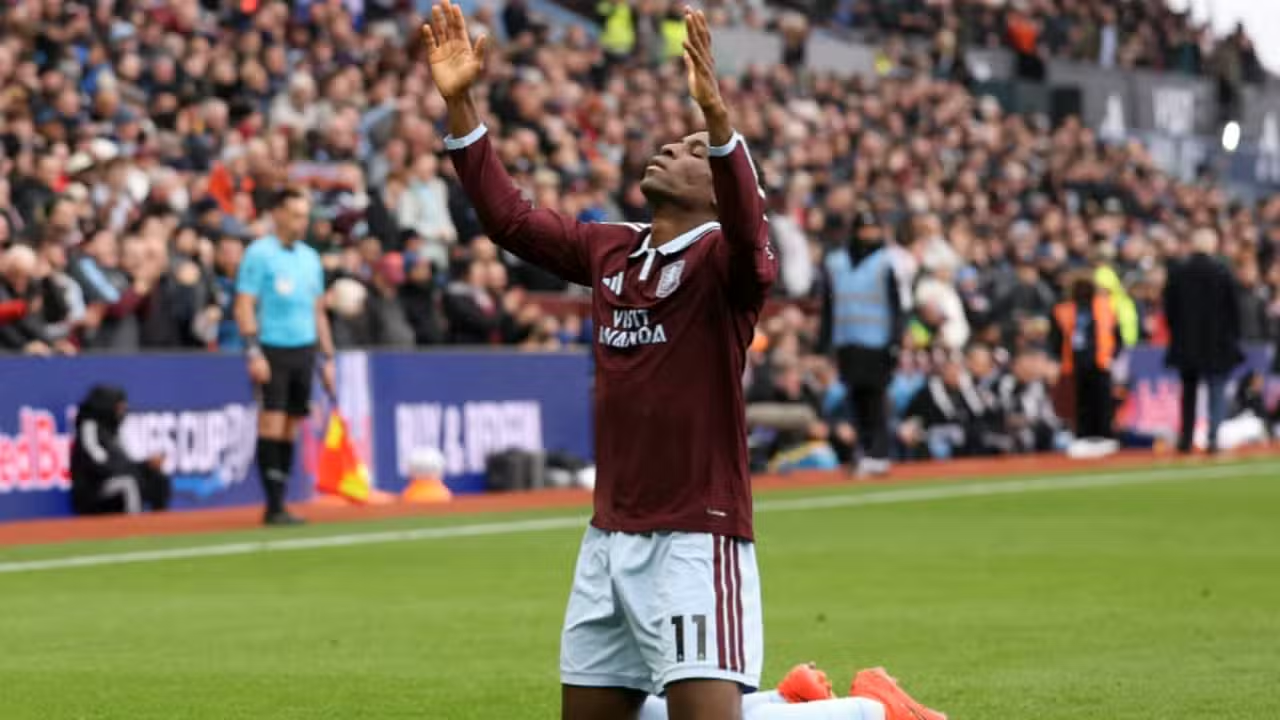
An intense discussion dominates the sports scene: Endrick. After the 1-1 draw against Morocco, the striker’s absence on the field raised questions, especially considering Igor Thiago’s lackluster performance and the Seleção’s difficulty in building offensive plays.
Coach Carlo Ancelotti, as widely reported, has shown caution with the young athlete’s development. However, the reason for his low rating goes beyond age or international travel, residing mainly in the evaluation of his tactical and technical performance throughout the season.
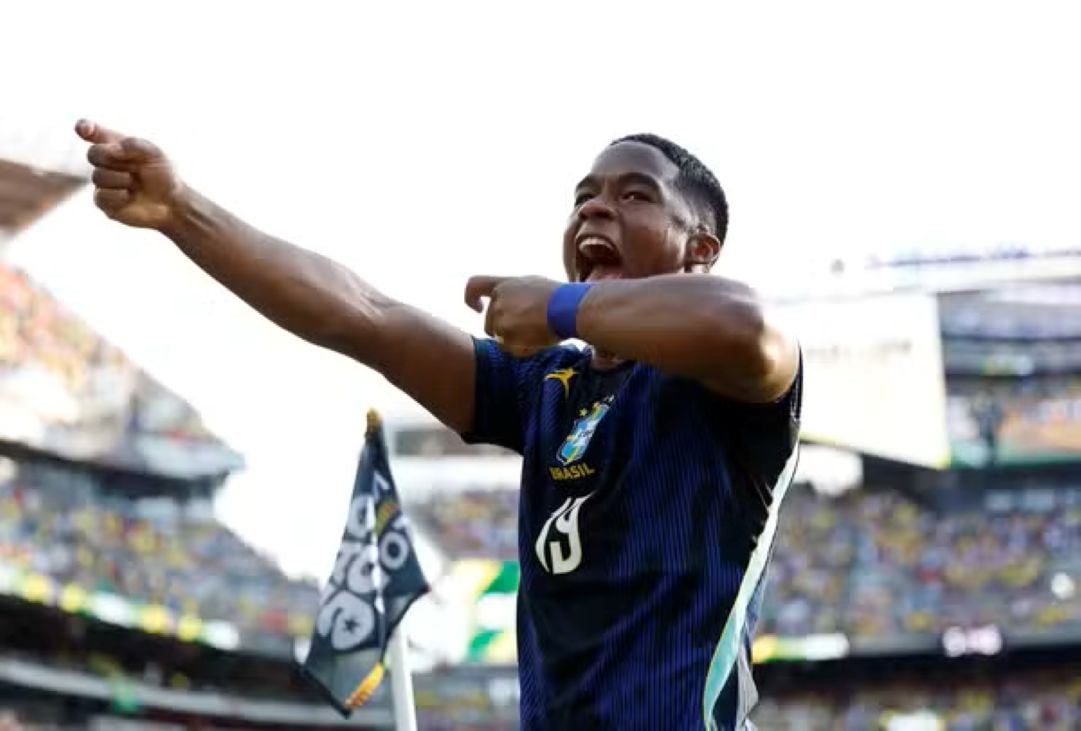
Endrick, wearing the Brazilian national team shirt in a World Cup match.
Even wearing the traditional number 9 shirt, Endrick’s role in the Lyon team differs from that of a classic center forward.
Since arriving at the French club, the young striker has made 22 appearances, starting 20 of them, and contributed 10 goals and six assists. His participation in goals happens, on average, every 109 minutes on the field. Under the command of Paulo Fonseca, who adopts the 4-2-3-1 formation, Endrick plays on the right side in a line of three attacking midfielders, alongside Khalis Merah centrally and Afonso Moreira on the left wing.
In the victorious clash against PSG in April, Fonseca opted for a 4-3-3 system, where Khalis Merah acted as a “false nine” and Endrick, once again, started his plays on the right, as can be seen in the image that illustrates this report.
In this tactical configuration, Endrick leverages his main characteristics: his notable physical explosion and ability to explore empty spaces. Instead of remaining fixed between defenders waiting for the ball, he starts from the right flank and enters the area at high speed.
In football vocabulary, this movement is known as “attacking from deep”, which consists of running behind the opponent’s defensive line to receive passes freely or overcome marking.
The movement that resulted in a goal against PSG
The clearest illustration of this style of play came in a match against Paris Saint-Germain, one of the strongest teams in Europe this season. In Lyon’s 2-1 victory, Endrick started the first goal from the right. He did not remain static between the defenders; on the contrary, he advanced from the side while PSG’s defense reorganized, exploiting the space left and surprising the markers to find the net.
At the moment of the first goal against PSG, Endrick starts his run from the right aisle.
This particularity of Endrick is not just restricted to goal attempts. Throughout much of the match, he receives the ball wide on the right, challenges the marker and attacks the area. Instead of positioning himself between the defenders, waiting for crosses or acting with his back to goal, he surprises by appearing in the gaps opened by the opposing defensive line.
Analysis of his heat map of the season reinforces this observation, demonstrating that most of his activities on the field are concentrated on the right flank.
Visualization of the Endrick heat map for the 2025/2026 season, with data from Wyscout.
Cahê Mota analyzes the likely reasons that led Endrick to remain on the bench in the match against Morocco.
Endrick’s positioning possibilities in the Brazilian National Team
A clear distinction appears between the theoretical plane and reality. In terms of possibilities, Endrick is seen as capable of playing in any of the three offensive roles. However, in practice, he competes for a place in the right sector with Raphinha, who is the starter in that range in Carlo Ancelotti’s 4-4-2 formation, and also with Luis Henrique, used on the same side in pre-World Cup friendlies and in the game against Morocco.
Competition for this position is not trivial. While the Lyon athlete is predominantly used to speed up plays and attack defensive gaps, Raphinha demonstrates a significantly greater participation in the offensive organization. The Barcelona player completes, on average, 36.6 passes every 90 minutes, contrasting with Endrick’s 16.0. This divergence is repeated in passes received (32.9 versus 13.2 per 90 minutes), in passes to the final third of the field (3.7 versus 2.1) and in passes directed to the area (3.1 versus 2.0).
Statistical data shows that Endrick exhibits greater decision-making power close to the goal. On the other hand, Raphinha makes a more continuous contribution throughout the match, helping to develop offensives and maintain the team’s general balance. One of the maneuvers frequently performed by Raphinha is to seek connection with the defensive midfielders, sometimes even on the left side of the field, as illustrated in the following image.
The Brazilian team presents flaws in the exchange of passes due to the lack of rapprochement between the midfield and defense.
This, however, does not imply that Endrick is doomed to a secondary position in the Brazilian team. The perception shared by coaches such as Ancelotti, Dorival, Paulo Fonseca and even Abel Ferreira is that Endrick needs to expand his influence beyond defining plays, adding more in the build-up phase and in moments without possession of the ball.
Coach Carlo Ancelotti expressed his view of the striker: “I had the impression that Endrick was a more centralized player, a typical number 9. However, he has been playing wide and showing great performance in that role. He is a young athlete, with immense quality. He is part of the future of the Brazilian team, alongside names like Rayan and Estêvão, who will certainly be central figures in the team in the future.”
Felipão offers his opinion on Endrick’s possible lineup in Brazil’s next match against Haiti.
Given this scenario, the question remains: will Endrick be selected as a starter or not? The answer will be revealed next Friday, at 9:30 pm (Brasília time), when the team will face Haiti in the second round of Group C of the World Cup.