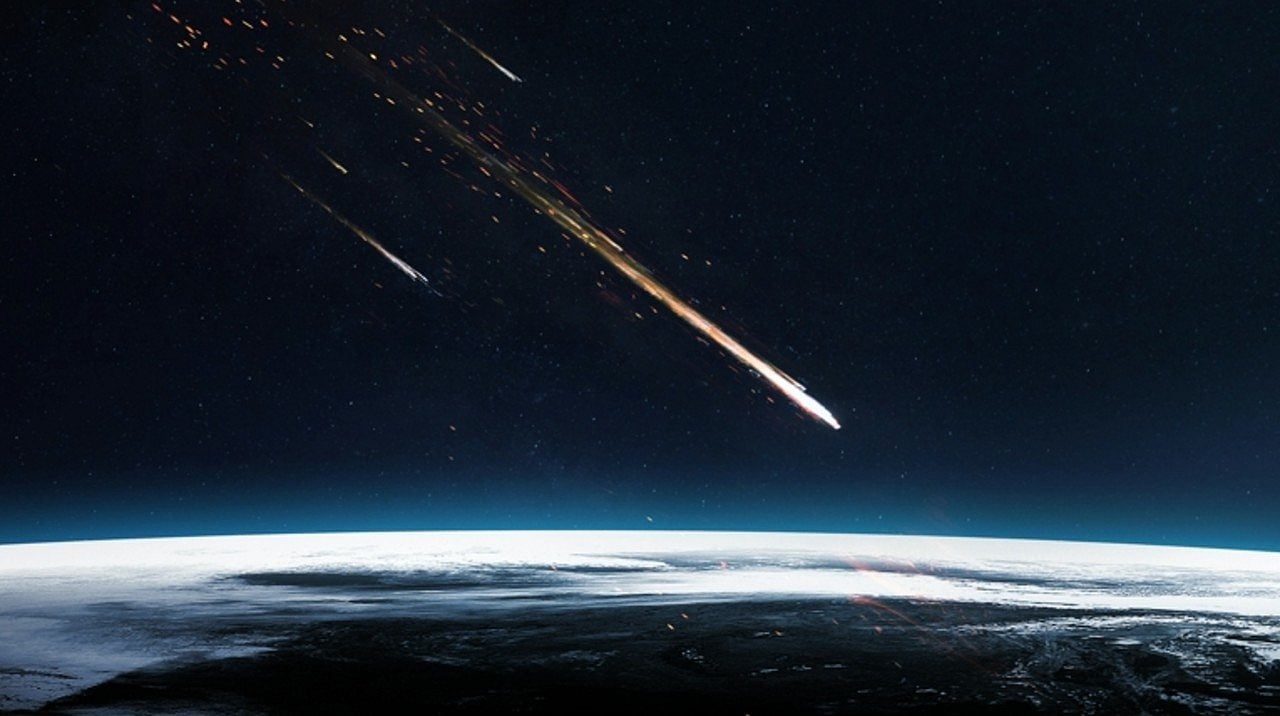
Fragments of a lunar meteorite, recovered in northwest Africa, provided evidence of an asteroid collision that occurred on the Moon about 3.5 billion years ago. This event coincides with other independently dated impacts on Earth and asteroid 4 Vesta, marking a crucial period where the first signs of life began to flourish on our planet.
The early phase of Earth’s existence, spanning its first billion years, remains largely inaccessible to direct geological studies due to the planet’s intense activity.
The surface that documented the events of the early Hadean and Archean has been almost completely annihilated, reworked by the movement of tectonic plates, worn down by water and wind, buried under more recent sedimentary layers, or melted and transformed by successive cycles of mountain building and crustal renewal. The few terrestrial rocks that survive from more than 3 billion years ago are notable exceptions, and most of their contents have been considerably modified by the long passage of geological time.
This sets up a particular situation, as the period in which life first emerged on Earth, between approximately 4 billion and 3.5 billion years ago, represents one of the most relevant intervals in the solar system’s timeline. However, it is also an era for which planet Earth itself has preserved the slightest direct evidence.
To understand the scenario of that time, when life was just beginning to manifest itself, researchers are forced to seek information from other celestial bodies.
How does the moon keep records that the earth has lost?
Based on existing evidence, the Moon does not have any of the active geological processes that would have erased Earth’s earliest record. There is no movement of tectonic plates, no flow of water, no atmosphere capable of eroding rocks, nor a biosphere that decomposes them. The lunar surface functions as a passive recording medium, preserving everything that hits it while the rock itself remains intact.
The same impact events that left no discernible trace on Earth, due to the constant movement and transformation of our planet, are still clearly visible on the Moon, which has remained unchanged.
The Moon also shares Earth’s orbital neighborhood and its history of bombardment. The two bodies have been close companions for approximately 4.5 billion years, sailing through the same space and being buffeted by debris from the same population of asteroids and comets. The material that reached the Moon, according to the available evidence, was broadly representative of what reached the Earth in the same period. In this way, the lunar record serves as a valuable substitute for the terrestrial record that no longer exists today.
Lunar samples reach our planet in two ways. The first involves direct collection by space missions, such as those carried out by Apollo, the Soviet Luna missions and the Chinese Chang’e missions, which brought material from specific locations on the lunar surface. The second way is more incidental.
Occasionally, an asteroid impacts the Moon with enough force to eject fragments of lunar rock at speeds that exceed the satellite’s escape velocity. Some of these fragments travel through the Earth-Moon system for years or millennia before falling to the Earth’s surface in the form of meteorites. To date, about 600 lunar meteorites have been catalogued, and each carries a record of the portion of the lunar surface from which it was ejected.
Analysis of the NWA 12593 meteorite found in Africa
In May 2026, a group of scientists led by Carolyn Crow of the University of Colorado at Boulder released the results of a thorough investigation of a specific lunar meteorite, identified as NWA 12593, in the prestigious journal *Geology*. The specimen was discovered in northwest Africa, a region where the search for meteorites has turned into a large-scale commercial activity, and was rescued for in-depth scientific analysis.
Crow’s team employed a combination of methods, including radiometric dating, mineralogical analysis, and electron backscatter diffraction imaging, in order to reconstruct the events recorded in the rock.
Fragment NWA 12593 revealed evidence of three distinct impacts on the lunar surface, each of which left unique mineralogical signatures on the small piece of rock.
The oldest and most relevant event, according to radiometric dating data, occurred approximately 3.486 billion years ago. The energy released by this collision was enough to melt the surface of the surrounding lunar region, transforming it into a fluid layer of liquid rock. The temperatures reached during this impact were high enough to generate cubic zirconia, a mineral form of zirconium dioxide that is also artificially produced for use in jewelry. Cubic zirconia only forms at temperatures greater than approximately 2,370 degrees Celsius, and under natural conditions it rarely persists as the mineral undergoes structural transitions to lower temperature forms as it cools. What Crow’s team identified in NWA 12593 was not intact cubic zirconia, but rather the characteristic structural trace left in its crystal lattice, known as cubic zirconia phase inheritance, which is an indicator of original high-temperature formation.
The second impact event was a lower intensity collision that followed the first. This impacted the layer of solidified molten material, created by the previous event, and united them under the heat and pressure generated, creating a rock called breccia.
Sample NWA 12593 consists of this breccia, a molten composite of fragmented material from the original molten layer and adjacent rocks, the mineralogical equivalent of crushed concrete remade under immense pressure.
The third event was the most recent collision that completely detached the breach from the lunar surface, launching it on a trajectory that brought it to Earth. Crow’s team has not yet been able to determine the exact date of this third impact, but it was geologically recent enough for the rock to survive the long journey without significant changes.
The meaning of impacts 3.486 billion years ago
The oldest impact identified in meteorite NWA 12593 is notable in its own right, serving as evidence of a significant event in the history of lunar bombardment. However, its importance grows substantially when compared to impact records preserved on other celestial bodies in the inner Solar System.
On our planet, a period of approximately 3.47 billion years ago is recorded in specific geological formations, known as spherules, which are layers of glass droplets and fragmented rocks resulting from the deposition of debris from large impacts. The oldest and most precisely dated spherules on Earth, found in the Barberton Greenrock Belt in South Africa and the Pilbara Craton in Western Australia, corroborate this date.
The agreements between the age of the lunar impact and the Earth spherules, according to Crow’s team’s analysis, are close enough to suggest a shared bombardment event rather than a fortuitous coincidence.
The third crucial correspondence arises with the asteroid 4 Vesta, the fourth largest body in the asteroid belt and the origin of a sizable family of meteorites called eucrites, which reached Earth. Eucrites carry their own radiometric records of impact events on their progenitor body, and the oldest of these events cluster around the same 3.5 billion year time window.
Crow’s team’s interpretation is that the convergence of impact ages on the Moon, Earth and 4 Vesta — three distinct bodies in different parts of the inner Solar System — points to a common cause, rather than a series of isolated coincidences.
The most parsimonious common explanation, based on available evidence, is the catastrophic breakup of a large asteroid somewhere in the inner Solar System around this time. The resulting debris would have spread throughout the inner Solar System over a period of approximately 500 million years, generating a wave of impacts on every body it encountered. The bombardment window identified by Crow’s team, 3.7 billion to 3.2 billion years ago, is consistent with the expected duration of such a debris wave.
The connection between cosmic impacts and the origin of life
The oldest and most widely accepted fossil evidence of life on Earth, documented in a 2006 peer-reviewed study led by Abigail Allwood and her colleagues in the journal *Nature*, was discovered in stromatolite formations in the Pilbara Craton in Western Australia, dating to approximately 3.43 billion years ago. The Pilbara stromatolites are stratified sedimentary structures produced by communities of ancient microorganisms that inhabited shallow marine environments, and the Allwood team’s analysis confirmed their biogenic origin, refuting competing abiotic hypotheses advocated in the scientific literature for decades. Microfossils from the Apex Chert, also from the Pilbara region, date from approximately the same period and represent some of the earliest candidate evidence for microbial life on the planet.
Life on Earth, according to the most solid interpretation of current evidence, was emerging and beginning to spread across the planetary surface at exactly the same time as the bombardment wave identified by Crow’s team reached the inner Solar System.
The relationship between large impacts and the emergence of life is, in fact, a controversial topic. One perspective, supported by some peer-reviewed analyses, suggests that large-scale impacts would have been catastrophically destructive to any nascent biosphere, sterilizing the surface and forcing life to retreat to deep underground environments or to resume after the bombardment stopped. A second view, supported by other analyses, proposes that the impacts may have been essential to the emergence of life, rather than harmful. Large impacts can create sustained hydrothermal systems, deliver organic molecules and water from the impactors themselves, and generate chemically diverse environments of the kind that models of prebiotic chemistry indicated were plausible sites for the synthesis of the first biological molecules.
Crow’s team’s findings do not directly resolve this dispute. What they establish is the frequency of the bombardment, the fact that large impacts were occurring at the exact moment life was emerging, and that this same bombardment was affecting multiple bodies in the inner Solar System simultaneously. Whether these impacts aided or hindered the development of life, based on available evidence, is a question for future peer-reviewed studies.
Methodological aspects and reservations of the research
Several methodological caveats apply to the literature described above.
Radiometric dating of impact events relies on isotopic systems that can be partially altered by subsequent thermal events. The date of 3.486 billion years for the first impact in NWA 12593 is robust, but the assumption that this date reflects a single discrete impact rather than a cluster of nearby events cannot be made categorically on the basis of a single rock. The broader bombardment period of 3.7 to 3.2 billion years ago identified by Crow’s team is more firmly established than any individual impact dating within that range.
The interpretation that the impact ages on the Moon, Earth, and 4 Vesta reflect a common cause is the simplest and most parsimonious explanation, although it is not the only one available. The convergence of impact ages could, in principle, be the result of three independent processes that, by chance, produced a similar chronology, although the prior probability of such independent convergence is low. The common cause interpretation is the best current reading of the evidence, but it is not definitively proven.
The connection between the bombing and the emergence of life is a correlation, not a proven causal relationship. The chronology coincides, but it also coincides with many other geological and chemical events that occurred on the early Earth in the same period. Establishing that the impacts caused or contributed to the emergence of life, rather than just coinciding with it, would require evidence that the current scientific literature does not yet have.
Conclusions and the future of space research
Several conclusions derived from the evidence presented by Crow’s team are worth highlighting.
The first conclusion points to an early history of the inner Solar System, in the period between approximately 4 and 3 billion years ago, that was substantially more turbulent than the terrestrial geological record alone would indicate. Earth has eliminated most evidence of its own bombing history. However, the Moon and the asteroid belt, in turn, preserved them. Lunar and asteroid records, according to the strongest interpretation of currently available evidence, indicate that large impacts continued to occur in the inner Solar System for hundreds of millions of years after the conventional end of the so-called Late Great Bombardment, around 3.9 billion years ago.
The second conclusion is that the bombardment, whatever its origin, was happening exactly at the moment when life on Earth was leaving its first detectable signs. The 3.5 billion year period encompasses Pilbara stromatolites, Apex chert microfossils and isotopic geochemical evidence of early biological activity. It also includes the impact event recorded in NWA 12593, the corresponding spherule beds on Earth, and the analogous impact ages at 4 Vesta. The two stories, of bombing and biogenesis, unfolded in the same period and on the same planet.
The third conclusion is that the methodology for reconstructing Earth’s earliest history, using lunar and meteoritic samples, now demonstrates true productivity. Crow’s team’s analysis of a small rock from northwest Africa generated evidence of events that occurred 3.486 billion years ago on the lunar surface, correlated these events with independent records on Earth and in the asteroid belt, and placed them in the context of the emergence of terrestrial life. The geological record that Earth has lost is, based on available evidence, partially recoverable from rocks that fell here from other locations.
The fourth hypothesis, based on the most robust interpretation of peer-reviewed evidence to date, suggests that the first 1.5 billion years of life on Earth were experienced under a sky considerably more dangerous than the modern sky, on a planet that was repeatedly buffeted by debris from events that the remaining terrestrial geology can no longer fully describe.
What managed to survive this period gave rise to all the living beings we know today.
The rest of the story is now being recovered, in small fragments, from the rocks that reached us from other places in space.