

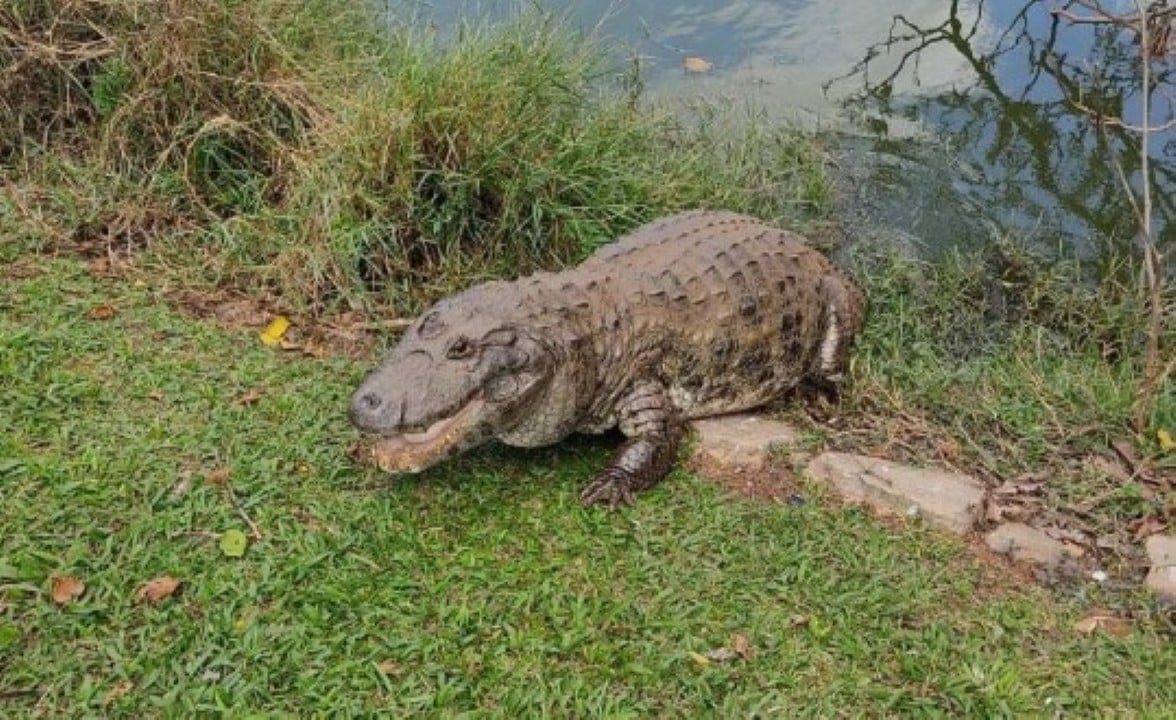
The exact origin of its presence is unknown. However, it is notable for its grandeur and calm behavior, rarely being seen on low temperature or rainy days, seeking solar heat to maintain its thermoregulation.
An employee at the São Paulo Zoo, with more than four decades of experience, remembers hearing reports about the enigmatic inhabitant of the lakes of the neighboring Botanical Garden since the beginning of her journey at the ticket office. Both she and the reptile have remained in the area since a period before the popularization of the internet and the reestablishment of democracy.
Although some visitors have spotted it on rare occasions, many others have never encountered it. The veteran in question is a yellow-snouted caiman, a species characteristic of the Atlantic Forest, whose presence in the area reinforces the resilience of native fauna in fragmented urban environments. The Zoo, the Botanical Garden and the Simba Safari are located in a preservation area of this biome, in the Fontes do Ipiranga State Park, located in the Água Funda neighborhood, south of the capital of São Paulo.
The story of the reptile in the park intrigues even the oldest employees
Despite its long stay, the reptile does not have an official name, being only called “Botanical Alligator” by workers. A recent attempt to locate it on a cold, rainy day was unsuccessful, as expected, due to its preference for higher temperatures.
The story takes on an even more intriguing touch with the information from park employees that the alligator has a companion. This female, however, is described as more reserved and almost never appears in the lake, which covers an area of approximately 80 thousand square meters, according to data from the Reserva Paulista concessionaire.
Cybele Lisboa, a 43-year-old biologist from Reserva Paulista, corroborated the presence of the female. She estimated the size of the male alligator at about 8 feet long and weighing approximately 220 pounds, assessments based on visual observation and comparison with other resident alligators at the zoo.
“It is a carnivorous species whose diet adapts according to development”, explained Cybele, who has worked at the zoo for 23 years. The biologist detailed that, in their youth, they consume insects, small fish and invertebrates. In adulthood, they keep fish as their main food, but include small mammals, such as opossums and rodents, as well as birds. She added that the life expectancy for a yellow-snouted caiman in captivity is approximately 50 years, with no precise estimate for the wild.
The legendary presence of the reptile is a fact widely known among employees, from those who have been working for the longest time to the youngest, including those who joined after the privatization of the site, around five years ago. However, the animal’s fame is not just restricted to those who work at the park; Residents of Água Funda and nearby areas also share stories and experiences about the alligator.
Testimonies prove the existence of the reptile and reveal its diet
Israel Monteiro, a 43-year-old barber, initially considered the stories about the alligator to be mere legends that he heard on walks with his family around the botanical area. His disbelief, however, ended the previous year, when he saw the animal resting in the vegetation while running along Avenida Miguel Estefno, which borders the Botanical Garden and the São Paulo Zoo, despite the fences that separate the park from the public road.
“When I was growing up, my father took us to the lakeside. To be honest, I didn’t even believe the stories. But last year, I saw him sunbathing, completely still. What a good life for an alligator, feeding on the best,” reported Israel.
The “quiet life” mentioned by Israel has a clear justification: the lake, according to reports from employees, is abundant in schools of tilapia, which constitute the basis of the animal’s diet. Furthermore, several birds frequent the area and, occasionally, can supplement their diet in moments of inattention.
Park employees confirm that his appearances are infrequent, but whenever he appears, the moments are usually recorded in photographs. A security guard even displayed an image of a very robust reptile.
However, a crucial question remains without a definitive answer: how did the reptile arrive at the location? Hypotheses include a possible escape from the zoo — a scenario almost ruled out, as the pipes would be too narrow for it to pass through and there are no records of escapes in internal reports. Other possibilities would be displacement caused by a flood in the area or, the most likely, being released there by someone who was illegally keeping him in captivity.
There is a sign at the edge of the lake warning the public not to interact with the animals. An employee summed up the situation by stating that he simply “chose the place” and “remains his own.”




