Astronomers finally detect wind from the black hole at the center of the Milky Way after 50 years of searching
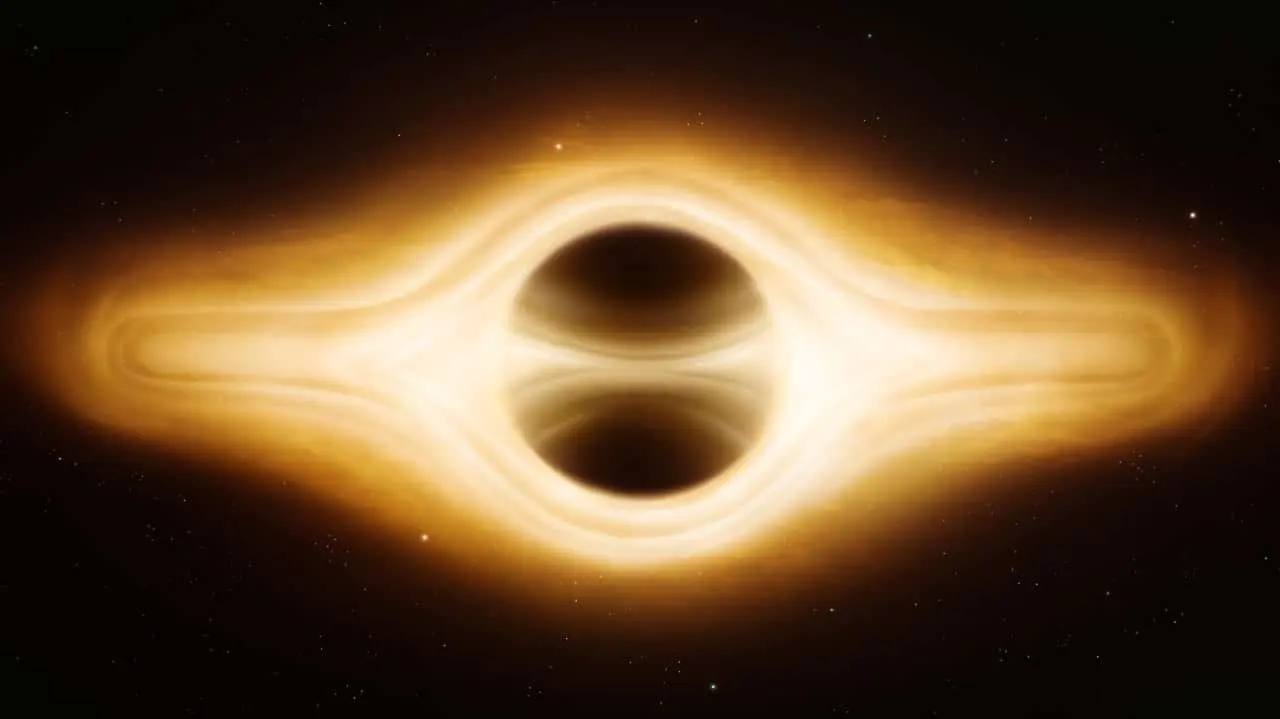
Astronomy researchers have revealed decades-awaited evidence that Sagittarius A*, the supermassive black hole located at the center of the Milky Way, emits a stream of material, bringing to light unprecedented details about its interaction with the cosmos.
After a decades-long investigation, evidence of a discreet but constant flow of matter coming from the heart of our galaxy was identified.
There was a missing piece in our understanding of the Milky Way’s central black hole. For more than fifty years, scientists have been searching for a characteristic wind that, according to theoretical projections, should emanate from Sagittarius A* (Sgr A*), the gigantic singularity hidden at the core of our galaxy. However, even with improvements in equipment and countless analyses, this expected movement remained elusive.
Currently, experts from Northwestern University have announced the detection of this phenomenon, providing an unprecedented perspective on the functioning of the enigmatic center of our galaxy.
Unraveling the Mystery of Sagittarius A* Flow After Five Decades
By obtaining the most detailed visual representation ever recorded of the area surrounding Sgr A*, the research team has managed to resolve one of astronomy’s most persistent dilemmas. The findings also enrich knowledge about the physical dynamics operating in the galactic center.
The results of the investigation were published in the renowned scientific journal The Astrophysical Journal Letters.
Mark Gorski, from Northwestern University and co-leader of the study, explained that “a black hole needs to emit some kind of flow, unless it is in an absolute vacuum, which does not exist in the universe.” He added that “thanks to the new observations, we have, for the first time, achieved enough clarity to identify the evidence of this flow. By analyzing the data, we confirmed: ‘This is it. What everyone was looking for 50 years ago is here.'”
Elena Murchikova, who also led the research alongside Gorski, highlighted: “We were able to prove, initially, that the molecular gas that is extremely close to the black hole supplies it.” She also highlighted that “the flow does not have great intensity and its orientation tends to change over time. This fact indicates that Sagittarius A* is not a singular phenomenon and that the Earth’s position in the cosmos is also not distinguished by exclusivity.”
The influence of black hole flows on the formation of galaxies
Mark Gorski serves as a research assistant professor at the Center for Interdisciplinary Exploration and Research in Astrophysics (CIERA) at Northwestern University, where he focuses his studies on galactic evolution. Elena Murchikova, in turn, is an authority on black hole astrophysics, teaching physics and astronomy at the same institution’s Weinberg College of Arts and Sciences and is also a member of CIERA.
Despite their reputation for attracting everything around them, black holes also have the ability to eject matter. For several years, the scientific community has been projecting that active black holes would release high-energy streams. As the gas is drawn spirally inward, it reaches speeds approaching that of light. This acceleration generates enough energy and pressure to eject some of this material back into space, either as winds or powerful jets.
Although there were records of previous eruptive events from Sgr A*, proof of an uninterrupted flow was elusive. The Northwestern team suggests that this difficulty is due to the current condition of the black hole, which is in a period of relative quiescence and is therefore notoriously complex to detect.
Leia Também

Messi reaches 19 goals in FIFA World Cups with great free kick for Argentina in clash with Jordan

Cristiano Ronaldo shines beyond the pitch at the 2026 World Cup with business empire and family luxury

At 41, Cristiano Ronaldo reaffirms his historic legacy and prepares to shine in the 2026 World Cup
Murchikova explained that “to study our own black hole, we need to traverse the plane of the galaxy.” She detailed: “This involves observing through a dense layer of gas, dust and ionized structures, which makes visualization a considerable challenge.”
ALMA telescope offers the clearest observation of the galactic nucleus
Improvements in observation methodologies, in short, allowed researchers to study the area with an unprecedented level of precision. Based on five years of in-depth observations carried out by the Atacama Large Millimeter/Submillimeter Array (ALMA) in Chile, Gorski and Murchikova were able to generate the most detailed representation yet of the cold molecular gas surrounding Sagittarius A*.
The new image recorded gas present just one parsec, the equivalent of approximately three light years, from the black hole. After employing a calibration method to cancel out the object’s intense radio emissions, the team developed a mapping that was one hundred times deeper and eighty times sharper compared to previous depictions. This improved perspective brought previously unseen formations to light.
A newly discovered aspect immediately caught the team’s attention. Scientists identified an extensive conical cavity, measuring almost a parsec (about three light years) long and opening 45 degrees, that was devoid of cold molecular gas. The most plausible conclusion was the existence of a hot flow emanating from Sgr A*. As this flow passes through the area, it displaces the cold gas or heats it to a level that makes it impossible to detect.
Gorski explained: “When a black hole ejects hot material, it does not mix with the cold material. It pushes it away or raises it to a temperature that makes it invisible. If the temperature is too high, the cold gas simply disappears from observation.”
Giant conical cavity confirms central black hole activity
Although stars also produce their own winds, the research team found that these isolated stellar streams would not be able to shape such a vast, unobstructed area. Not even the sum of the energy released by neighboring stars would be enough for this effect.
Gorski described the area as “a significant absence of matter.” He added: “We have estimated the amount of energy required to form this cavity, and the value exceeds the supply capacity of the stars in the region. Therefore, it is imperative that there is a contribution from the supermassive black hole. Furthermore, the conical shape of the cavity points directly towards the black hole.”
Before releasing their findings, the scientists looked for additional validation. They compared their own results with previous records from NASA’s Chandra X-ray Observatory, which had identified intense X-ray emissions in the same location. The Chandra data showed an exact match with the gas-free cavity detected in the ALMA analyses.
Gorski stated that “extraordinary claims require equally remarkable evidence.” He continued: “Our goal was to ensure that we were not faced with a simple error in the image. Therefore, Chandra’s X-ray representation complemented our analysis impeccably, confirming the correlation of molecular features.”
Chandra X-ray observations corroborate new discovery
Murchikova revealed that “when faced with something new, the first reaction is not to think ‘How incredible, we have made a discovery’”. On the contrary, she described the initial thought as “‘Oh my God, what is wrong with my methodology?’”. However, she concluded that “when our image was superimposed on the X-ray, all the elements aligned and understanding became clear.”
Considering the scope of the flow’s influence on a nearby stream of ionized gas, the team calculates that this emission has been active for at least 20,000 years. The findings also indicate that Sgr A* is relatively calm compared to a vast number of other supermassive black holes in different galaxies.
Murchikova emphasized that most black holes in other galaxies remain in a low-activity state for much of their existence, “but we are often only able to study them when they are at their peak energy.” She added that “it is extremely relevant to investigate black holes in this state of least activity, despite it not being the most common to be observed. Sagittarius A* now offers us an unprecedented opportunity to understand the dynamics of a black hole during its quiescent phase, a behavior little documented until now.”