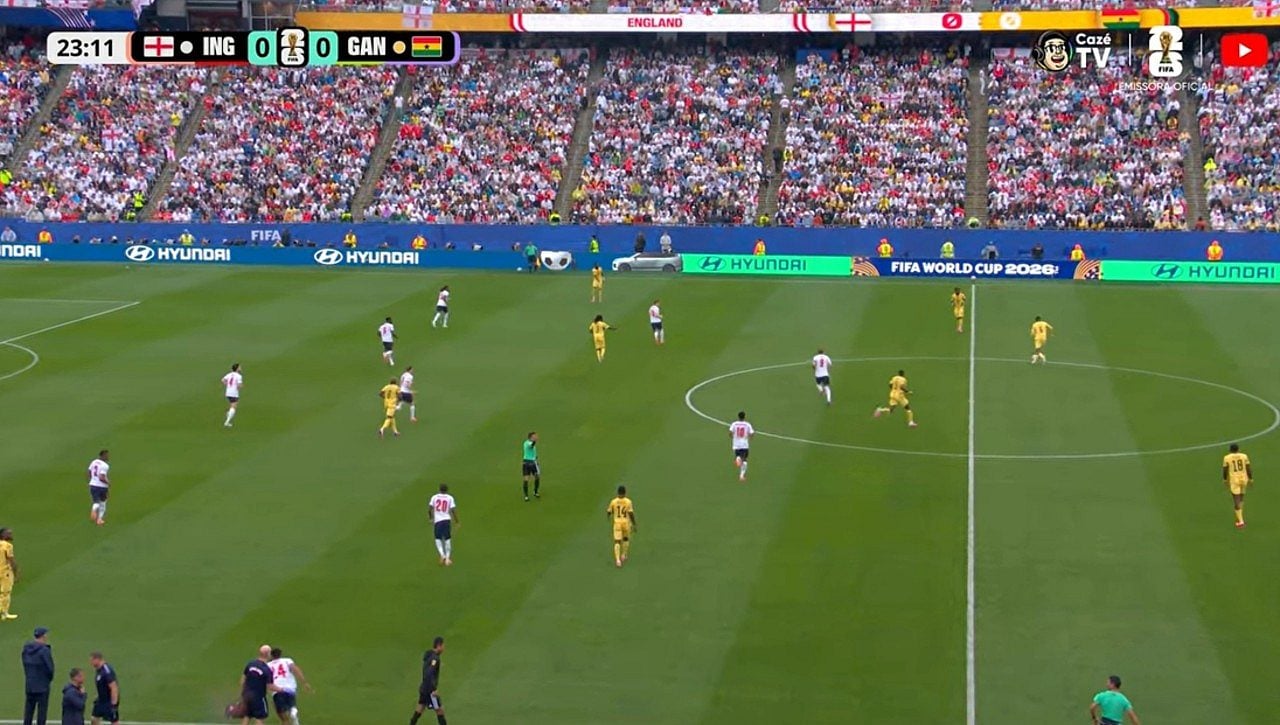
The clash between England and Ghana for the 2026 FIFA World Cup, at Gillette Stadium, in Foxborough, United States, continues with a scenario of intense English dominance in the first 23 minutes of the first half. Despite the score still unchanged at 0-0, the English team recorded an overwhelming 88% ball possession, compared to just 12% for the Ghanaian team. This massive control reflects a match where England completely dictates the pace, while Ghana adopts a reactive stance, focused on defense and trying to neutralize the opponent’s attacks.
Overwhelming control of ball possession at the start of the match
The ball possession statistic, which shows England having almost nine out of every ten touches of the ball in the first 23 minutes, is remarkable and unusual in a tournament as high-level as the World Cup. Generally, such unbalanced numbers are seen in games with great technical disparity, but even in these cases, maintaining 88% for such a prolonged period is exceptional. This demonstrates a clear strategy by the English to surround the opponent, exchanging passes and looking for spaces in the solid Ghanaian defense, which remains compact.
For England, the challenge lies in converting this numerical and territorial superiority into real scoring chances. So far, the team has recorded three shots, none of them directly on goal. The volume of play, driven by the likes of Declan Rice in midfield, is undeniable. Rice even made a blocked shot in the 16th minute, an indication of the constant pressure exerted by the Europeans.
The containment strategy adopted by the Ghana national team
On the other hand, Ghana presents a tactical approach that prioritizes defensive solidity, seeking to frustrate England’s offensive actions. With only 12% of the ball possession, the African team invests in closing spaces, hindering the opponent’s progression and, perhaps, exploring quick transitions or set pieces. Players like Thomas Partey in midfield and the attacking duo of Iñaki Williams and Jordan Ayew have the arduous task of containing the English advance and, when possible, breathing with the ball at their feet.
Ghana’s tactic, although it results in little possession, does not mean passivity. The team appears physically present, committing more fouls (five compared to England’s two) and attempting tackles, showing that it is active in marking. However, the lack of submissions so far demonstrates the difficulty in breaking the English siege and bringing danger to the opponent’s goal, indicating that the offensive strategy has not yet had any effect.
Minute by minute: the highlights of the first half
Follow the main events at the start of the game, with the most important plays recorded up to 23 minutes into the first half:
- 16′England intensifies its pressure and wins the first corner of the match, conceded by defender Jonas Adjetey after a play on the left.
- 16′Right after the corner, Declan Rice tries a powerful shot with his left foot from a difficult angle, but the ball is blocked by the Ghanaian defense, preventing it from reaching the goal.
- 18′English defender Marc Guéhi suffers a foul in the defensive field, committed by Iñaki Williams of Ghana, relieving the pressure on the English area.
- 18′In the same minute, a new infraction is marked, this time with Ezri Konsa, from England, committing a foul on Jordan Ayew in Ghana’s defensive field, creating an opportunity for the African team to breathe.
- 20′Marc Guéhi, from England, is again the target of a foul, this time in the attacking field, committed by Jordan Ayew, showing the physical intensity of the duel and Ghana’s attempts to stop the English advance.
- 21′The game is briefly interrupted due to an injury to Ghana forward Jordan Ayew, causing concern among the technical team.
- 21′Almost simultaneously, Reece James, England’s right-back, also required medical attention, and the match was briefly stopped for the players to recover.
Challenges and perspectives for the rest of the confrontation
With the game underway and still scoreless, both teams will face important tactical dilemmas as the first half progresses and, subsequently, into the second half. For England, the priority will be to transform their dominance of ball possession into offensive effectiveness, finding ways to break through Ghana’s defensive blockade. It is likely that the English coach will seek to adjust the positioning of the attackers or explore more plays on the flanks to create clearer chances. The lack of shots on goal, despite the pressure, is a point that will certainly be analyzed by the technical committee.
Ghana, in turn, needs to find a balance between defensive solidity and the ability to threaten the opponent’s goal. Maintaining just 12% possession of the ball and no shots throughout an entire match is an unsustainable scenario for any team aiming to win. The African team will need to be more aggressive in recovering the ball and bolder in transitions, exploiting the speed of their attackers in quick counterattacks. Keeping the score at 0-0 could be a positive result if they manage to hold off the pressure and, who knows, surprise at some point with an unexpected goal.
The current scenario suggests that the game will remain intense, with England incessantly looking for the goal and Ghana resisting bravely, hoping for an opportunity. Referee Said Martinez, from Honduras, has the task of maintaining control over a match that appears to be physically contested.
Follow complete coverage of the 2026 FIFA World Cup with Mix Vale
To ensure you don’t miss any details of this exciting tournament, the Mix Vale news portal offers live, minute-by-minute coverage of all matches of the 2026 FIFA World Cup. Stay up to date with all the plays, goals and decisive moments, with real-time updates directly on your device. Subscribe for free to Mix Vale notifications at www.mixvale.com and receive the news instantly, ensuring that you don’t miss anything about your favorite team and all the world cup clashes.
The 2026 FIFA World Cup continues in full swing with a schedule full of important clashes. In addition to the match between England and Ghana, several other games promise to shake up international football pitches. Check out some of the upcoming duels:
Future duels at the 2026 FIFA World Cup
- Today, 8pm:Panama faces Croatia
- Today, 23:00:Colombia vs Democratic Republic of Congo
- Tomorrow, 16:00:Switzerland plays against Canada
- Tomorrow, 16:00:Bosnia and Herzegovina duels with Qatar
- Tomorrow, 7pm:Scotland faces Brazil
- Tomorrow, 7pm:Morocco vs Haiti
- Tomorrow, 22:00:Czech Republic plays with Mexico
- Tomorrow, 22:00:South Africa vs South Korea
- June 25, 17:00:Ecuador faces Germany
- June 25, 17:00:Curaçao duels with Ivory Coast
- June 25, 20:00:Tunisia plays against Netherlands
- June 25, 20:00:Japan vs Sweden
- June 25, 23:00:Türkiye plays against the United States
- June 25, 23:00:Paraguay vs Australia
- June 26, 16:00:Norway faces France
- June 26, 16:00:Senegal against Iraq
- June 26, 9:00 pm:Uruguay plays against Spain
- June 26, 9:00 pm:Cape Verde vs Saudi Arabia
- June 27, 00:00:Egypt duels with Iran
- June 27, 00:00:New Zealand vs Belgium
- June 27, 18:00:Panama faces England
- June 27, 18:00:Croatia vs Ghana
- June 27, 8:30 pm:Colombia duels with Portugal
- June 27, 8:30 pm:Democratic Republic of Congo plays against Uzbekistan
- June 27, 23:00:Jordan faces Argentina
- June 27, 23:00:Algeria vs Austria
There is still a lot of football to play in the 2026 FIFA World Cup, and Mix Vale will continue to bring all the information, analysis and results for sports lovers. The match between England and Ghana is just one of the many chapters that promise excitement and great plays.