James Webb Telescope reveals deadly galactic winds that explain the extinction of stars in the early universe
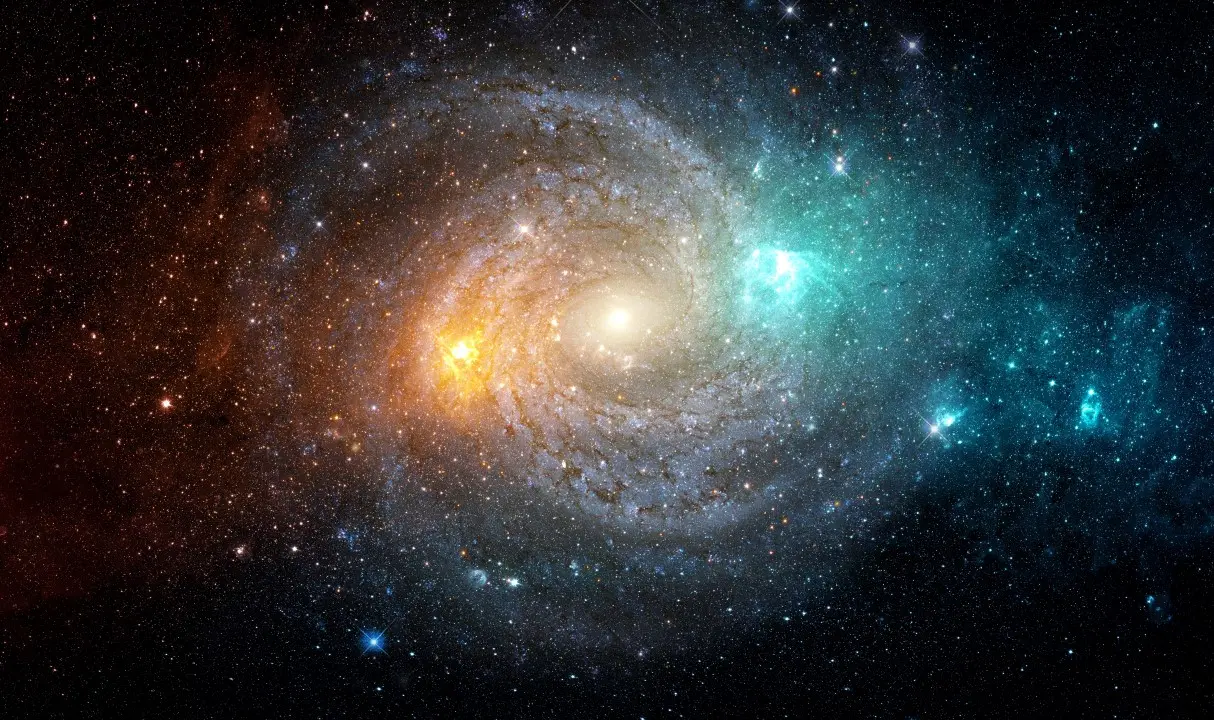
Newly published research indicates that powerful winds driven by stars are capable of annihilating galaxies, preventing the creation of new stars at an early period in cosmic history. This finding, based on data from the James Webb Space Telescope (JWST), offers new insight into galactic evolution.
The process of collision between galaxies, which leads to their merger into a single massive structure, can also cause the “death” of these celestial clusters by releasing jets of gas that inhibit the formation of stars. This complex cosmic interaction redefines the understanding of how galaxies evolve.
This dynamic could shed light on a mystery of the early universe, where several observations from the James Webb Space Telescope (JWST) have detected galaxies that grew surprisingly large in just a billion years after the Big Bang. Equally unexpected, many of these galaxies had already ceased their stellar production and became inactive about a billion years later.
Although galactic winds were thought to be responsible for “killing” galaxies in the past, astronomers lacked direct proof that this process could actually suppress star formation at such a remote stage in the cosmos. Now, a new study released on June 10 in the journal Monthly Notices of the Royal Astronomical Society, by an international team, describes how gas streams generated by stars can extinguish galaxies, creating the inactive structures observed by JWST.
Gas leak detection in the early universe
Scientists used JWST in conjunction with the Atacama Large Millimeter/submillimeter Array (ALMA) radio telescope, located in Chile’s Atacama Desert, to investigate the galaxy system known as CRISTAL-02 as it existed a billion years after the Big Bang. The thorough analysis revealed crucial details about his activity.
With a stellar mass that exceeds that of the Sun by 10 billion times, CRISTAL-02 represents an advanced stage of a merger between multiple galaxies. Furthermore, the system features a gigantic plume of gas, which extends for a distance almost equal to the galactic system itself, and which is escaping into space at hundreds of kilometers per second.
This colossal flow, which comprises 1.5 billion solar masses, appears to be driven by an intense burst of star formation and the death of stars, as the study authors explain. Both phenomena occur during galactic collisions, compressing large clouds of gas and triggering the birth of new stars, including massive stars that collapse in violent supernova explosions every few million years. The intense radioactive winds released by these young stars and their dying older sisters can then suppress star formation by energizing and dispersing pockets of cold molecular gas before it can gravitationally collapse to give rise to new stars.
“The galaxy has a powerful wind that is ejecting material twice as fast as the galaxy itself forms stars,” Rebecca Davies, an astrophysicist at Swinburne University of Technology in Australia, said in a statement. This observation highlights the intensity and effectiveness of these winds.
The CRISTAL-02 galactic system may be creating around 260 new solar-mass stars each year, a rate three times higher than that of galaxies of similar mass and age. However, the researchers also found that it is losing more than 500 solar masses annually, a rate 20 times faster than that seen in typical massive galaxies.
Leia Também

Messi reaches 19 goals in FIFA World Cups with great free kick for Argentina in clash with Jordan

Cristiano Ronaldo shines beyond the pitch at the 2026 World Cup with business empire and family luxury

At 41, Cristiano Ronaldo reaffirms his historic legacy and prepares to shine in the 2026 World Cup
“We don’t know much about how the first galaxies stopped forming stars. This work directly shows this process in action,” Andreas Faisst, an observational astronomer at Caltech, explained in an email to Live Science. He added: “If the flow continues, the galaxy will run out of gas to form stars in less than 100 million years—a blink of an eye in astrophysical terms.”
Evidence for a common cosmic phenomenon
This investigation offers a model for galactic senescence, a process of gradual deterioration. “Almost half of the primordial massive galaxies are interacting with other nearby galaxies, which suggests that this is not an isolated phenomenon, but rather a widely distributed cosmic event,” added Davies.
However, previous simulations indicated that streams from active black holes, not stars, could be primarily responsible for the creation of quiescent galaxies. Outflows driven by stellar explosions cease when star formation stops, while outflows generated by black holes can persist for hundreds of millions of years afterward.
For this reason, researchers cannot rule out the possibility that the flow observed in CRISTAL-02 was generated by a powerful but inactive black hole at the time of observation. The complexity of the phenomena requires continuous investigation.
Additionally, scientists compared CRISTAL-02’s flow with a sample of 99 other similar flows, spanning 12 billion years, to see if this feedback process evolves over time. They concluded that the efficiency of the flow has remained largely constant throughout cosmic history, even as the internal properties of galaxies have changed and the universe has expanded and aged. Furthermore, delimiting the feedback mechanisms in the early universe, which dictate galactic evolution, can help astronomers improve cosmological simulations that seek to explain the appearance and behavior of the current cosmos.
“If many early galaxies collide and experience rapid growth, it may not be surprising that we see so many ‘dead’ galaxies in the early universe,” Davies explained. “CRYSTAL-02 offers a natural solution to the mystery of why these massive galaxies live fast and die young.”
Such processes are still ongoing today, regulating star-dense sectors in our own galaxy. They could also determine its distant future, as the Milky Way could collide with Andromeda, its closest neighbor, in about 4.5 billion years. This merger “will likely trigger a stellar explosion associated with intense stellar winds perhaps similar to what we observed in CRISTAL-02,” Faisst predicted in an email, highlighting how studies like this help us anticipate the fate of our own cosmic home.