Rare ancestral dormant black hole weighing 6 billion solar masses is identified in distant galaxy
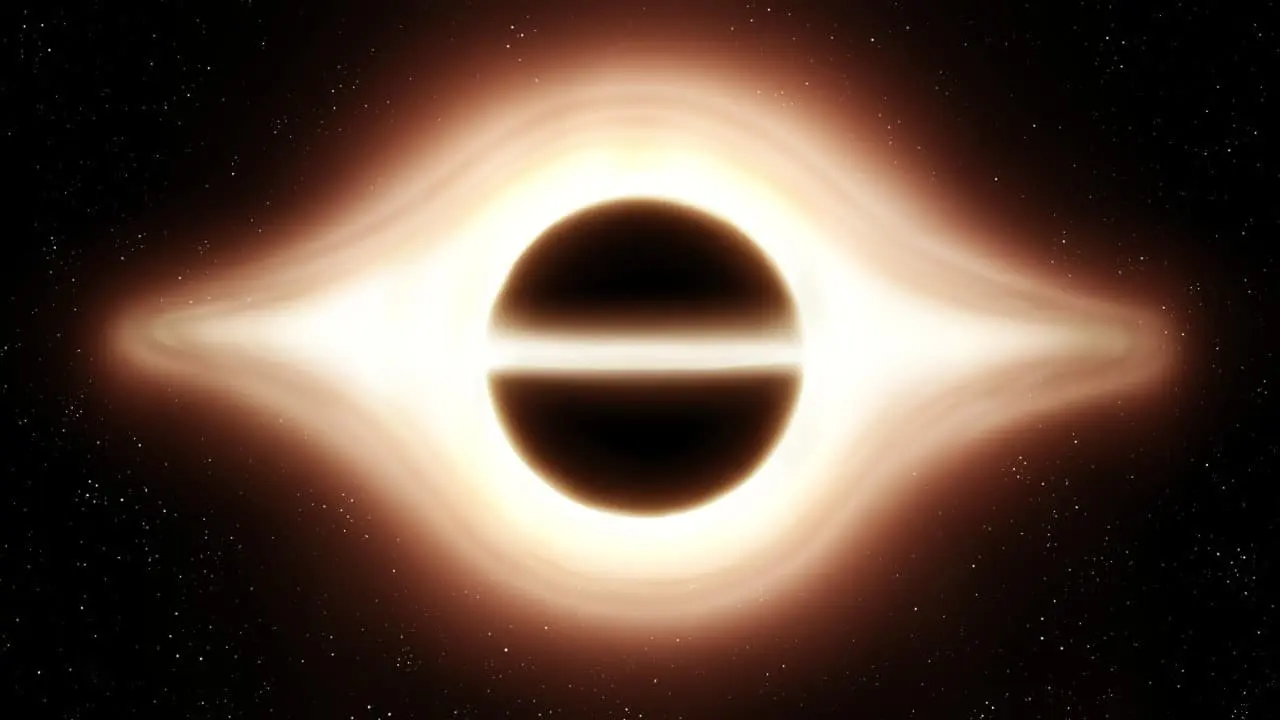
Scientists have detected the most remote dormant black hole ever recorded, whose origins are lost in the early universe.
To understand the initial phases of the cosmos, astronomers often observe quasars, which are supermassive black holes in full activity of consuming matter, emitting intense luminosity. However, these spectacular phenomena do not tell the complete story. Now, the identification of the furthest known dormant black hole provides a unique glimpse of a colossal cosmic entity that has ceased activity.
The global research group, with the participation of scientists from University College London (UCL), located this black hole in the galaxy MRG-M0138, located at a distance of more than 10 billion light years from our planet. This finding, detailed in the journal Science, exceeds the distance record for an inactive black hole by fifteen times.
With an estimated mass of around 6 billion times that of the Sun, this black hole is perceived at a time when the universe was only 3 billion years old. While active quasars offer clues about accelerated growth, the presence of a sleeping giant reveals the quieter phases, providing a unique chance to explore the coevolution of massive black holes and their host galaxies in the early stages of the universe.
To calculate the colossal mass, researchers employed data from NASA’s James Webb Space Telescope (JWST), precisely mapping the displacements of stars orbiting the object, which would otherwise remain imperceptible. Although this technique, known as stellar dynamics, has already been used to measure inactive black holes in nearby galaxies, this is the first successful application at such an immense distance in the cosmos.
Professor Richard Ellis, study leader and member of the Physics and Astronomy department at UCL, highlighted the importance of the discovery. He explained that “analyzing the collective motion of stars at the center of this remote galaxy has made it possible to measure the mass of its supermassive black hole, something that would otherwise be impossible to detect.” He added that “by proving the applicability of this approach to galaxies in the early universe, it opens the way for a more in-depth study of the development of black holes over time and their influence on galactic evolution.”
Understand how the mass of an invisible black hole was calculated
By their nature, black holes do not radiate light directly, but the gas they capture can release immense volumes of radiant energy. These points of intense luminosity, known as active galactic nuclei or quasars, are among the brightest in the universe and are comparatively simple to detect.
Unlike quasars, the supermassive black hole in the galaxy MRG-M0138 is in a state of inactivity. Without the precipitation of gas towards it at this time, its detection by astronomers was possible only by observing the gravitational impact exerted on the stars in its vicinity.
By analyzing the conjugate motion patterns of the stars that surround the galaxy’s core, the team confirmed the existence of the black hole and was able to estimate its mass. The variation in velocities between the stars closest to the black hole and those furthest away provided the crucial elements for this measurement.
Leia Também

Messi reaches 19 goals in FIFA World Cups with great free kick for Argentina in clash with Jordan

Cristiano Ronaldo shines beyond the pitch at the 2026 World Cup with business empire and family luxury

At 41, Cristiano Ronaldo reaffirms his historic legacy and prepares to shine in the 2026 World Cup
This methodology mirrors those used to determine the mass of the black hole located at the heart of the Milky Way, our galaxy, and also in other nearby galaxies. However, this represents the inaugural application for a celestial body located at such an extraordinary distance. Previously, the most remote galactic object investigated by this technique was approximately 700 million light-years away.
How gravitational lensing enabled a historic discovery
Ordinarily, observing stellar movements in such a distant galaxy would be an unfeasible task. Scientists have overcome this difficulty by employing the phenomenon of gravitational lensing, which works as a natural cosmic amplification.
An intermediate galaxy, located between Earth and MRG-M0138, acts by bending and redirecting the light coming from the distant galaxy, which resulted in a thirty-fold magnification of its image. This feature allowed researchers to reconstruct the internal configuration of the galaxy with a precision that would otherwise have been unattainable.
Dr Andrew Newman, lead author at Carnegie Science in Pasadena, California, commented on the method. He stated that “fusing JWST data with the effect of gravitational lensing allowed us to probe deep into the black hole’s area of influence, where the gravitational force accelerates the stars.” Newman went on to describe it as “one of the most effective techniques we have for gauging the mass of a black hole, which made us excited to apply it so far back in the history of the universe.” Previously, only a few inactive black holes of this magnitude had been identified, all located significantly closer to our planet.
New insights into the evolution of galaxies through discovery
This finding offers crucial clues about the joint evolution of galaxies and their central black holes in the early eras of the universe. Although observations of neighboring galaxies have demonstrated a robust correlation between galactic mass and the mass of the black hole, scientists still need more information from older cosmic phases to unravel the genesis of this interconnection.
The study group found that both the black hole and its host galaxy are inactive. The galaxy no longer generates new stars, leading to the assumption that MRG-M0138 may have hosted an extremely luminous quasar in the remote past. The researchers’ hypothesis is that the rapid growth of the black hole released energy that, by heating or ejecting essential gas, decisively slowed the formation of new stars.
There is an expectation among scientists that future observations, carried out with the James Webb Space Telescope (JWST) and other instruments, will bring to light many more dormant black holes from the primordial eras of the universe. Such revelations could deepen understanding of how these cosmic entities prevent the creation of stars and how dormant black holes can be reactivated with the influx of new matter.