Unprecedented andradite mineral in Martian meteorite suggests Mars has had a surprising geological history and may harbor life
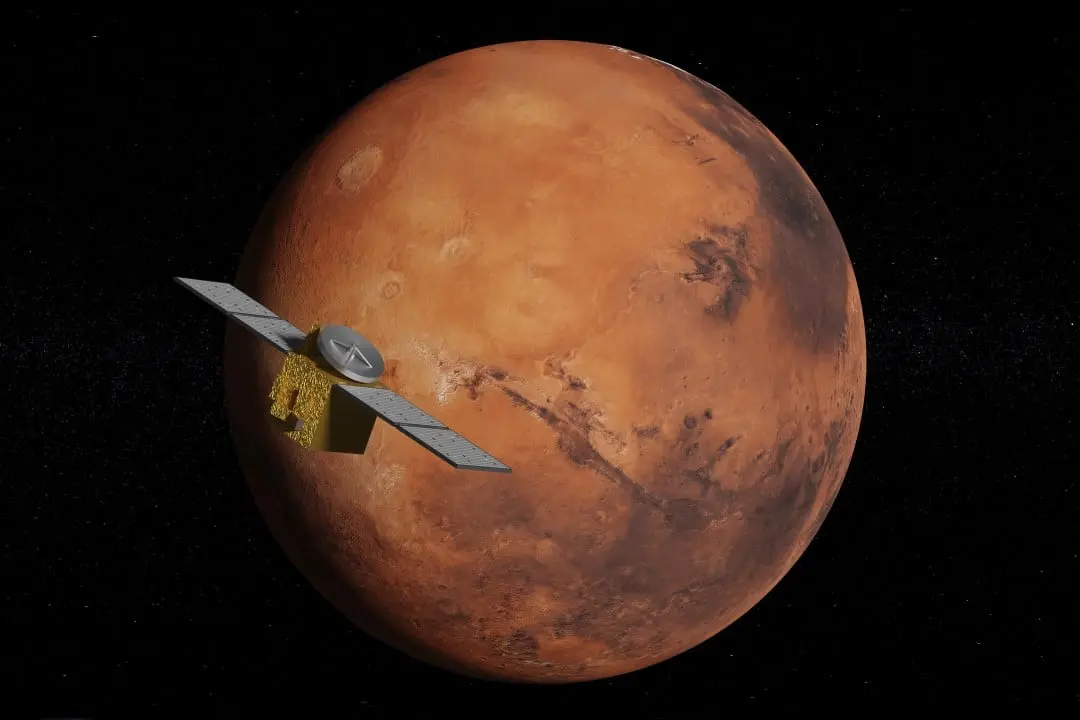
A space rock originating from Mars has been fundamental for scientists to uncover unprecedented aspects of the Martian past. For the first time, researchers have confirmed the existence of andradite, a type of mineral garnet, inside a rocky fragment from the red planet. This finding, detailed in research published in the journal Geochemical Perspectives Letters, could provide crucial clues about the geological evolution that has sculpted Mars for eons.
The identification of the mineral compound occurred in a piece of the meteorite NWA 8171, whose Martian provenance is recognized. Although the mineral andradite is often found in certain terrestrial settings, its occurrence on Mars was previously unknown. Scientists were intrigued by this detection, as the formation of andradite generally requires particular conditions of heat, pressure and the mixing of rocks with liquid substances.
In the rock fragment, in addition to andradite, other minerals such as pyroxene, feldspar and apatite were also identified by the researchers. The joint analysis of these components made it possible to reconstruct part of the rock’s chronology, opening the way for new conjectures about the geological events that unfolded both underground and on the surface of Mars.
As the study researchers point out, this discovery indicates that Mars may have been the scene of a wider variety of geological phenomena than previous assumptions. One of the theories raised is that the alteration of the rock was driven by the circulation of heated liquids in the planet’s underground layers. This process is often observed in hydrothermal systems, places where superheated water reacts with rock formations, triggering chemical changes that give rise to new minerals.
This possibility is of great importance, given that hydrothermal systems are often associated with scenarios suitable for the emergence of primordial life forms. Although there is no direct biological evidence in this discovery, it supports the perspective that Mars, in past times, may have offered much more welcoming conditions for life than the inhospitable environment we know today.
Leia Também

Messi reaches 19 goals in FIFA World Cups with great free kick for Argentina in clash with Jordan

Cristiano Ronaldo shines beyond the pitch at the 2026 World Cup with business empire and family luxury

At 41, Cristiano Ronaldo reaffirms his historic legacy and prepares to shine in the 2026 World Cup
Another line of investigation explored by scientists suggests that andradite may have originated from a type of magma that has not yet been cataloged by science. If this theory is validated, it would point to an internal geological complexity of Mars greater than that which space missions and meteorite analyzes have been able to document to date.
The rocky fragment studied belongs to a category of materials that reached Earth after being expelled from the Martian surface by asteroid collisions. These cosmic pieces act as authentic “time capsules”, providing scientists with the ability to investigate the planet’s composition and evolutionary trajectory, eliminating the requirement for expensive sample collection missions to Mars.
The detection of andradite marks, for experts, the beginning of a new line of investigation focused on the genesis of Martian rocks and the phenomena that have shaped the planet through time. Subsequent research will need to examine other specimens to determine whether the mineral manifests itself in multiple locations on Mars or whether its presence is a reflection of highly unique geological circumstances.
This finding highlights the vast amount of information still waiting to be discovered about Mars. Despite decades of exploration using probes, orbiters and robots, the red planet continues to present new developments that challenge established scientific theories and deepen our vision of the development of the rocky planets that make up the Solar System.