

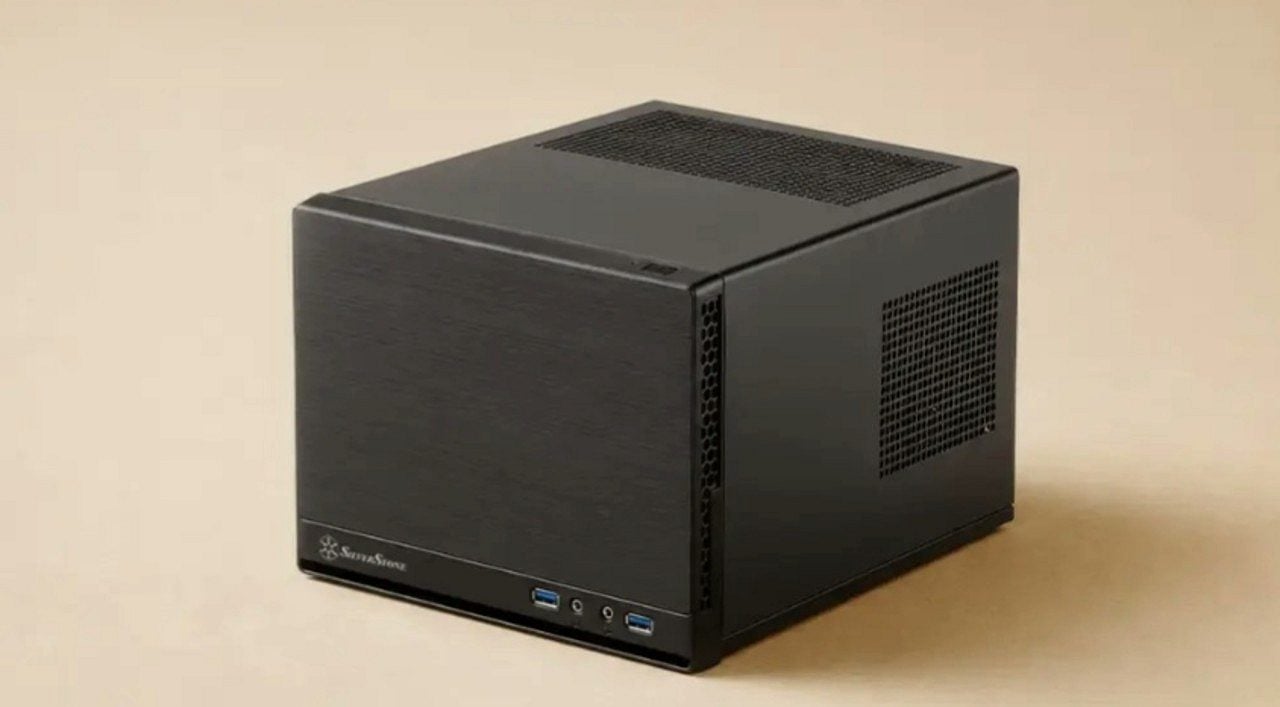
A new hardware option has emerged on the European market for gamers, directly challenging Valve’s Steam Machine concept. French company LDLC presented the “LDLC PC STIM”, also known as Stim Machine, a gaming computer in a compact form factor. This new device seeks to compete with the SteamOS platform, promising superior graphical performance while maintaining the same cost, despite some physical and operational limitations.
French retailer presents a new gaming computer
To highlight its advantages, LDLC published a detailed comparative table, putting its system head to head with Valve’s device. The store uses green markings to highlight the characteristics of its hardware, seeking to attract consumers who are technology and gaming enthusiasts.
The price of the LDLC system starts at €999.99, equivalent to approximately R$5,895, for the kit version, with all assembly parts. The option already assembled and configured by the store costs €1,039.99, approximately R$6,130. This value for the assembled model is similar to that of the 500 GB Steam Machine in Europe, which costs €1,039 without the controller, and €1,108 in the complete package with the Steam Controller. Those interested in assembling their own equipment can save around 4% of the total cost.
Internal components and system expandability
The internal architecture of the Stim Machine is made up of parts easily found on the market. The system’s core is an AMD Ryzen 5 8400F processor, equipped with six cores and twelve threads, a profile that matches the Zen 4 chip present in the Steam Machine. The 16 GB DDR5 RAM allows future expansion, supporting up to 128 GB.
For data storage, the device comes with a 500GB NVMe SSD. A point in favor is the B650 motherboard, which has two free SATA slots, allowing future space expansions, unlike the Steam Machine which is limited to microSD cards. This entire configuration is housed in a Mini-ITX SilverStone Sugo SG13B-Q case, which already includes Wi-Fi connectivity.
The main advantage of Stim Machine is its graphics processing capacity. Unlike the Steam Machine, which incorporates a semi-customized AMD GPU with RDNA 3 architecture and 28 computing units, the Stim Machine is equipped with a more recent dedicated graphics card: the 8 GB Radeon RX 9060 XT, based on the RDNA 4 architecture. This direct competition stimulates innovation and benefits consumers, who now have access to more powerful and flexible hardware for a similar price, driving the segment of compact gaming PCs.
Although both systems feature 8GB of video memory, the Radeon RX 9060 XT offers significantly higher raw performance. This extra power manifests itself in significantly increased frames per second rates when running games at their native resolutions. In addition to the generational advancement, Radeon’s updated lineup also provides native support for FSR 4 technology, which uses artificial intelligence to improve performance optimization.
The difference between the Radeon graphics card and its flexibility
Durability and upgradability are key aspects, and LDLC’s PC graphics card is replaceable in the future, offering remarkable flexibility. This feature is not found on Valve’s proprietary hardware. On Valve’s official device, even upgrading the RAM proves to be a complicated task, requiring the disassembly of internal parts.
However, despite the benefits in power, LDLC hardware has disadvantages in relation to its size and practicality for use in domestic environments. The SilverStone SG13B case has a volume of 11.5 liters, while the Steam Machine, in contrast, takes up just 3.8 liters. This means that the French retailer’s proposal is around three times larger, which reduces its appeal as a discreet device to be placed on a TV rack.
Size Disadvantages and Software Challenges
Additionally, concerns arise regarding heat management, the cooling system and noise production, especially when a GPU like the RX 9060 XT is installed in a small chassis. In contrast, the original Steam Machine is known to operate significantly quieter even during peak usage.
In terms of software, Valve still has considerable superiority in features aimed at user convenience. This includes features like Instant Sleep/Wake, which allows you to instantly suspend and resume your system, and HDMI CEC support. The Stim Machine, in turn, does not come with the Windows operating system pre-installed and requires the user to install and configure SteamOS following a tutorial, a process that may intimidate less experienced users.
The presence of these options on the market, paradoxically, ends up being advantageous for Valve itself. By expanding the SteamOS user community, more consumers are driven to the company’s digital gaming platform, which represents its main source of revenue and business focus.
Observing the evolution of this market segment, Valve engineers Pierre-Loup Griffais and Yazan Aldehayyat revealed in recent interviews that the next generation of the company’s desktop console should be released in a shorter time frame than a possible successor to the Steam Deck handheld device.
Stim Machine Technical Details
- Processor: AMD Ryzen 5 8400F (6 cores and 12 threads)
- Video card: AMD Radeon RX 9060 XT (8 GB, RDNA 4 architecture)
- RAM memory: 16 GB DDR5 (expandable up to 128 GB)
- Storage: 500GB NVMe SSD (B650 motherboard with 2 additional free SATA slots)
- Case: SilverStone Sugo SG13B-Q (Mini-ITX, 11.5 liters)
- Connectivity: Built-in Wi-Fi
- Operating system: Without Windows (accompanies tutorial for installing SteamOS)