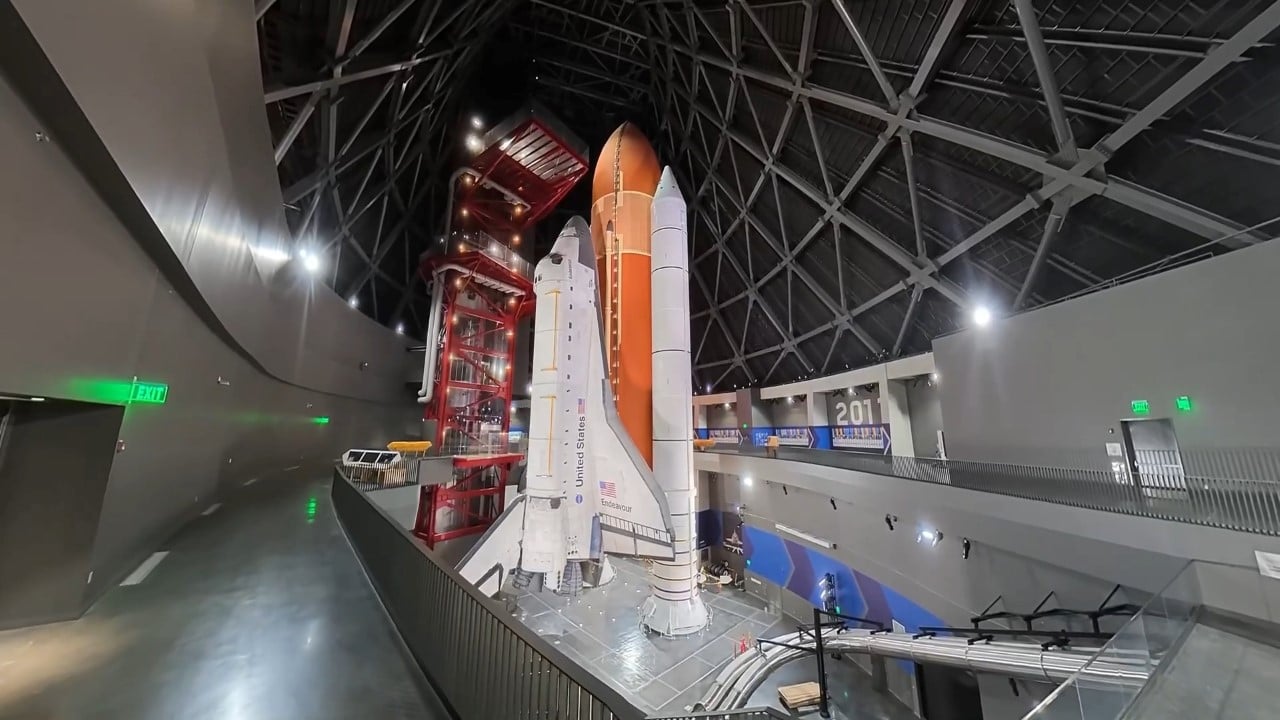
The California Science Center, located in Exposition Park in Los Angeles, opened its doors on Wednesday for a first public showing of the space shuttle Endeavor. The spacecraft was assembled in its full launch configuration, including the solid-fuel booster rockets, creating the impression that it was about to take off.
Housed in a new pavilion that practically doubles the area of the former science museum, the 20-story space shuttle complex has become the focal point of an innovative wing dedicated to aerospace. This section represented a long-standing aspiration for the institution’s leaders, conceived even before the opening of the center itself.
In an interview on Wednesday, Jeffrey Rudolph, president and CEO of the California Science Center, recalled the beginning of the idea: “I predicted that one day the space shuttles would be decommissioned,” and added, “We should get one for our museum.”
Although the new Samuel Oschin Aerospace Center, home of the space shuttle, is not scheduled to officially open until Nov. 13, officials offered a preview on Wednesday. The event marked the completion of the construction of the colossal building.
After its opening, the center will stand out globally for being the only place where the public will be able to observe a complete space shuttle system, with an orbiter that actually carried out missions in space and returned to Earth.
Named after the 18th century exploration ship commanded by James Cook, the space shuttle Endeavor was mostly built by Rockwell, in Palmdale, using components from various sources. The spacecraft made its first flight in 1992, totaling 25 space missions, and accumulated approximately 359 million kilometers, with 12 dockings with the International Space Station.
The five space shuttles developed by NASA were designed for reuse, transporting equipment and performing maintenance in orbit, including on satellites and the Hubble Space Telescope. The astronauts on board were often involved in extensive extravehicular activities during repair work. Endeavour’s last mission, in May 2011, after the formal closure of the program, aimed to deliver spare parts to the International Space Station.
When Endeavor was decommissioned, NASA organized a contest to determine which museum would receive the spacecraft. The California Science Center emerged victorious, and many Southern Californians cherish the memory of its last flyby of the region in September 2012. At the time, the spacecraft departed from the Kennedy Space Center in Florida, attached to a Boeing 747 Shuttle Carrier Aircraft modified by NASA, before being carefully transported over land to its final installation at Exposition Park.
Perry Roth-Johnson, curator of science and technology at the museum and member of the team, said that “virtually every person in the city has a personal story related to seeing the arrival of the space shuttle.”
After being delivered, Endeavor was first displayed in a horizontal position, attracting curious visitors, while work began on the new 200,000 square foot aerospace center.
The most complex stage of the undertaking consisted of vertically assembling the spacecraft, a process known as “stacking”. This involved lifting it to a height of 20 stories and attaching it to the two solid-fuel rocket boosters and liquid fuel tank, replicating its launch configuration.
According to Roth-Johnson, the spacecraft was raised to its maximum altitude in 2023, using large cranes. Once the pavilion’s concrete base was completed, the ship, booster rockets and fuel tank were meticulously inserted before the dome-shaped steel roof was erected around it.
Roth-Johnson reported that moving the fuel tank took two days, as strong winds on the first day prevented its safe positioning.
The museum’s management sought the assistance of NASA experts for this complex operation, with some of these professionals still involved in the project. The total estimated cost for the initiative is US$450 million, with US$410 million already raised.
Upon arrival, visitors will be guided to a compact room to watch a five-minute film about the space shuttle program. During the final segment, which simulates the launch, the environment will be filled with water vapor, replicating the fog and clouds of a real takeoff. As the steam clears, large doors open dramatically, revealing the space shuttle Endeavor in its pavilion.
Inside the pavilion, it will be possible to appreciate the vertically mounted space vehicle from multiple points of view. This includes the opportunity to look inside the cargo hold, known as the cargo platform. At the top, the small windows used by astronauts stand out. He explained that the area was pressurized, allowing the crew to float in their suits without needing additional oxygen.
A transparent elevator will be available, offering visitors the chance to climb up to view the top of the structure and then descend to explore the base, walking beneath the ship’s towering engines.
Externally, the space shuttle displays gray heat shields, capable of withstanding temperatures of up to 3,000 degrees Fahrenheit, contrasting with the white shields, which withstand a limit of 700 degrees.
In addition to the space shuttle pavilion, the museum’s aviation section will house approximately 100 historical artifacts. Among them are the 1902 Wright glider, crucial for the brothers Orville and Wilbur Wright to achieve controlled flight, the Apollo-Soyuz command module provided by the Smithsonian Institution, and a full-scale replica of Viking 1, the first US space probe to land on Mars, among other valuable pieces.
The new wing of the museum will also feature several interactive activities. Visitors will have the chance to experience a 13.7-meter “slide,” simulating space travel, and the opportunity to explore the flight deck of a Korean Air commercial aircraft.