

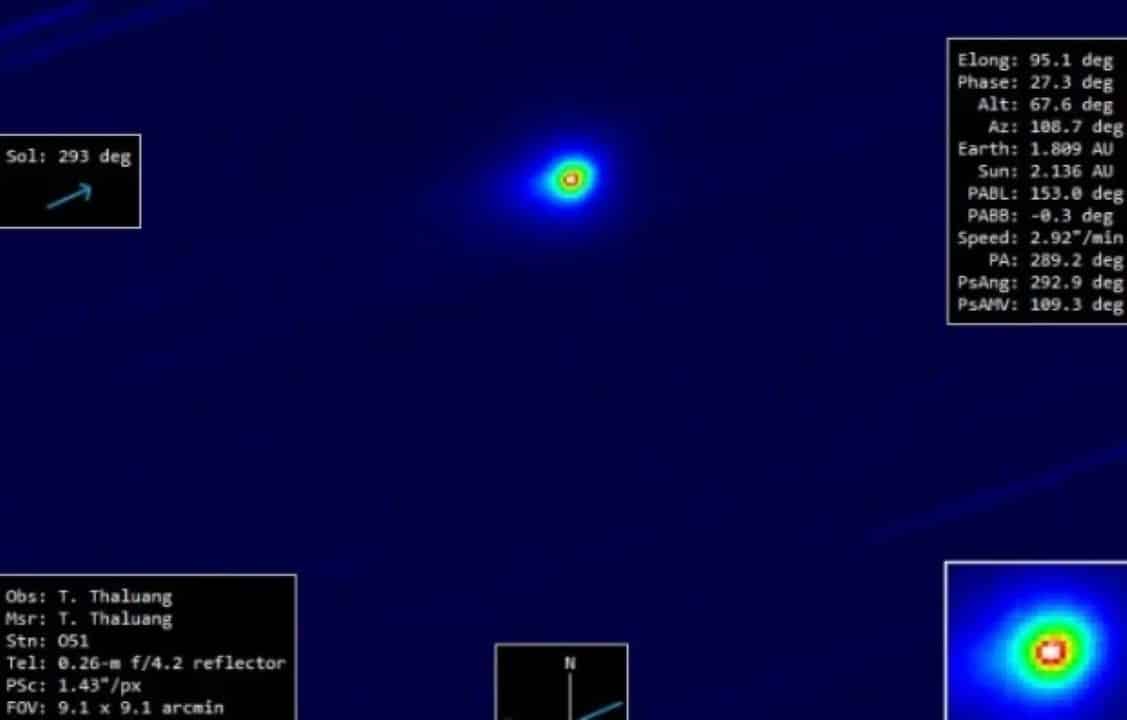
Researchers linked to the SETI Institute have completed a thorough scan of radio emissions from 3I/ATLAS, the third celestial body confirmed to visit our Solar System from deep space. The operation used the complex Allen Telescope Array — originally funded by Microsoft co-founder Paul Allen — to look for any technological signature that betrayed an artificial origin. Over a period of seven continuous hours, the radio telescopes scanned frequencies between 1 and 9 gigahertz. The monitoring did not capture absolutely any signal that deviated from the standard of a natural object.
The details of this scientific endeavor made the pages of the specialized publication The Astronomical Journal. The conclusions of the study state that the visitor is just a clump of ice and rock ejected from its original stellar neighborhood. Initially detected in July 2025 by the ATLAS observation complex in Chile, the star drew attention for its extreme speed and hyperbolic orbit, characteristics that attest to its distant origin. Immediately after the discovery, observatories around the world repurposed their equipment to capture as much data as possible before the body began its journey back into the darkness.
Rigorous screening separates Earth noises from possible alien transmissions
The monitoring window generated a colossal amount of raw information for the institute’s computers. Astronomers identified approximately 74 million narrowband emissions during the analysis. This avalanche of records is the result of the extremely high precision of current antennas, which end up capturing all the electromagnetic pollution generated around our planet. To clean this database, the team applied state-of-the-art computational filters, separating what could be a distant message from routine transmissions from satellites and cell towers.
Digital refinement reduced the number of alerts to just 211 occurrences that deserved special attention. Each of these candidates underwent rigorous visual inspection, where scientists evaluated the wave behavior in time and frequency. The final verdict pointed out that all the anomalies were, in fact, already known human technologies operating in Earth orbit. The ease in isolating these false alarms highlights the leap in quality of radio astronomy software, which today can scan the cosmos without getting confused with the noise of the planet itself.
Gas and dust analysis proves rocky nature of distant visitor
The dynamics of 3I/ATLAS as it approaches solar heat did not deviate from the rule of traditional comets. The heating of its surface caused the release of gases and dust, forming a visible cloud around the core. Different telescopes analyzed the light reflected by the star and confirmed the presence of volatile materials in its structure. The red color and the chemical signature of the ejected elements leave no doubt about their conventional formation. The point of closest proximity to the Sun, known as perihelion, was reached in October 2025.
At that instant of closest approach, the space rock passed 1,356 astronomical units from our star, equivalent to just over 200 million kilometers away. A global network of optical, radio and infrared instruments tracked the path millimeter by millimeter. The consensus between the different research centers buried theories that the object could be a ship. Unlike other cases, the star did not suffer inexplicable impulses that would suggest the use of engines, and its core completed one rotation on its own axis every 16.79 hours, a perfectly normal rate for pieces of cosmic ice.
Screening standards set limits for detecting weak technologies
Astronomers’ speed of reaction ushered in a new standard for the study of fast space events. Radio telescopes pointed to the star’s coordinates in less than 24 hours after the global discovery alert. Scientist Sofia Sheikh, responsible for coordinating the scan, argues that every body coming from outside the Solar System needs to go through this security check. Even without visual evidence of anomalies, the application of protocols to search for intelligent life is essential, as the time to observe these targets in high resolution lasts just a few weeks.
The survey created an unprecedented measuring stick for future approaches to similar targets. The team determined that any equipment emitting between 10 and 110 watts of power at those frequencies would have been picked up. To give you an idea, this is the energy consumed by a bright light bulb or a small appliance on Earth. The methodology followed strict rules to ensure the reliability of the search:
- The software adjusted the frequencies in real time to nullify the Doppler effect caused by the comet’s high speed.
- The focus was on narrowband transmissions, the most logical format for intentionally sending data into space.
- Cross-checking with satellite catalogs eliminated any signals that looked promising in the first screening.
- The sensors underwent extreme calibrations to be able to hear electromagnetic whispers coming from that region of the sky.
The success in tracking such faint emissions over such vast distances testifies to the firepower of modern observatories. Valeria Garcia Lopez, who also signed the study, believes that finding alien machinery is no longer fiction and has become a real technical possibility. The researchers assume that human probes themselves, like the old Voyager missions, will one day invade the space of other stars. Exhaustively mapping the behavior of common rocks is the essential step to understanding when something metallic and artificial crosses our cosmic backyard.
Legacy of observations sets the stage for the next stellar interlopers
The passage of 3I/ATLAS consolidates a new era in the astronomy of wandering objects. This timeline began in 2017 with 1I/’Oumuamua — which sparked heated debate at the time due to its elongated cigar shape and atypical acceleration — and continued with comet 2I/Borisov in 2019. Each stellar intruder delivers vital information about how planets are born in other regions of the Milky Way. The current visitor surprised by revealing a particular chemistry, ejecting methanol and heavy water in proportions very different from those seen in comets that are born in the Oort Cloud, the icy frontier of our own system.
The Allen Telescope Array infrastructure, installed at the Hat Creek Radio Observatory in the California mountains, was the backbone of this frequency coverage. The creation of an unprecedented processing system accelerated data digestion, overcoming the bottlenecks faced in past research. Finding absolute radio silence is not considered a failure by scientists. On the contrary, the absence of transmissions establishes concrete parameters for what to look for and helps calibrate instruments for future hunts.
Telescopes spread across the globe will maintain focus on the star as it plunges back into interstellar darkness. Observation campaigns already scheduled for the following months seek to extract the last drops of information about its physical structure before it disappears completely. The fact that it does not carry alien technology only reinforces what astronomical models already predicted about the nature of these travelers. The analysis script successfully tested in this mission is ready to be activated immediately as soon as the fourth visitor from another solar system is spotted by terrestrial radars.




