LHCb reveals last member of double charm particle family, concluding decades of search

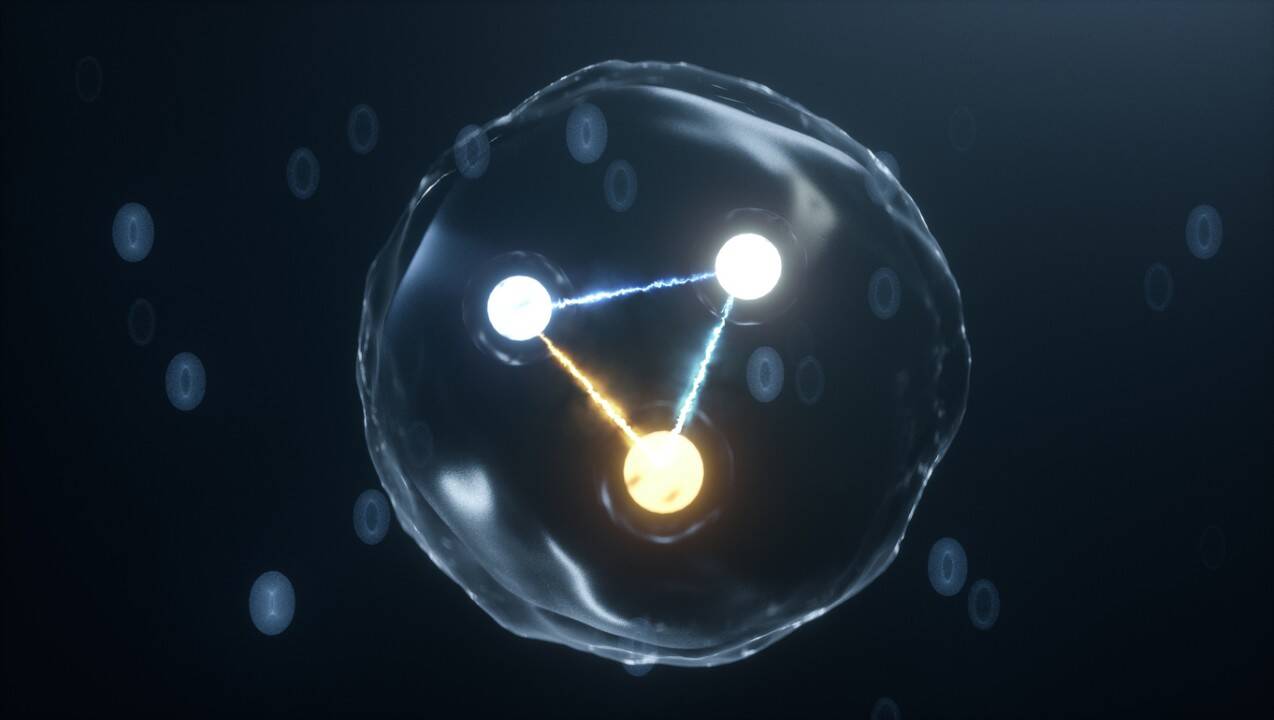
The LHCb collaboration announced the identification of a new subatomic particle, formed by a strange quark and two charm quarks, which completes a family of baryons theorized for more than six decades. This revelation marks the end of a search for elements that are fundamental blocks of matter.
The foundation of matter: quarks and initial combinations
Quarks are recognized as the essential components of matter, existing in six distinct varieties: up, down, charm, strange, top and bottom. They combine in pairs, forming mesons, or in trios, which are baryons. Six decades ago, the development of theoretical models allowed scientists to classify possible combinations of quarks and even predict the existence of previously unobserved particles.
A significant milestone occurred in 1964, when the detection of a new particle at Brookhaven National Laboratory validated theoretical predictions. Composed of three strange quarks, its existence confirmed the solidity of the models that described the formation of particles.
The rise of the charm quark and new theoretical predictions
Particle physics was impacted again in 1974, with the identification of the fourth quark, called charm. This revelation required an update of existing theoretical models to include the many new combinations of quarks, and among the new predictions were double charm baryons.
These specific baryons are made up of two charm quarks and a third quark, which can be up, down or strange. Physicists’ interest in this family of particles lies in the ability of their large mass differences between quarks to provide valuable data about the strong force, the fundamental interaction responsible for holding quarks together in composite structures.
Overcoming challenges to detect the new baryons
In the past, technological limitations prevented both the production and detection of doubly enchanted baryons. In contrast to the 1964 discovery, which involved analyzing 80,000 photos of bubble chamber collisions, the current search requires the high energies of the Large Hadron Collider (LHC) and the analysis of trillions of collisions.
The LHCb Collaboration had already found the first doubly charmed baryon in 2017 and a second in early 2026. Now, half a century after the first theoretical predictions, the third and final member of this family of doubly charmed baryons has finally been identified.
The recent identification is based on information collected in 2024 from high-energy proton-proton collisions at the LHC. The new doubly enchanted baryons, produced in these collisions, have a brief existence, disintegrating into more stable particles after traveling a tiny space in the detector. The LHCb team managed to trace the trail of these ephemeral particles to their points of origin, confirming the signature of the new particle with a mass about four times that of a proton.
Meaning of the new discovery, according to expert
“This is a moment of great historical importance,” said Paula Collins, future deputy spokeswoman for the LHCb experiment. She highlighted that, among the 85 composite particles already observed at the LHC, the three doubly enchanted baryons stand out for their uniqueness, decaying due to the weak force and living long enough for flight distance measurements. The discovery was made possible by LHCb’s improved detector, which has advanced tracking and identification capabilities.
Future perspectives and LHC updates
The research work, however, is far from complete. Next steps include using the latest data from LHCb to make precise measurements of the new particle’s characteristics, such as its mass and lifetime, and improve knowledge about other doubly enchanted baryons. There are still hopes of observing excited counterparts of these particles and identifying new baryons that include beauty quarks.
With the imminent conversion of the LHC to the High Luminosity format, the LHCb experiment foresees important improvements in its detectors for the 2030s. Scientists anticipate that these improvements will allow access to many other particles not yet discovered, opening a new and promising chapter in the area of particle physics.