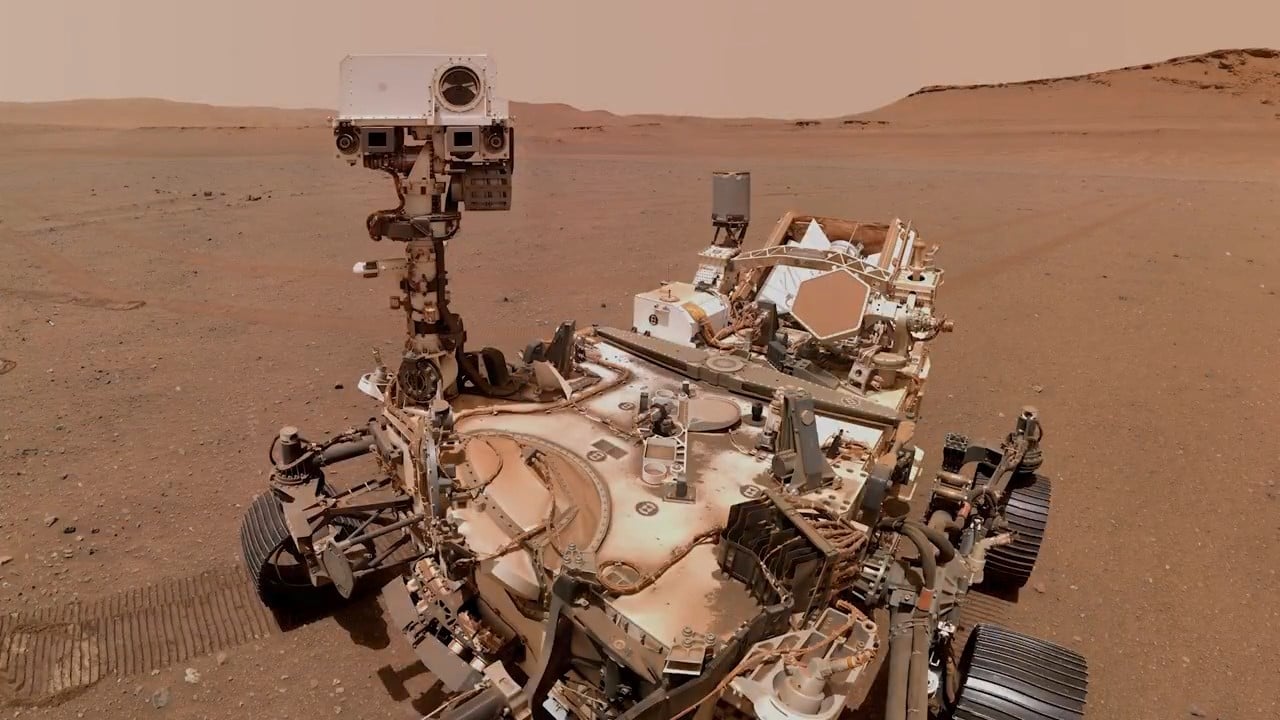
US space agency NASA is evaluating an innovative strategy to strengthen its Artemis lunar exploration program by considering adapting one of its Mars engineering rovers to operate at the Moon’s south pole. The plan would involve transforming a spare model, originally designed for the Curiosity and Perseverance missions, into a nuclear-powered lunar explorer.
If the proposal is approved, this mission would give a new purpose to the decades-old testing robot, while also helping NASA prepare for the future installation of a permanent human base on the lunar surface.
How a Mars Testing Robot Could Become a Lunar Explorer
The rover in question, called PROMISE (acronym for Polar Rover for Observation, Mapping, and In-Situ Exploration), was initially created at NASA’s Jet Propulsion Laboratory. It served as a model for terrestrial engineering, critical to the development and support of the Curiosity and Perseverance rovers on Mars.
Formerly known as OPTIMISM, the equipment dedicated years to helping engineers test software updates, commands and hardware fixes, before these modifications were sent to rovers on Mars, millions of kilometers away. NASA used PROMISE to validate each significant change to Curiosity or Perseverance, thus minimizing risks to real spacecraft in operation.
Now, the space agency considers that this same rover could be used in valuable scientific activities on the Moon.
During the presentation of the Artemis program update, NASA administrator Jared Isaacman made a joke by quoting Yoda’s famous phrase in Star Wars: The Empire Strikes Back, “There is another”, before announcing the potential of granting PROMISE its own space mission.
Isaacman explained that NASA has already accumulated extensive operational experience with Curiosity and Perseverance, which indicates that the engineering model may no longer be needed exclusively as a test platform.
Understand why PROMISE is the ideal candidate for the Moon
One of the main reasons NASA considered PROMISE is the presence of its radioisotope thermoelectric generator (RTG), the same nuclear power system employed by the Curiosity and Perseverance rovers.
Unlike solar-powered vehicles, an RTG produces electricity from the natural decay of radioactive material, ensuring that the rover can operate continuously regardless of sunlight.
This capability gives PROMISE invaluable value for missions close to the Moon’s south pole, the region where NASA intends to install its future base for the Artemis program.
Although certain areas of the lunar south pole receive prolonged periods of sunlight, many regions are marked by extensive, icy shadows, which make the use of solar energy difficult. A nuclear-powered rover could continue operating under these adversities, collecting scientific data even in the absence of sunlight.
According to NASA officials, PROMISE would require only limited renovation to adapt to lunar operations.
Robot support for NASA’s lunar base plans
The rover announcement coincided with the award of new commercial lunar landing contracts, part of NASA’s Commercial Lunar Payload Services (CLPS) program.
The agency selected the companies Astrobotic, Firefly Aerospace and Intuitive Machines to transport scientific instruments and technological demonstrations to the lunar surface in the coming years.
These missions represent one step in NASA’s phased approach to building a permanent lunar outpost, avoiding an immediate attempt at long-term human presence.
NASA anticipates launching up to 20 CLPS missions by 2029, each with the goal of deepening scientific knowledge about the lunar environment, laying the groundwork before astronauts begin regularly living and working on the Moon.
The next probes will carry instruments developed to investigate how rocket exhaust affects lunar dust, improve navigation using laser reflectors and measure radiation levels in different regions of the Moon.
Preparations for a continued human presence on the Moon
NASA says a detailed understanding of the lunar south pole still represents one of the biggest challenges before Artemis astronauts can establish a long-term base.
This region is believed to host significant deposits of water ice, which in the future could become sources of drinking water, breathable oxygen and rocket fuel for missions deeper into space.
Agency officials indicate that additional robotic explorers, like PROMISE, could map terrain, investigate resources and assist in identifying safe locations for future structures.
Carlos Garcia-Golan, manager of NASA’s Moon Base program, commented that although the idea of sending a backup rover from Mars to the Moon may seem unusual, it demonstrates the agency’s willingness to optimize the use of technology already available.
With Curiosity and Perseverance continuing their successful operations on Mars, NASA now envisions the chance to give its Earth “twin” a second life, this time on the lunar surface. If the proposal moves forward, PROMISE could be one of the pioneering nuclear-powered rovers to explore the Moon, offering crucial experience for the next phase of human lunar exploration.