
Unprecedented mysterious substance signal identified on Pluto and Titan


The James Webb Space Telescope (JWST) has detected a peculiar absence of a wavelength of light on both the dwarf planet Pluto and Saturn’s large moon Titan. The new observations indicate the presence of something previously unknown.
This surprising finding points to the possible existence of a molecule never before seen, neither on other bodies in the Solar System nor on distant exoplanets. The discovery challenges current knowledge about the chemical composition of these icy worlds.
Understand how astronomers identify chemical elements with the Webb telescope
In the universe, each element or molecule has a unique “fingerprint”, absorbing specific wavelengths of electromagnetic radiation.
For this reason, one of the primary approaches for space scientists to study distant planets and moons—both those orbiting our Sun and those in far-flung star systems—involves closely analyzing the light they reflect, looking for dark “absorption lines” that correspond to known chemical compounds.
A practical example is molecular oxygen, which absorbs light at 230 nanometers. Thus, if a distant planet’s electromagnetic spectrum exhibits an absorption line at this frequency, researchers can safely infer the presence of oxygen in its atmosphere, as detailed in a 2021 study. The element of value here lies in the particularity that in this case, JWST detected an absorption that *does not match* any known compound, which requires further investigation and potentially leads to the discovery of novel extraterrestrial chemistry.
JWST has demonstrated a remarkable ability to obtain electromagnetic spectra, allowing the precise identification of chemical substances in the atmospheres of exoplanets, in regions close to distant stars and even in remote galaxies. The telescope has already managed to identify a molecule on an alien world that could be an indicator for the existence of extraterrestrial life.
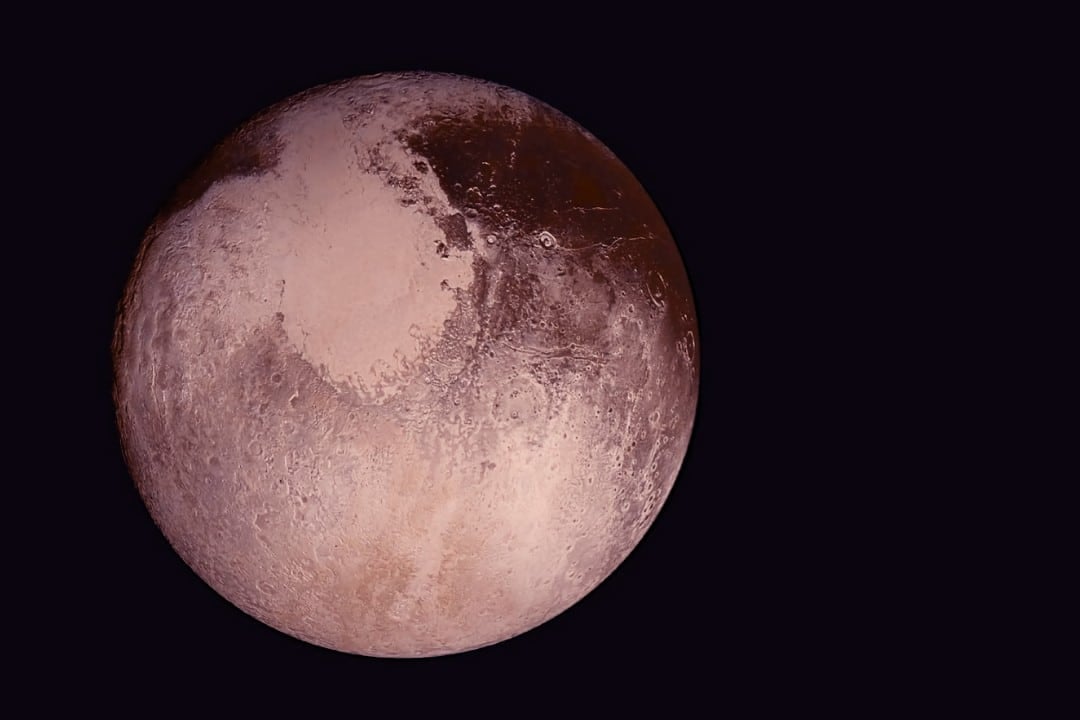
Details of recent observation carried out by James Webb
In recent research, submitted for review June 11 on the arXiv server, scientists examined Webb data collected from Pluto and Titan. The main focus was on extremely short wavelengths, an area that, until now, remained understudied.
The analysis confirmed the existence of a distinct absorption line, close to 5.11 micrometers, in the spectra obtained from both celestial bodies. It is important to highlight that these conclusions have not yet gone through the peer review process in a scientific publication.
The team responsible for the research sought references in similar studies of other planetary spectra, however, they did not locate “any referenced band that corresponds to the location of the absorption observed on Titan and Pluto”, as stated by the scientists in the text of the article.





